
Film Retrospective: “Taxi Driver” at 50 –The Lonely Man Is Still Out There
By Matt Hanson
Martin Scorsese’s feverish New York classic remains a master class in urban atmosphere and subjective filmmaking—and a chilling study of how alienation curdles into violent fantasy.
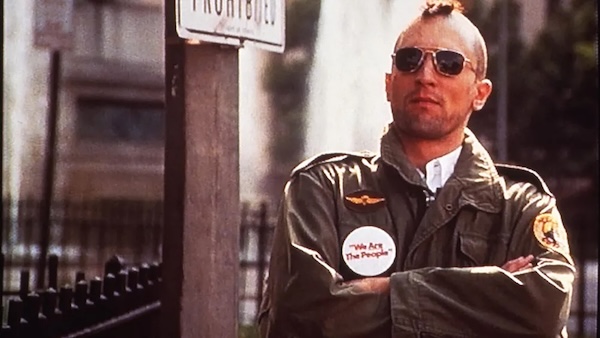
Robert De Niro as Travis Bickle in Taxi Driver. Photo: Columbia Pictures
One of the things that gives Taxi Driver, which turns 50 this year, a unique, hypnotic power is that it is such a great city movie. Director Martin Scorsese captures how it feels to walk through New York—or any city, for that matter—although especially a place like New York. You’re in the soup: there’s always something happening on the corner; a colorful stranger bustles along; a random guy yells at someone else, or just to himself; kids play; people loiter on the periphery; cars honk; and there are endless brick walls.
You’re simultaneously alone and surrounded by many other people, who are all, of course, leading characters in their own tiny little dramas painted on a big canvas. The story’s microfocus on the deeply troubled title character isn’t pretty, but then neither is humanity. The prodigiously young team of Scorsese and De Niro, both of whom were in their early 30s at the time, with not many films under their belts, thrust Travis Bickle—someone we’d otherwise barely notice in real life, and for good reason—into our cultural attention.
Taxi Driver is brimming with cameos taken straight from the street. My favorite is the old guy in a sparkly jacket and with thickly pomaded hair who is standing at a street corner at night demonstrating, with great dignity, various swing-drumming styles. That’s the one and only Gene Palma. A more disturbing sighting is the creepily matter-of-fact gun salesman Steven Prince, a nervy pal of Scorsese’s and the subject of his documentary American Boy, who sells an alarming amount of large weaponry in about five minutes, even as Travis casually starts aiming it at random people. Even more disturbing is Scorsese’s last-minute cameo appearance as the psychotically jealous pickup driver from hell.
Taxi Driver uses all its ominous ambiance to slowly slide you right into the middle of poor Bickle’s twitchy mind. It’s all in the visual grace notes. A lifelong night owl, I marveled at how the long hours behind the wheel register on scrawny Travis’s pale face: his haunted eyes as he cruises around the streets in the dark; his dingy yellow cab floating like a small ship on a dark ocean. Steam billows up from the manhole covers; neon lights burn. A poignant, sax-forward soundtrack by the great Bernard Herrmann, who was dying as he finished the score, adds to the grimy grandeur.
I don’t know whether Taxi Driver is being taught to prospective filmmakers, but it should be. Consider the way the camera gravely pans when Travis apprehensively scans the people walking by, or how he abruptly shudders when there’s a sudden disruption. De Niro does an inexplicable thing with his hands as he sits alone in a porno theater. Then there is that brilliant shot when Travis pours Alka-Seltzer into a glass and we peer in as it sizzles—it is an objective expression of his subjective anxiety. Or when he pops another pill and the camera slowly rises: we swallow the pill with him.
The massive success—a $30 million gross on a $1.9 million budget, plus lots of Oscar nominations—of a film that tells the story of a lonely weirdo should remind both Hollywood insiders and up-and-comers that you don’t need piles of money or gee-whiz special effects to make a popular and ambitious film.
Part of Travis’s problem, it must be said, is a guy thing. The stiff stoicism traditionally expected of men—Hollywood hasn’t helped in this regard—has curtailed the value of self-reflection. The antihero deeply fears becoming vulnerable, weak, or exposed as the naïve adolescent he truly is. It is easier for Travis to anoint himself “God’s lonely man,” which makes him sound more like a victim than he really is. Still, there is nothing monastic about Travis, who spends all day murmuring about the filth he sees all around him as he watches the miniskirted ladies of the night sashay by. The urban jungle has all the makings of adolescent fantasies.
Taxi Driver’s gender politics become even more complicated when Travis decides that his new purpose in life is to “save” Iris, Jodie Foster’s shockingly young sex worker. I rolled my eyes when I saw someone refer to Foster’s performance as “delightful.” That’s trying too hard. A better word would be fearless. Iris’s life choices don’t bother her very much; making that disinterested attitude work calls for a gutsy, prodigious feat of acting. What’s even more impressive is that Foster apparently had to explain the film’s nihilistic fever dream at the Cannes press conference by herself, in French, while Scorsese and De Niro hid in their hotel rooms.
The “You talkin’ to me?” scene became famous, in part, because of the power of an ad-libbed line, reportedly inspired by an onstage quip from Bruce Springsteen. Travis is picking an imaginary fight with an imaginary antagonist, whose imaginary head he then fantasizes about blowing off. The proud sneer that comes across his face—“You’re dead”—says a lot about what Travis thinks will be the payoff for self-assertion. As does his sudden obsession with having a lean, healthy body. Lacking any other conception of discipline, violence—directed both outward and inward—becomes his only idea of control.
Actor and cinephile Bill Hader once described Travis’s choice to kill Iris’s pimp as a “this is what we do” action. Hader’s “we” can refer to men, but in a larger sense it also means Americans: we are a rather violent people. The Bernie Goetz controversy, involving a Bickle-like New York City subway vigilante who shot four teenagers he claimed were trying to rob him, happened only a few years after Taxi Driver premiered. D.H. Lawrence’s characterization still rings true: “The essential American soul is hard, isolate, stoic, and a killer. It has never yet melted.”
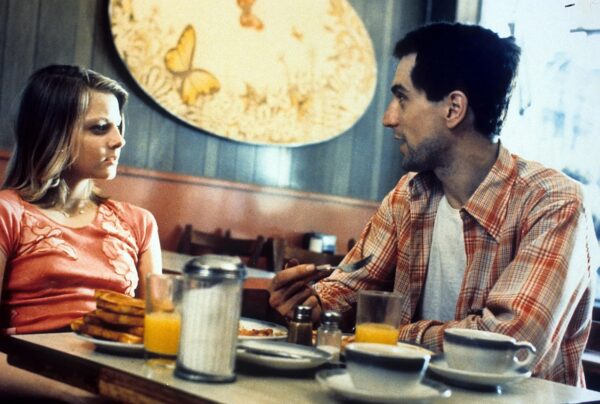
Jodie Foster and Robert De Niro in Taxi Driver. Photo: Columbia Pictures
Of course, it is not Scorsese or the movie’s fault that Taxi Driver has been linked to multiple real-world assassination attempts. The narrative taps into a dark part of the human condition, and that is what great art can do. Just because you explore the night side of the human condition does not necessarily mean that you endorse or encourage what you find there.
The film is so masterful at dramatizing its alienated antihero’s angst that it is easy to forget how dangerous it is to identify with him. Scorsese and De Niro profoundly understand Travis’s pain and confusion, and they artfully draw us into it. Of course, sympathy for this kind of person can only go so far. As the story leads to its bloody climax, propelled by Travis’s nihilism, our empathy disappears.
Travis isn’t a hero, even if some crackpots might mistake him for one. The big cowboy-like shootout goes horribly wrong. Travis can’t even bring himself to shoot the pompous politician—though that would not magically change anything, anyway. He can barely get through a tedious conversation with a Secret Service agent before he tips his hand. Maybe that freaky-looking mohawk wasn’t the best idea if you’re planning to do something dramatic in broad daylight. Travis Bickle comes off as a sensitive, alienated, and anguished idiot. But he is still an idiot.
Vigilante violence is a dead end. You can knock off all the bad guys you want to, but violence will not change the social conditions that create them and encourage them to thrive. Iris does end up back at home, and her parents send Travis a grateful letter. But it is unclear what her life will be like after she has swapped New York City streets for an ordinary adolescence in Pittsburgh. That could be an interesting movie.
Ultimately, God’s lonely man attains no transcendence, spiritual or otherwise. Instead, Travis goes right back into his old routine, just one of the many grungy, inarticulate palookas fuming bitterly to themselves. There are still plenty of disaffected loners wandering around with chips on their shoulders and guns on their hips. As no less a tough-minded critic than Pauline Kael anxiously shouted at the end of her private screening all those years ago: “He’s still out there!”
If anything, today’s Travis is an underpaid Uber driver listening to talk radio and podcasts for hours instead of actual news programs. He is no doubt ranting about vaccinations, chemtrails, and election rigging. What Scorsese didn’t anticipate 50 years ago is that today’s versions of Travis don’t just shoot politicians—they become them.
Matt Hanson is a contributing editor at The Arts Fuse whose work has also appeared in The American Interest, The Baffler, The Guardian, The Millions, The New Yorker, The Smart Set, and elsewhere. A longtime resident of Boston, he now lives in New Orleans.
1 Comment
Leave a Comment

Nice piece Matt, very insightful and interesting cultural observations, as usual. Iconic movies , like Taxi Driver, or art for that matter, stay relevant (has it really been 50yrs?) because they touch something deep in the human soul, even if it’s a dark corner.