
Theater Review: John Turturro Resists the Herd in A.R.T.’s “Rhinoceros”
By Bill Marx
Director Diane Paulus’s high-spirited A.R.T. adaptation of Ionesco’s anti-conformist play sometimes overplays its comic business, but John Turturro’s scruffy, strident, and anguished Berenger gives the production its necessary mix of horror, humor, and desperate resistance.
Rhinoceros by Eugène Ionesco. Translated by Derek Prouse. Adapted by the American Repertory Theater. Directed by Diane Paulus. Staged by the A.R.T. at the Loeb Drama Center, Cambridge, through September 27.
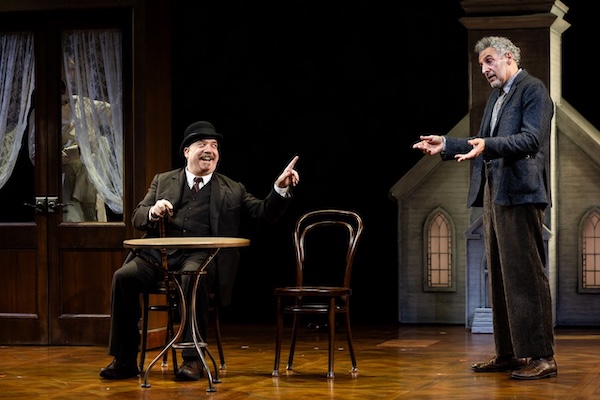
Paul Giamatti (Jean) and John Turturro (Berenger) in the American Repertory Theater production of Rhinoceros. Photo: Hawver and Hall
In New England, 2026 is the year of the Rhinoceros, at least among our major regional theaters. In March, the Yale Repertory Theatre mounted a production of Eugène Ionesco’s exposé of authoritarian creep (my review), and now the American Repertory Theater is following up with its own compelling adaptation of the 1959 script. These stagings are part of a welcome boomlet for the dramatist–a revival of Arlekin Players’ recent splendid production of Ionesco’s Delirium will be opening on September 8 in Brooklyn.
The repeated sightings of the beast make grim sense. In Rhinoceros, Ionesco targets collectivist movements of Left and Right while drawing on his memories of Nazism’s rise in Romania. The play, he said in an interview, seeks “to denounce, to expose, to demonstrate how an ideology is transformed into idolatry, how it pervades everything, how it brings the masses to hysteria.” Today, pachyderms of uncontrolled cruelty are again on the rampage: fascist muscle is pushing the current administration, tyrannical swarms are increasing around the world. But Ionesco’s target was larger than autocratic geopolitics; he condemned “the malady of conformity which knows no bounds, no boundaries.”
As I have argued elsewhere, the postwar absurdists—Ionesco, Beckett, Albee, and their peers—offer unusually acute diagnoses of our shell-shocked response to polycrisis. Their worlds of irrationality, panic, dehumanization, bureaucratic cruelty, and social contagion anticipate a reality increasingly shaped by online homogenization and AI-assisted conformity. In Cory Doctorow’s term, today’s rhinocerization is the enshittification of public and private life: the steady degradation of systems, language, institutions, and imagination until submission to the herd feels inevitable—even normal. The dictatorship of the algorithms inevitably entrenches uniformity as it goes about undercutting individual creativity.
As for how Rhinoceros should be staged, Ionesco wrote in his essay “Experience of the Theater” that “the unendurable admits of no solution, and only the unendurable is profoundly tragic, profoundly comic, and essentially theatrical.” That volatile fusion of humor and terror supplies the key to staging this play and many of the dramatist’s others. The play’s last remaining human, Berenger, reasonably concludes that there is no way to know whether the transformations of his fellow villagers—his friend Jean and his beloved Daisy among them—into rhinoceroses are reversible. The dramatic action systematically renders his existence “unendurable.” People seem content to devolve into beasts, a metamorphosis propelled by admiration for unquestioned strength, rationalized obedience to power, and the spell cast by grotesque beauty. Humankind’s preference for the primal offers ample opportunities for humor, from villagers who deny what is unfolding before their eyes to their slow, steady refusal to remain human. Ionesco exploits them skillfully without indulging in the zany at the expense of the serious.

Tatiana Maslany and John Turturro in the American Repertory Theater production of Rhinoceros. Photo: Hawver and Hall
In what will be her final production at the Loeb Drama Center (before A.R.T.’s move to new digs in Allston), director Diane Paulus makes the most of Ionesco’s farce, propelling the action with snappy, high-spirited invention. The company’s adaptation is zesty, fleshing out some of the playwright’s sketchily drawn characters with droll bits of physical business and sprinkling in topical updates, including a few obscenities. At times, though, Paulus piles on the hijinks: a dead cat can be beaten for a laugh only so many times. Nor does the set’s pint-sized church—eventually tipped on its side—do much to visualize the play’s increasingly airless, rhino-enforced claustrophobia.
The performances, by contrast, are consistently strong. Paul Giamatti establishes an appealingly friendly, if patronizingly bossy, rapport with John Turturro’s Berenger, before his character’s chronic insecurity—concealed beneath a façade of hidebound certainty—morphs spectacularly into the animalistic. Giamatti’s transformation into a rhinoceros is hilariously fussy, a memorable sequence of comic starts and stutters. Yet its modulated agility ends up softening the ugliness and violence signified by the transformation. People willingly turn into monsters in this play: they reject their humanity in exchange for the satisfyingly brute power of indifference. As Daisy, Tatiana Maslany nimbly pokes at the role’s nurturing stereotype, suggesting that it can be a surprisingly thin veneer over the bestial. Her apparent empathy—her care for Berenger, for example—masks a more conventional attraction to unassailable strength: the seductive promise of belonging in groupthink’s siren song. If the males in the play are barbarized by their need for certainty, its women are undercut by their need for attachment–Mrs. Bœuf becomes a beast out of love for her husband.
For Ionesco, individuality is not a matter of stubborn, conscious choice. It is an intuitive acceptance of anguish as the way of the world—a chronic pain made even more absurdly “unendurable” once society turns authoritarian. Berenger is condemned to be human, and John Turturro offers a marvelous, multilayered version of the anguished antihero. The emotional range of his scruffy, strident, hapless, alcoholic nonconformist expands and contracts with impressive ease, moving from comic and pathetic to needy and resolute. It is a terrific performance, testament to the playwright’s belief that, in the theater, the revelation of an unbearable truth can be luminous and comforting.
Sixty years ago, in Conversations with Eugène Ionesco (translated by Jan Dawson), the dramatist made this idyllic wish about the future of Rhinoceros: “It is very possible that Rhinoceros will become incomprehensible—I hope it will—in a world where all men have become lucid, with free personalities and autonomy of thought, and yet not separated from each other. When that world exists, people will no longer understand what I am trying to say. Or else they’ll try to decipher my play like some document from a vanished era. I hope this will happen.” The tragedy is not merely that we understand the play; it is that we keep finding new ways to crank out rhinoceroses.
Bill Marx is the editor-in-chief of The Arts Fuse. For over four decades, he has written about arts and culture for print, broadcast, and online. He has regularly reviewed theater for National Public Radio Station WBUR and The Boston Globe. He created and edited WBUR Online Arts, a cultural webzine that in 2004 won an Online Journalism Award for Specialty Journalism. In 2007 he created The Arts Fuse, an online magazine dedicated to covering arts and culture in Boston and throughout New England.
Tagged: Alex-Ross, American Repertory Theater, Broadway, Eugène Ionesco, John Turturro, Paul Giamatti
4 Comments
Leave a Comment

Thank you for the well-articulated analysis of why this play feels so appropriate for our current time. It’s not just the creeping fascism – but the “polycrisis” including “online homogenization and AI-assisted conformity.” Great stuff.
I saw this play last week and (having no real knowledge of it beforehand) was thrown off-kilter by the mix of hijinks and menace in the first act, in the enjoyable way that a great dark comedy can make you feel.
I was mesmerized by Turturro in the second act and have found myself reflecting on his performance frequently. What a thrill to see him perform in a small theater.
Seeing this play did not provide catharsis, but it felt very relevant and made me feel a little less like I am losing my sanity in these times. This review is very helpful as I think about the experience and discuss with others.
Thanks for the comment. Ionesco was interested in what he called “tragicomedy” — there is no catharsis. It was about dramatizing an unbearable truth. There was illumination and comfort in that journey, yes, but no solution or emotional solace.
Superb writing about Ionesco, I would, however, like a little more of your thoughts about how “Broadway” Paulus and her ART actually came around to the avant-garde this time. Some context. Also, I wonder if Ionesco saw the 1950s Invasion of the Body Snatchers before writing this one, the same themes, the same last act with a woman and man against the world and the woman as betrayer. Also Richard Matheson’s “I Am Legend” about the last man on earth.
A story on the production in the Boston Globe suggests that John Turturro approached Diane “Broadway or Bust” Paulus about staging Rhinoceros. So the offer came with star power, compounded by the presence of Paul Giamatti. (In other words, no celebrities, no production.) The upping of the comedy quotient in the staging no doubt owes something to commercial considerations. Luckily, it does not undercut the merits of the performances. The Yale Rep production of the drama earlier this year was darker — but it didn’t have Turturro’s anguished anti-hero.
Keep in mind, this play is Ionesco’s most popular — it ran on Broadway in 1961, with Zero Mostel, whose raucous transformation scene was said to have been amazing. (There is a 1974 film version of the play starring Mostel and Gene Wilder. It was part of the American Film Theatre series. I recall that the text was played as fodder for farce, just what the playwright hated.) The 1960 West End production of Rhinoceros is legendary for its artistic firepower — directed by Orson Welles, it starred Lawrence Olivier and Joan Plowright. Relocated the action to London.
As for Ionesco and popular culture, I am very skeptical he was familiar with the Hollywood film and story you mention. He was damned pernickety — it took him decades to see any value in Moliere (!).
Rhinoceros is rooted in Ionesco’s experience in Romania in the ’30s, when budding intellectuals enthusiastically embraced fascism. Many of Ionesco’s closest friends and peers—such as the philosopher Emil Cioran and the religious historian Mircea Eliade—became passionate supporters of the Iron Guard. Ionesco, alongside his Jewish friend — playwright, journalist, and novelist Mihail Sebastian — watched with terror as members of their circle accepted totalitarianism. Ionesco described this ideological shift as a collective loss of humanity. The Cold War and left-wing French politics (Sartre’s enthusiasm for Stalin) no doubt also inspired the play.