Film Reviews: “It Ends” and “The Dog Stars” — Apocalyptic Fizzles
By Peter Keough
Not much bang and plenty of whimper
It Ends (2025). Directed by Alex Ullom. At the Boston Common, Alamo Drafthouse, and the suburbs on August 27.
The Dog Stars. Directed by Ridley Scott, based on the novel by Peter Heller. At the Boston Common, Kendall Square, Causeway 13, and the suburbs on August 27.
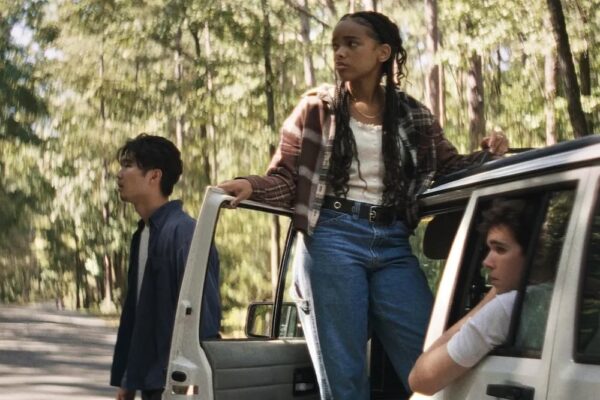
Phinehas Yoon, Akira Jackson, and Noah Toth in scene from It Ends. Photo: Courtesy of SXSW
Graduating from college has always posed a generational challenge: leaving behind friends and reliable routines to confront an uncertain future. But the outlook may be especially bleak for Gen Z, facing a smorgasbord of political crises—from consumer culture’s mind-numbing ubiquity to the inexorable onset of environmental catastrophe.
That said, the three grads in Alex Ullom’s low-budget, polished, sometimes inspired but ultimately enervating debut, It Ends, are initially upbeat. James (the unflappable, phlegmatic Phinehas Yoon), Day (the low-key, compassionate Akira Jackson), and Fisher (Noah Toth, the group’s neurotic Jesse Eisenberg) are glad to join their former classmate Tyler (Mitchell Cole, a brooding Chris Pratt type) on a semi-celebratory road trip. They have also devised an amusing online game to occupy themselves: a quiz about who would be more formidable in a fight—50 hawks, 10,000 rats, five gorillas, or a guy with a gun (this may be the only question the filmmaker is willing to answer).
At one point, Tyler interrupts their badinage and petty squabbling by pointing out that a turn posited by their GPS has not shown up. Surely he must have just missed it, they respond accusingly. They all blame one another — meanwhile, the road continues and no offramp is forthcoming. Something is not right.
And so begins It Ends, which is kind of like The Cabin in the Woods (2011), except that the victims don’t even make it to the cabin. Instead, they drive for miles through a forest on a road with no turns and no end in sight. Every time they stop, they are assaulted by throngs of desperate crazies. Occasionally, they pass an abandoned car and sometimes ransack it. But as the days pass, they experience neither weariness nor hunger nor any other biological need. The miles mount up and they are still nowhere.
They pass the time probably pretty much the same way they did in the dorm back in the day, shooting the shit, playing dumb games, and arguing about the kinds of things that can really bother an undergrad. Like, are we dead? Are we in hell or purgatory? Who are the people in the woods? And why doesn’t the car run out of gas?
The car doesn’t, but the film might. As some critics have pointed out, the 89-minute film might have worked better as a half-hour Twilight Zone episode—1960’s “The Hitch-Hiker,” for example. For a more elegant and effective feature-length rendition of a similar scenario, check out Dane Elcar’s 2022 gem Brightwood. Comparisons have also been made to Jean-Paul Sartre’s No Exit, with its famous maxim, “Hell is other people”—a sentiment amply illustrated here. But the work of another existentialist, Albert Camus’s The Myth of Sisyphus (1955), may be more germane. While the others lose hope or interest in solving their problem, James, like the rock-rolling hero of Camus’s essay, persists. Though the others chastise him and his quandary affords no resolution, James retains an implacable need to reach the end of the road—or arrive at some understanding of why he is there.
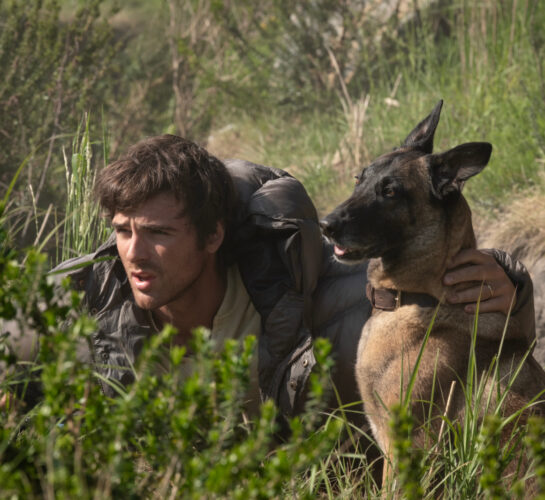
Jacob Elordi as Hig and Jasper in The Dog Stars. Photo: Fabio Lovino/ 2026 20th Century Studios.
A similar existential quandary underlies Ridley Scott’s flashy but flaccid take on Peter Heller’s novel The Dog Stars (2012), itself a vapid retread of Cormac McCarthy’s The Road (2006) and its unflinching 2009 John Hillcoat screen adaptation. It’s 2035 and a generic flu has wiped out civilization. The few left alive kill one another for what’s left. Among them are Bangley (Josh Brolin), a ruthless gun nut and cynical survivalist, and Hig (looming and genial Jacob Elordi, who resembles a young John Kerry), a widower whose only love now is for his plane and his somewhat annoying dog Jasper.
Bangley and Hig have set up a homestead at an abandoned airfield outside Denver and endure a fractious relationship as they defend their turf from what Bangley calls the “roaches”—survivors more desperate and less well equipped than they are. Bangley seems pretty comfortable with the situation; Hig suggests that he might like it too much. Hig, on the other hand, keeps flying off in search of something better: a place where people care for one another, where it’s not kill or be killed.
But all he finds is picturesque devastation, along with caches of medical supplies and cases of Coca-Cola and Sprite—product placement—which he shares with an ungrateful Bangley and with a nearby colony of sickly Mennonites for whom he has been providing. Ironically, could this be the humane community he pines for, right under his nose? His care for them is something else his partner doesn’t approve of, and though he appreciates Hig’s aerial-reconnaissance services, the home-cooked meals, and the Cokes, Bangley, like James’s friends in It Ends, can’t help chiding him for his quixotic pursuit of something unattainable: not the meaning of it all, in this case, but simple human decency.
At one point, after they have killed a couple of “roaches” who turn out to be children, Hig decides to crash himself, Jasper, and the plane into the side of a mountain. But he stops at the last minute when he hears a radio broadcast from an airfield near remote Grand Junction. After the situation with Bangley worsens, he sets off to find the signal. On this journey, he finds not woods and highway, like the travelers in It Ends, but another geezer with guns (Guy Pearce), his nubile daughter (Margaret Qualley), Allison Janney dressed as a retro flight attendant—and the Reapers. A more lethal species of “roaches,” they are roving hordes of tattooed berserkers on horseback, armed with bows and arrows like renegades in a 1950s B Western.
This perhaps unintentional racist allusion aside, Scott at times aspires to the stunning visuals of Blade Runner, as in a shot of a skyscraper-high projection of an NBA player on an endless loop. Also to his credit, he has condensed much of Heller’s lackadaisical plotting—though at the expense of his affecting descriptions of wildlife and nature. There are a few unfortunate additions, notably the segment involving Janney, whose lunacy belongs in another, perhaps better movie. What is most disappointing about the film, though, is that it offers the spectacle of doomsday without any attempt to understand why it is happening or, more important, why people are so attracted to it. It’s apocalypse porn, pandering to those who, like Bangley, get off on that sort of thing.
Peter Keough writes about film and other topics and has contributed to numerous publications. He was the film editor of the Boston Phoenix from 1989 to its demise in 2013 and has edited three books on film, including Kathryn Bigelow: Interviews (University Press of Mississippi, 2013) and For Kids of All Ages: The National Society of Film Critics on Children’s Movies (Rowman & Littlefield, 2019).
Tagged: "It Ends", "The Dog Stars", Akira Jackson, Alex Ullom, Guy Pearce, Jacob Elordi, Josh Brolin, Noah Toth, Phinehas Yoon