
Film Review: “Buddy” Turns Children’s-TV Cheer Into a Nightmare of Control
By Sarah Osman
Casper Kelly’s wildly unhinged horror-comedy, featuring Keegan-Michael Key as a murderous orange unicorn, finds dark laughs—and a sharp study of abuse—inside the artificial warmth of 1990s kids’ programming.
Buddy, directed by Casper Kelly. Screening at Coolidge Corner Theatre, AMC DINE-IN Framingham 16, and Showcase Cinemas Warwick.
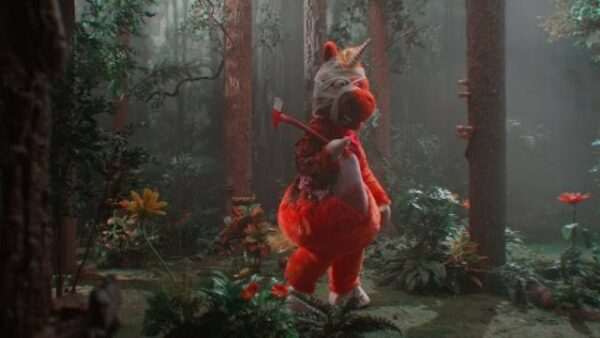
A scene from Buddy. Photo: Worry Well Productions
Buddy, the directorial debut of Casper Kelly, is one of the most unhinged films I have ever seen—and I do not say that lightly. My husband has a knack for finding some of the strangest movies ever made. He somehow unearthed the Egyptian Rocky Horror Picture Show remake, complete with Disco Dracula and sound cues lifted from Jaws. The film is called Anyab, and it is available on the Internet Archive. Buddy belongs in the same deranged cinematic league.
Voiced by Keegan-Michael Key, the titular Buddy is a magical orange unicorn who seems to be a nonunion version of Barney the Dinosaur. He stars in It’s Buddy, a cheesy 1990s children’s program in which kids learn life lessons through song. But when one child refuses to join Buddy’s dance party, he is abruptly replaced in the next episode by Hannah (Madison Skyy Polan). Two other children, Wade (Caleb Williams) and Freddy (Delaney Quinn), begin to suspect Buddy’s true authoritarian nature: he will kill to preserve control over his cutesy little prison. With the help of a talking backpack and a battered mailbox, the kids must escape Buddy’s realm before it is too late.
That is about as much as I can say about the plot without spoilers. Every time I thought I had the film figured out, it took another wild left turn. The bottom line: Kelly has created a genuinely berserk horror comedy.
Making that genre designation clear is important, because Buddy is extremely funny. The killings are so absurd that you cannot help but laugh. Buddy’s behavior and one-liners—including a perfectly deployed “bitch”—heighten the comedy, largely because of Key’s gleefully unrestrained performance as the monstrous unicorn. The humor is dark: at one point, Buddy rips the face off a train that bears more than a passing resemblance to Thomas the Tank Engine. But the film also satirizes the sickening artificiality of ’80s and ’90s children’s entertainment. Ironically, Buddy is less disturbing, at least to me, than Disney’s animated musical fantasy The Brave Little Toaster, in which cars sing about their own deaths.
Along with its gruesome jokes, the film succeeds as an impressive feat of puppetry, which has become something of a lost art. Disney, meanwhile, seems content to leave the beloved Muppets languishing in an unused soundstage somewhere. The puppeteers create remarkable empathy for the silent, battered mailbox, whose only wish is to be repaired. Key’s vocal performance would not land nearly as well without Sergey Zhuravsky and Jonathan Yurco, the puppeteers who bring Buddy compellingly to life in both his benign and monstrous forms.
For all its homicidal excess, Buddy is also a meditation on abuse. Some critics have argued that the film underlines the trauma inflicted on children by ’80s and ’90s children’s media.
The story does touch on that infusion of anxiety, but Kelly also uses the genre’s familiar imagery—the cuddly yet sinister host who sings about love, the friendly mailman, the anthropomorphic furniture—to say something more pointed about child abuse. Buddy speaks the language of an abuser. He manipulates, gaslights, and mocks everyone around him, especially the children. He insists that he will not become angry—then flies into a rage. He professes love for his victims only after inflicting harm. The unicorn demands absolute control. This theme is the true horror of Buddy: this is not merely a grotesque-looking unicorn, but an abusive narcissist hiding behind the language of care.
The effects of that violence connect the film’s adult characters to the children currently squashed under Buddy’s thumb. The young cast, all of whom are excellent, play children struggling to survive an impossible situation. The adults around them suggest the cost of surviving abuse: lingering damage, unhealthy coping mechanisms, and the tendency to seek out partners who replicate the traits of an earlier abuser.
Oddly enough, Anyab offers a useful comparison. As outrageous as Egypt’s Rocky Horror remake may be, it also critiques the country’s materialism and an ’80s economy that was bleeding ordinary people dry—hence its vampire imagery. Buddy and Anyab may be off their rockers, but both uncover disturbing truths about the worlds that produced them. Perhaps absurdity is the most effective way to comment on a sociopathic reality.
Sarah Mina Osman is based in Los Angeles. In addition to The Arts Fuse, her writing can be found in The Huffington Post, Success Magazine, Matador Network, HelloGiggles, Business Insider, and WatchMojo. She has an MFA in Creative Writing from the University of North Carolina Wilmington and is working on her first novel. She has a deep appreciation for sloths and tacos. You can keep up with her on Instagram @SarahMinaOsman and at Bluesky @sarahminaosman.bsky.social.
8 Comments
Leave a Comment
Oh okay , but sorry I live in france and my friend in Egypt and we went to watch it , this film will be release in the international theater or not ??
Great review, thanks! I saw the film in one of those boutique theaters that are so popular these days. There were maybe 25 people there. I couldn’t believe it: the only person laughing and guffawing was me. It seemed like all these people were viewing this movie solely through the eyes of the horror genre. Since watching a movie is a collective experience, I felt out of place and became self-conscious about my laughing. When people were leaving the theater I got several stares as if I were some kind of freak. The film has many layers and tons of homages/references, including to That ’70s Show, Willie Wonka, and even Cool Hand Luke. Glad to see I wasn’t the only one to get the extensive humor in this movie.
THIS MOVIE IS THE WORST PIECE OF SHIT THAT I HAVE SEEN IN MY LIFE…WHAT IS THIS SHIT ABOUT? WHAT IS THE PURPOSE OR REASONING OF THIS STUPID GARBAGE…? NO BEGINNING AND NO END…I DO NOT THINK YOU CAN CALL THIS A MOVIE… WHAT A WASTE OF TIME AND MONEY…!
I completely agree. Just saw this movie and really wish I had that time back.
WTF there is absolutely gore!? I thought it was a children show 😭🥀 i was not surprised at the gore, the bloody experience and the torture 😞
Legitimately one of the best movies I’ve seen in a long time in that regard.
Grew up with malignant narcissists around in the church and actually was one of the background characters / singers for an evangelical group that did a bible themed show like this. Movie really, REALLY hit home with the silent indecision when you feel like you have to make a choice to stick up for yourself at all which always ended with yelling and worse, or suddenly switch and start to fawning mode to smooth it all out so the only hurt you get is the denial of your own interests.
But hey, I’m out of that now, and while my consequences weren’t as severe, that ending really did nail feeling of just getting out, and feeling completely overwhelmed by where to start your life at now that you aren’t in anymore, no friends, limited family, no connections, and no sense of self that isn’t tied to the abuse you just escaped.
Why do I feel that movies — like this one and violent WINNIE THE POOH — are directed by pseudo-pedophiliacs? Thanks for the review.
I love buddy