
Theater Review: “The Wash” Finds Power and Joy in Solidarity
By David Greenham
A compelling cast brings warmth, humor, and resolve to Front Porch Arts Collective’s stirring portrait of Black washerwomen fighting for their rights in 1881 Atlanta.
The Wash by Kelundra Smith. Directed by Tasia A. Jones. Scenic design by Janie E. Howland, lighting design by Amanda E. Fallon, sound design by Joshua Jackson, projection design by Pamela Hersch, and costume design by Athena Parkman. Staged by Front Porch Arts Collective at the Boston Center for the Arts through November 22.
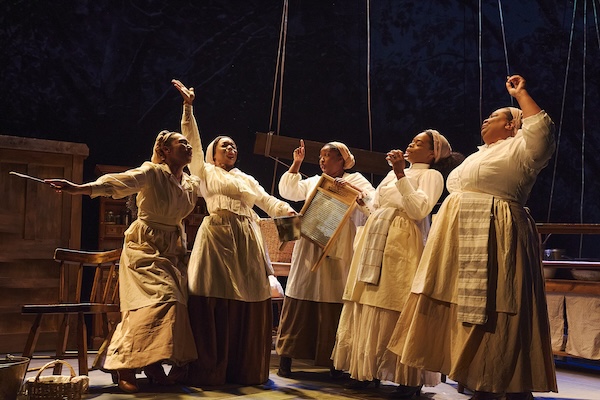
Front Porch Arts Collective production of The Wash: (l. to r.), Kiera Prusmack, Lindsey McWhorter, Jada Saintlouis, Marhadoo Effeh, and MaConnia Chesser. Photo: Ken Yotsukura
It looks as if, when the counting is done, Black women will have played a key role in Tuesday’s “blue wave.” The creative team at Boston’s Front Porch Arts Collective couldn’t have known that the first production of the company’s 10th season — which I saw the day after the midterms — would be the most relevant stage play imaginable. Kelundra Smith’s 2024 drama, The Wash, which is based on a true story, revels spectacularly in the joy of strong Black women.
Set in Atlanta during the hot summer of 1881, The Wash introduces Anna (a steadfast Lindsey McWhorter), the owner of a house that she and others have transformed into a laundry. They take in washing from white people in the community. Her co-workers include the hilariously curmudgeonly Jeanie (MaConnia Chesser), Thomasine (Marhadoo Effeh), Jewel (Kiera Prusmack), and Charity (Jada Saintlouis).
The scene opens with wordless music and a rhythmic dance that captures the washerwomen’s solidarity and the punishing labor of scrubbing clothes and bedding with buckets and washboards.
Early one July morning, Jeanie finds Anna already at work, struggling to keep the business afloat. Many customers haven’t paid their bills since May; others offer beans and rice instead of cash. “War been over about 20 years,” Anna says of their continued disrespect. “We ought to be over this.”
For Anna, $30 would mean a wagon and a chance to supplement her income by selling cornbread. Jeanie hopes to save enough to travel to Rochester, New York, for her grandson’s birth. More urgently, Anna owes property taxes. If she can’t pay, she could lose her house.
Anna worries that customers will be furious if the women dare to stop working. Jeanie thinks that might be just what it takes to make them pay. “Them crackers gotta do right by us because we know all their secrets,” she says. The women laugh over the intimate revelations in their customers’ laundry—including evidence of “Mr. Frasier” and his affairs, betrayed by the different perfumes lingering on his sheets.
As the story unfolds, the women’s lives beyond the washboards come into focus. Thomasine struggles to keep her daughter in school and her family together despite an abusive husband. Charity is alone: Her father died when she was six, and her mother died of pneumonia after the war. Jewel says little about her private life, but the others recognize her affection for her “friend” Deloris—a relationship neither woman can safely acknowledge.
By the end of the first act, Anna resolves to strike. “No pay, no wash!” she declares. Jewel and Charity immediately join her, but Jeanie and Thomasine hesitate. “The crackers will have us swinging from a Georgia pine,” Jeanie warns. Charity counters with a paraphrase of Isaiah 61: “The Lord loves justice and hates robbery.” Anna refuses to yield: “You either live fighting, or die lying down.”
When the second act opens, the Washing Society has grown to 800 members. A knock at the door brings Mozelle (Eliza Fichter), a white washerwoman who says that others in her community want to join. The women are wary, but Mozelle works to earn their trust and recruits more white washerwomen, expanding the Society’s ranks.
As the movement grows, so does the danger. The strikers become targets of violence. “All they see is skin, they don’t see us,” Thomasine says.
After Anna is attacked and beaten, some want to abandon the strike. This time, Jeanie supplies the resolve: “We bruised, but never broken.”
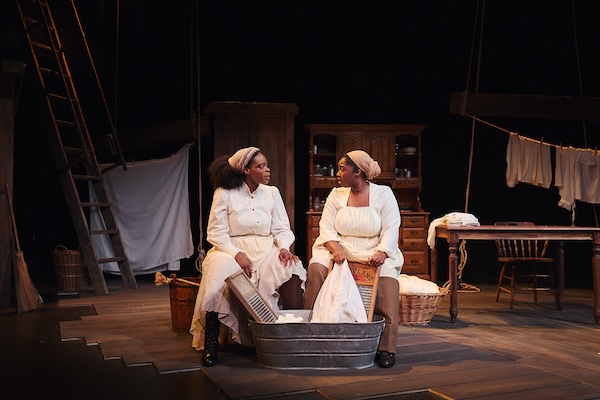
Front Porch Arts Collective production of The Wash: Marhadoo Effeh and Jada Saintlouis. Photo: Ken Yotsukura
The Wash unfolds on Janie E. Howland’s abstract set, which effectively evokes the makeshift home and business. Amanda E. Fallon’s sepia-toned lighting suggests summer heat while giving the proceedings an antique glow. Joshua Jackson’s eclectic sound design evokes sheets snapping in the wind. Athena Parkman’s costumes begin in period fashion, then blossom spectacularly with color as the women gain confidence and strength.
Director Tasia A. Jones keeps the storytelling clear and gives the play’s poignant moments room to breathe, allowing the women’s histories and ambitions to emerge.
The cast delivers beautifully. McWhorter’s Anna is the sun around which the others orbit, anchoring the narrative with her resolve. Chesser’s openhearted Jeanie is equally compelling — her emotional range and comic timing command our attention.
Effeh’s Thomasine faces the most difficult balancing act, torn between her hopes for her children and her loyalty to her colleagues. Effeh captures that struggle with quiet conviction.
Prusmack’s Jewel and Saintlouis’ Charity are a joy throughout. As Mozelle, Fichter balances gentleness with desperation, her earnestness making us root for her from her first appearance.
The pivotal moment in The Wash—and in the history of the Washing Society—comes when the women turn their collective strength into a letter to Atlanta’s mayor, demanding recognition of their union. Their insistence on being heard gives the play its considerable force: Women whose labor sustains a city refuse to remain invisible.
Of course, that demand resonates well beyond the stage. In a world where white men—including me—have held power for so long, The Wash offers a stirring vision of Black women claiming the authority to shape their own futures.
David Greenham is an arts and culture consultant, adjunct lecturer on Drama at the University of Maine at Augusta, and is the former executive director of the Maine Arts Commission. He can be found at https://davidgreenham.com/
Tagged: Atlanta washerwomen’s strike, Black Women, Black theater, Boston Center for the Arts, Boston-theater, Front Porch Arts Collective, Historical drama, Kelundra Smith, Tasia A. Jones, The Wash, Washing Society, labor history, solidarity, theater review, women’s history