Film Review: “Godzilla Minus Zero” — Atomic Trauma Meets a Kaiju Brawl for the Ages
By Nicole Veneto
Director Takashi Yamazaki goes bigger, darker, and more explicitly anti-American in a sequel whose jaw-dropping destruction outmuscles its uneven human drama.
Godzilla Minus Zero, directed by Takashi Yamazaki. Screening at Alamo Drafthouse Cinema – Seaport, AMC Boston Common 19, AMC Causeway 13, and Mugar Omni Theater – Museum of Science. Screening at Alamo Drafthouse Cinema – Seaport, AMC Boston Common 19, AMC Causeway 13, and Mugar Omni Theater – Museum of Science.
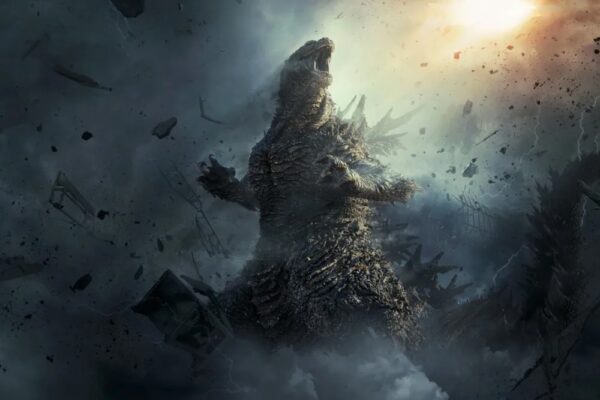
The King of the Monsters gets territorial against a fearsome apex predator in Godzilla Minus Zero. Photo: Toho/GKIDS
Few pop-cultural exports enjoy Godzilla’s longevity, malleability, or standing in both high and low culture. Debuting two years after the end of the American occupation—and less than a decade after Hiroshima and Nagasaki—in Ishirō Honda’s harrowing 1954 classic, the King of the Monsters took on a life of his own amid the fifties’ sci-fi craze, albeit in a heavily re-edited and depoliticized form for American audiences. A perpetually sweating Raymond Burr was sutured in. Though the nuclear metaphor was diminished, along with overt references to Japan’s atomic trauma, Godzilla became a permanent fixture in American-Japanese cross-cultural relations, propelled by sheer monster-movie mayhem alone. He’s a dynamic, bona fide movie star, capable of being both a terrifying force of nature and a protective, family-friendly mascot. But the significance of Honda’s original incarnation — a paradoxical representation of postwar Japan’s simultaneous victimhood and culpability — has always eluded American adaptations. The critical poignancy and political heft found in even the silliest Japanese entries were reduced to half-baked social commentary (Godzilla, 2014) or popcorn schlock (as part of Legendary Picture’ Monsterverse) in Hollywood’s hands. And don’t even get me started on what Roland Emmerich did to the guy.
While Hollywood has struggled to reconcile Godzilla’s sociopolitical specificity with big-budget American spectacle, Japan struck critical and commercial gold with 2023’s Godzilla Minus One, giving our favorite atomic monster the Spielbergian treatment at a fraction of the cost of your average Marvel movie. In blending prestige wartime melodrama with blockbuster-sized kaiju action, director Takashi Yamazaki delivered an Oscar-winning, populist franchise reboot that stuck close to Godzilla’s historical roots without sacrificing international appeal. At the same time, Yamazaki—whose 2014 kamikaze film, The Eternal Zero, was an alleged favorite of the late Prime Minister Shinzo Abe—weathered criticism for Minus One’s nationalist undertones. Those undertones are more pronounced than in other Godzilla films, particularly in Minus One’s failure to confront imperial Japan’s culpability beyond its disregard for ordinary Japanese life. The collective trauma Godzilla traditionally represents — as both victim and aggressor — was reduced to an individual metaphor: a physical representation of reticent kamikaze pilot Kōichi Shikishima’s (Ryunosuke Kamiki) survivor’s guilt. Sending the creature to a watery grave provided a masculinist shot at self-redemption from wartime cowardice.
Yamazaki’s follow-up, Godzilla Minus Zero, eases up on this troubling subtext while casting a deservedly critical eye toward the United States, a destructive foreign occupier analogous to Godzilla’s three-headed adversary King Ghidorah, the titular Monster Zero. And, like any good sequel, Minus Zero is an ambitious step up in almost every respect. What it lacks in the narrative tautness of its predecessor, it more than makes up for with jaw-dropping, IMAX-scale kaiju carnage. The series’ first R rating isn’t a case of MPA overreach—please don’t bring your children to this.
Two years after Godzilla was (allegedly) blown to pieces, postwar Japan’s efforts to rebuild suffer another blow when a dragonlike space monster lays siege to Matsumoto City. With the occupying United States forces unwilling to offer more than begrudging support because of Cold War machinations, it falls to the newly formed Large-Scale Disaster Response Bureau, headed by reedy former naval engineer Kenji Noda (Hidetaka Yoshioka, upgraded from supporting player to co-lead), to deal with another gargantuan menace. Joined by gifted meteorologist Makoto Aoyama (Masami Nagasawa) and vengeful survivor Dr. Kanji Murakami (Min Tanaka), Noda recruits his old pal, the now happily settled-down Kōichi, for another kaiju-killing mission. Alas, the attack succeeds only in mutating the electric dragon into a three-headed behemoth infinitely more devastating than the Allied forces’ air raids. Luckily for all involved, this is a Godzilla film; manmade weaponry may be useless against King Ghidorah but, like any barely repressed trauma, Godzilla will always return. There can be only one King of the Monsters, and Japan certainly isn’t big enough for the two of them.
For those keeping tabs, Minus Zero marks the tenth time Godzilla has faced King Ghidorah since the latter’s introduction in 1964. While previous throwdowns (save for Legendary’s egregiously murky-looking 2019 sequel) made tactile use of suited actors stomping around miniature sets, Yamazaki and his VFX team use the opportunity to refine the already impressive CGI that earned them an Academy Award. Even if their work still pales in comparison to the eldritch horrors Hideaki Anno and Shinji Higuchi conjured in Shin Godzilla, the digital artistry on display begets some of the most violent imagery ever depicted in the seventy-year franchise. This isn’t the weightless kind of CGI violence commonly found in superhero fodder, but the sort buoyed by stark historical realism and an onscreen body count. Kaiju-on-kaiju violence is to be expected—and there’s a lot of it. A graphic re-creation of Hiroshima’s aftermath, with melted bodies and charred corpses, however, is a first for a series that once had its star do a touchdown dance in space.
Godzilla’s embodiment of postwar nuclear trauma is so prominent throughout the franchise that it hardly counts as subtext. Yet Yamazaki takes Minus Zero further than any other Godzilla movie in visualizing the mass casualties and aftereffects of atomic warfare, whether kaiju-inflicted or manmade. Having miraculously survived Godzilla’s attack on Ginza in the previous film, Kōichi’s wife/domestic life partner Noriko (Minami Hamabe, afforded more narrative agency this time around) suffers from a peculiar kind of radiation sickness: exposure to Godzilla’s atomic breath infected her with mutative, regenerative cells, opening future installments up to the body horror promised in Shin Godzilla’s final frames. But the true horror is reserved for newcomer Dr. Murakami, whose backstory draws on the real-life case of Hiroshima and Nagasaki survivor Tsutomu Yamaguchi. Warped by the loss of his entire family to the atomic bombs, Dr. Murakami sees Godzilla’s return as a unique opportunity to exact divine revenge against the United States, resulting in a sequence wholly unthinkable in the post-9/11 filmscape.
That Yamazaki’s Godzilla films have experienced an unprecedented level of success in America—which, to reiterate, Minus Zero depicts as a secondary antagonist, if not as interchangeable with King Ghidorah—can be attributed as much to their continued interest in the material’s underserved human story as to their stunning visual effects work. Given the expanded character roster, the latest installment is less focused on individual character arcs than Minus One is: Kōichi and Noriko’s familial drama retreads well-covered ground for narrative convenience, and Dr. Murakami’s storyline could use a second pass. Even King Ghidorah’s (supposed) exit from the playing field is rather underwhelming considering the climactic WWE-style kaiju smackdown that precedes it. On the whole, it makes sense to think of Yamazaki less as the Japanese Steven Spielberg and more as Japan’s resident James Cameron, albeit with Michael Bay’s political leanings and inclination toward big, loud destruction. Either way, the director more than delivers on a kaiju brawl for the ages. To quote Ken Watanabe’s much-memed assertion in Gareth Edwards’s reboot: “Let them fight.”
Nicole Veneto is a locally revered abject woman and acclaimed millennial hag with an MA in Women’s, Gender, and Sexuality Studies from Brandeis University, where she concentrated on feminist media studies. Her writing has been featured in MAI Feminism & Visual Culture, Film Matters Magazine, and Boston University’s Hoochie Reader. She’s the co-host of the podcast Marvelous! Or, the Death of Cinema and a features programmer for the Boston Underground Film Festival. You can follow her on Letterboxd, Substack, and her podcast on Twitter @MarvelousDeath.
Tagged: Godzilla, Godzilla Minus One, Godzilla Minus Zero, Japanese Cinema, King Ghidorah, Monster Movies, Nuclear Trauma, Postwar Japan, Takashi Yamazaki, film reviews, kaiju, science-fiction