Book Commentary: Why University Presses Matter in New England
By Scott Bane
From preserving literary history to championing overlooked voices, the region’s university presses build communities of readers—and give books like mine a home.
Beginning on the second Monday in November, University Press Week runs from November 9 to 13 this year and features author conversations, readings, symposia, and other events to raise the profile of books published by university presses. A few years ago, in an essay in The New York Times, Margaret Renkl went so far as to suggest that university presses are pumping blood and oxygen into American literature. The reasons are well known: greater consolidation in the commercial publishing world and an appetite for blockbusters to counter Amazon’s power over the marketplace. Renkl’s piece focuses mostly on examples from the South. But many of her ideas hold true for New England, too, with its distinguished literary history.
Today, the region benefits from books published by a dozen university and college presses, ranging from Amherst College Press to Yale University Press. Books from nearly all of these presses are included in University Press Week’s 2026 reading list of 94 titles. All of these presses bring out scholarly publications, and many also publish books for general readers that serve smaller audiences or fill distinctive niches within the literary world, such as poetry, Jewish studies, or New England regional history.
My book likely would not have been published were it not for a university press. A Union Like Ours: The Love Story of F. O. Matthiessen and Russell Cheney tells the story of an early-20th-century same-sex “marriage”—a word that Matthiessen used in 1924 to describe his relationship with Cheney. The University of Massachusetts Press’s Bright Leaf imprint published the book in 2022. But before the book ultimately found a home, it had been turned down 28 times—one more rejection than Dr. Seuss’s And to Think I Saw It on Mulberry Street, but two fewer rejections than Stephen King’s Carrie. The book went on to be named a finalist for the prestigious Randy Shilts Award for Gay Nonfiction, given by the Publishing Triangle, a national association that works to advance LGBTQ books and other works in the publishing world. And I’m hardly alone. Other UMass Press titles have won or been shortlisted for important national prizes, such as the George Washington Prize, which honors books about the nation’s founding. Similarly, Wesleyan University Press’s books have won or been shortlisted for nine Pulitzer Prizes and six National Book Awards.
University presses in New England are also making interesting choices about the books they accept for publication—choices that both build and reflect communities of readers. Brandeis University Press’s Ducks on Parade, edited by the sculptor Nancy Schön, is a crowdsourced book that captures how Bostonians have dressed the figures in Schön’s sculpture Make Way for the Ducklings in imaginative costumes celebrating the New England Patriots and Boston Red Sox or supporting the Women’s March and Black Lives Matter. Beyond its prestigious awards, Wesleyan University Press bridges the town-gown divide with The Route 9 Anthology: A Collection of Writing from Wesleyan Students, Faculty, Staff & Middlesex County Residents. (Wesleyan is located in Middlesex County, Connecticut.)
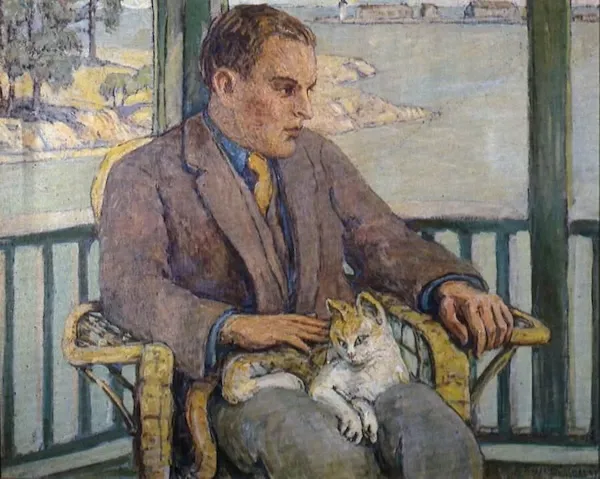
F. O. Matthiessen with Pansy Littlefield, painted by Russell Cheney, 1926. Photo: russellcheney.com.
F. O. Matthiessen, who was a professor of history and literature at Harvard from 1929 to 1950 and a seminal figure in raising the profile of American literature, would have endorsed university presses’ role in expanding what counts as literature and thereby strengthening communities of readers. Matthiessen was no stranger to university presses himself: his landmark 1941 study of American literature, American Renaissance: Art and Expression in the Age of Emerson and Whitman, was published by Oxford University Press. In that book, Matthiessen writes: “The true function of scholarship as of society is not to stake out claims on which others must not trespass, but to provide a community of knowledge in which others may share.” In an increasingly atomized twenty-first-century United States, the books that university presses publish provide a vital public service by creating the shared community of knowledge that Matthiessen envisioned.
Scott Bane is the author of A Union Like Ours: The Love Story of F. O. Matthiessen and Russell Cheney.
Tagged: A Union Like Ours, American literature, F. O. Matthiessen, LGBTQ history, New England, Russell Cheney, University Press Week, University of Massachusetts Press, literary history, publishing, scholarly publishing