Poetry Review: “Those Who From Afar Look Like Flies,” Tome II — Read Them Twice
By Igor V. Satanovsky
In the second half of a two-tome bilingual anthology of Italian poetry, Igor V. Satanovsky tests his theory of Quantum Poetics on the English pages, where a poem’s last line can change what its first lines mean.
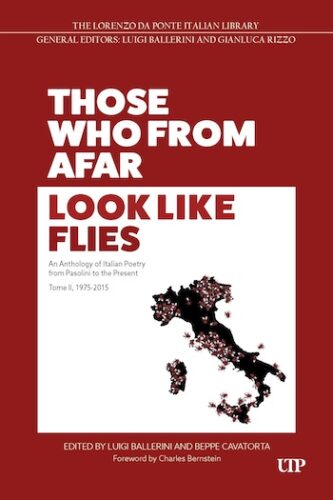
Those Who From Afar Look Like Flies: An Anthology of Italian Poetry from Pasolini to the Present, Tome II (1975–2015), two volumes, edited by Luigi Ballerini and Giuseppe Cavatorta. University of Toronto Press, 2026, 2,120 pages, $250.00.
Note: This review grew out of a paper I read at Luigi Ballerini’s invitation at the launch of Tome II, held November 12 at NYU’s Casa Italiana Zerilli-Marimò.
 Giuseppe “Beppe” Cavatorta died in Tucson on October 10 at 62, a month before the second tome of this anthology was launched. He taught Italian at the University of Arizona, and he and Luigi Ballerini had been building the anthology for two decades. Tome I, from Pasolini to 1975, came out in 2017. Tome II arrives in two volumes: the first runs from the 1970s through the 1990s, and the second holds the new millennium. The greatest anthologies serve as the highways of poetry: they carry poets across decades and languages. Luigi and the late Beppe Cavatorta deserve a salute for building this one.
The title paraphrases the last category of animals in the Chinese encyclopedia that Jorge Luis Borges cites in “John Wilkins’ Analytical Language”: those that from a distance look like flies. It’s a sardonic comment on how invisible Italian poetry has been to the American public. The cover of Tome II visualizes the joke: a black map of Italy covered with flies. From afar, as the title says, the Italian poets look like flies, and from afar, over two thousand pages and forty years, you can see the whole map.
Did the experiment begin in language, or did it have to reach reality? Pasolini fought the neo-avant-garde over that question for the rest of his life. The poets kept crossing and re-crossing the lines they had drawn, and new camps kept forming around the sign, the I, and the media. Tome II names the result in a section title: “The Permanent Spell of the New.”
From above, the camps share one thing. They fought over what poetry should be about, yet left the poem itself where it was: a thing made of language, pointed at the world or at itself. In 1965, the critic Fausto Curi wrote that we do not have to ask poetry what it is, only what it does. The new poetry, he said, “recognizes its own being in its own operation”; it “knows it is not an ontology but a function.” What if the operation is the ontology? And where does it happen?
Quantum Poetics, the theory of the poem I’ve been developing, begins with those questions. A poem is what happens, each time, between the page and a reader. It is an event. A line can hold more than one state until a reader selects one. Every reading leaves a trace. A later line can change what an earlier one was able to mean, so the first reading never returns. Put simply, a poem is unstable. That instability is the ontology, and the poetics follows from it.
Language has always done these things: it shimmers, it doubles, it reverses on you. Quantum Poetics names these behaviors and gives each one a test, so that, as I put it in my book, they can be practiced deliberately rather than stumbled into.
I don’t read Italian. I read the facing pages, which this anthology was built for: Italian on the left, English on the right. The difference between them is a translator’s reading.
I ran three tests on Tome II: one for re-timing, one for ghosts, one for shimmer. I’ll explain each name when we get to it. Here is Valerio Magrelli’s poem, in Jamie McKendrick’s translation.
Poetry
Poems always have to be reread,
read, reread, read again, recharged;
every reading energizes them —
they’re machines to recharge sense,
and meanings gather in them, a buzz
of particles that lie in wait,
withheld sighs, clicking and ticking
inside the Trojan Horse.
Now read the middle again:
they’re machines to recharge sense,
and meanings gather in them, a buzz
of particles that lie in wait,
withheld sighs, clicking and ticking
The horse isn’t in those lines, and you saw it anyway. The change happened the first time you read them, at the last line. Until “the Trojan Horse,” you read “poems” as “machines to recharge sense,” and you would have read them that way every time. Then the horse arrived, and the charge became an ambush of meanings. The one they are waiting for is the reader. That is re-timing: the last line changed what the earlier lines were able to mean. The device is as old as the epigram. What Quantum Poetics adds is the test: after the last line, can you still have the first reading? You just took the test. The first machine didn’t come back.
This poem comes from a book whose poems take their titles from the sections of a newspaper. Remember newspapers? We used to read them once and throw them away. But Magrelli says that poems must always be reread, and the verse proves it by how it behaves. Still, Magrelli belongs to no avant-garde. An essay in the tome places him in Montale‘s line, among poets who set the 1960s Italian avant-garde aside as a relic. The test runs across that divide, and it works on the avant-garde’s arch-enemy too. In Pasolini’s late poem “At First Phatic and Later Emphatic Verses,” translated by Ballerini, Cavatorta, and Stephen Sartarelli, Ezra Pound and the Soviet dissidents Andrei Sinyavsky and Yuli Daniel chat about the weather. The old Pound drops two Chinese characters into his small talk, as if he were still trapped inside his Cantos. It rained until Easter, and the nights are cold, “strange, in Siberia.”
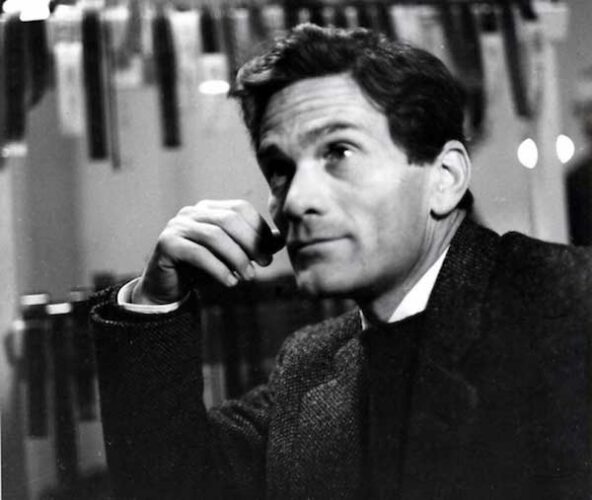
Italian poet, novelist, filmmaker, and Marxist intellectual Pier Paolo Pasolini in 1964. Photo: Wikimedia Commons
Pasolini, a Marxist, seats the American poet who embraced fascism beside two Soviet dissidents, and the political lines blur. Pound begins to look like a dissident serving time in Siberia. After Pound’s first Chinese character, Pasolini stops naming the speakers, and we can no longer tell who is saying what. Someone says, “We got used to it.” Someone says, “We have nothing to offer you.” Is it Sinyavsky and Daniel? Is it Pound, in the royal “we”? Or is Pound speaking for all three to a figure about to appear? If so, the effect comes before the cause: they answer him, and then he arrives.
He is a shadow, a dead man going home to a mother who won’t recognize him. “I left my bones on the Ussuri shores,” he says. The Ussuri runs along the Soviet–Chinese border, where the two armies fought in 1969, and we can’t even tell whether the ghost is Chinese or Soviet. Then he adds, “without renouncing my ideal!” A victim of Realpolitik is a ghost who still carries the ghost of an ideal. After he speaks, the small talk about the cold can never again sound like small talk.
The editors read the poem alongside a sentence printed on the cover of every Italian edition of I Novissimi since 1965. That anthology gathered the poets Pasolini fought against. The sentence says that those who write a poem (and thus also those who, in reading it, rewrite it) experience all the possible ambiguities and the inclusiveness of language. The Novissimi came closest to understanding the reader’s full role. I take their sentence literally.
Pasolini places other writers inside his poem. Corrado Costa puts the reader inside his. “Identify Seven Mistakes in the Same Film Seen Twice in a Row,” in Paul Vangelisti’s translation, lists what changed on the second showing of a sexy flick, beginning with diminished passion. Number six sits in parentheses: “His member seemed shorter to me.” To me. The joke hides a shift. The observer has joined the list of mistakes and become part of the poem’s apparatus, even though the title insists it is the same film. By number seven the furniture has changed, and a woman loses a shoe, then a finger, an arm, her legs, until “there’s nothing more to see.” The movie itself becomes a ghost.
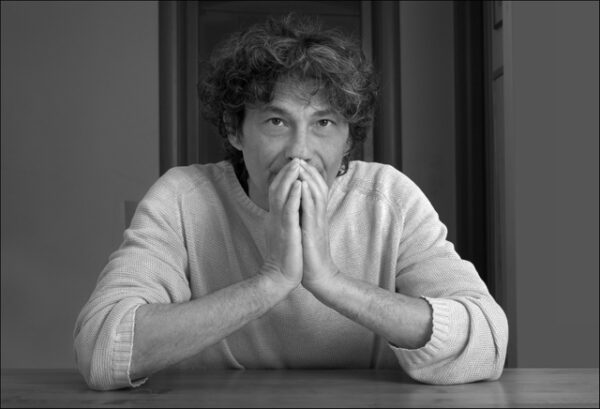
Italian poet Biagio Cepollaro. Photo: courtesy of the artist
The anthology is full of ghosts: poems full of ghosts, words full of ghosts. I call this Ghost Semantics: a second word surfaces inside the first, and both stay alive. The translators expose these apparitions. Biagio Cepollaro, of the avant-garde Gruppo 93, splits a word with a slash in “In Cezanne’s Studio”: confusa/mente on the left-hand page. His translators, Ballerini and Cavatorta, split their English the same way: “mix/mindedly,” which reads as mixedly and mix-minded at once. Marco Giovenale, in the New Millennium section, writes denti/ridenti: “teeth” inside “smiling,” as a dictionary tells me. His translator, V. Joshua Adams, coins a word to keep the nesting: “miling/smiling.” Charles Bernstein’s foreword lists “transcreations” among the anthology’s offerings, and these are two. Each translator runs the poet’s operation again in English. The words don’t survive the crossing; the operation does. An operation that can be run again is what I call a protocol.
The poet who pushed the doubled word furthest belonged to no camp. Emilio Villa misdated his poems on purpose, so they resist dating. So Tome I filed him under three headings: “Research Poetry Unlabeled,” “Flashback,” and “Flash-Forward.” Tome II gives him thirty pages and names him first in its dedication, beside Elio Pagliarani. In “poetry is,” translated by Dominic Siracusa and Gianluca Rizzo, poetry is “life penalty, release / on one’s word, liberté sur parole.” To an English ear, parole is a prison word: release before the sentence ends. In French, and in the Italian parola on the facing page, it simply means “word.” The line therefore holds two freedoms at once. One is conditional: out on parole, serving a life sentence. The other is absolute: freedom in the word itself. Neither reading releases the other. I call that shimmer.
The second volume sets a harder test of re-timing, this time across eight centuries. Alba Donati’s “Grief on the Destruction of Beslan,” translated by Richard Dixon, recounts the 2004 school siege in forty-three numbered sections: red handprints on the blue heating pipes, a child’s instant noodles left on the floor, fifty thousand rubles for each of the dead. Then, without warning, the register changes: “Anyone riding towards the land of Beslan / will find it emptied / the city destroyed / the school in ashes.” The language describes an emptied city, yet the catastrophe we have been reading about happened in a school. These lines seem to belong to another act of destruction. A coda follows, dated “3 September 2004, 11.00 – Beslan.” Donati was under anesthesia in surgery while the school gym was being blown up, so the poet enters the event at the moment she could observe nothing. That night she dreams of God, who “seemed a Russian writer, one from another time.” Only then does a note disclose the sources: a journalist’s reports from Beslan and an anonymous Russian account of Ryazan, destroyed by the Mongols in 1237. Go back to the rider. The destroyed city was Ryazan, and Beslan now stands in its place. Even the Russian writer in the dream may have a second identity. Donati says she borrowed the journalist’s eyes to “write what is already written.” The poem has three observers, one of them eight centuries old, and the one who signs it was asleep.

Poet Alba Donati. Photo: Leonardo Pasquinelli
Donati’s poem is the second in a section called “Poetry with History in It.” The first is the editor’s own: an excerpt from Ballerini’s Cephalonia (2005), a prize-winning book-length poem on the 1943 massacre of Italian soldiers on the Greek island, translated by Evgenia Matt. I don’t see an editor’s presence in his own anthology as a problem. He is an observer and arranger who steps into his own apparatus and shows you where he stands. Ballerini’s first speaker is a dead Italian soldier who gives two versions of his death, “wandering, unburied,” a close relative of Pasolini’s ghost from the Ussuri. The poem shows what the selector values. It also accounts for part of what my tests found: an editor who writes this way chose these poems.
The tome’s apparatus gives you more positions. Bernstein’s foreword comes first: “poetry is what is found in contradictions.” Critics are printed beside the poets: Antonio Loreto on Costa, Cecilia Bello Minciacchi on Villa, Dixon on Donati. The appendices carry the argument past the poems. They include Marjorie Perloff on Italian and American poetry at the millennium, Andrea Cortellessa’s “The Nightmare of the Novissimi,” and, last, Primo Levi’s “The Versifier,” a short play about a poet who owns a machine that writes his verse. Its final line is: “The text you have just heard, for example, was composed by the Versifier.” One sentence, and everything before it changes hands.
Levi wrote the play in 1960, and Pasolini’s poem appeared in 1971. Both dates fall outside the tome’s declared range: the editors break their chronology when the larger picture needs it. They time-travel. The tome stops at 2015 and arrives in 2026, but Levi’s sentence is on time.
What are we to make of the Flies, both tomes together? They are rare: sixty years of another country’s poetry with the poets’ wars left in. They matter to poetry lovers well outside Italy. Alas, at $250 for Tome II alone, most of those readers will have to find the book in a library.
The wars left camps. The editors need them to organize their history, even as their selections keep undoing the boundaries between them. The behaviors my three tests found cross those boundaries. Each was one poet’s invention, and together they were scattered across camps and decades with no common frame. Quantum Poetics labels them and gives them back to poets as creative protocols.
The permanent spell of the new lifts, because the new happens in the event. I don’t read Italian, but even I can see the new in one of its words for “again”: di nuovo, “of new.” A poem written for the reading is new every time it is read, and it needs no new school for that.
I found my own questions on the anthology’s right-hand pages. The largest is the one Curi set aside: what is a poem?
In “poetry is,” Villa left one more word held in two states on both pages — In(de)terminato on the left, In(de)terminable on the right.
Indeterminable until a reader arrives.
Interminable, because the next reader opens it again.
Until then, it’s not even a poem.
Igor V. Satanovsky is a Kyiv-born poet, translator, artist, and book designer, and the author of ten poetry collections. He co-hosts the Quantum Age Poetry reading series at the Stavros Niarchos Foundation Library (NYPL). His essay on Quantum Poetics appeared in the spring 2026 issue of BlazeVOX, and he has recently completed a book on the subject. He lives in New York City.
Tagged: Giuseppe Cavatorta, Igor V. Satanovsky, Italian Poetry, Luigi Ballerini, Pier Paolo Pasolini, Quantum Poetics, bilingual poetry, book-reviews, poetry anthologies, poetry in translation