Visual Arts Review: Louise Giovanelli — The Artifice of Looking
By Margherita Artoni
At White Cube Mason’s Yard, “In the Light of False Suns” turns theatrical light, wigs, and cinematic gloss into a study of how we project onto images.
Louise Giovanelli: In the Light of False Suns, at White Cube Mason’s Yard, 25–26 Mason’s Yard, London, through January 2027.
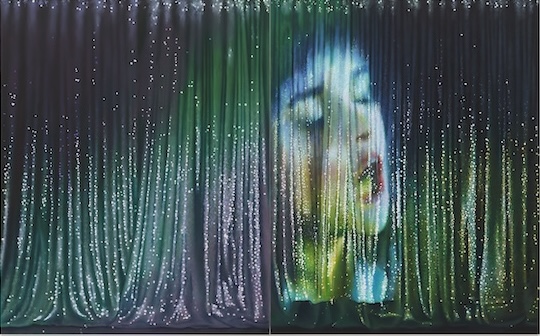
Louise Giovanelli, Ad Astra, 2026. Photo: © White Cube/Theo Christelis
Painting invites a peculiar kind of belief. Viewers see the artifice of a constructed scene, yet respond to its power to evoke an experience beyond the canvas. Louise Giovanelli works in this gap. She takes familiar visual motifs and transforms them through subtle shifts in scale, illumination, and material treatment. Her paintings ask how images generate emotional force and how perception shapes their meaning.
At White Cube Mason’s Yard, In the Light of False Suns takes its title from parhelia. In this atmospheric phenomenon, sunlight refracts through ice crystals and produces bright spots on either side of the sun. These apparent duplicates add a second source of light through optical displacement, which makes them a fitting frame for the exhibition’s interest in mediated illumination. The presentation at White Cube links the phenomenon to cinema, theatrical spectacle, and religious imagery, all of which bear on the show’s theme of visual seduction.
In Ad Astra (2026), a two-panel oil on linen, a woman’s face with closed eyes and parted lips is superimposed on curtains lit by theatrical light. Psychological intimacy meets public display. The face suggests an inward state, while the glowing drapery evokes a stage waiting for its performers. The scene wavers between private reverie and public spectacle.
This setting infuses the image with a quiet sensuality. The closed eyes rule out any exchange of looks, while the parted lips hint at vulnerability. The painting captures the moment before an appearance, when anticipation starts to shape the viewer’s response. Its erotic undertone is restrained, emerging through gesture, atmosphere, and the closeness of face and curtain.
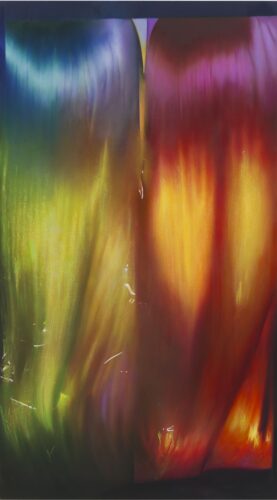
Louise Giovanelli, Media Luna, 2026. Photo © White Cube /Theo Christelis
This arrangement recalls Laura Mulvey’s 1975 essay “Visual Pleasure and Narrative Cinema,” which analyses how film structures looking and positions its spectators. Giovanelli takes up a related question through the stillness of painting. Her figure’s face is offered to view, but its expression stays out of reach. The image invites projection while protecting the figure’s psychological privacy, and that unsettles the usual relationship between the displayed subject and the viewer.
In Media Luna (2026), Giovanelli returns to a long-standing subject: wigs and the visual complexity of hair. The work extends earlier pieces and series, including Axis, Equator, and Plexus. Two wigs fill a large vertical canvas. Vivid color and reflective passages form a surface where recognizable forms are pulled into visual instability. Contours seem to fluctuate within the surrounding color fields, which emphasizes the line between representation and abstraction.
Wigs suggest disguise, transformation, and performed identity. Detached from the wearer, they evoke a character whose body lies outside the frame. The costume’s cultural meanings give the work a theatrical dimension, and the absent wearer becomes an imaginative possibility that extends the subject beyond the depicted objects.
Giovanelli’s practice sits alongside that of several contemporary painters who explore the psychological and formal possibilities of figuration. Lynette Yiadom-Boakye paints figures whose interior lives resist narrative explanation. Michaël Borremans builds enigmatic situations from tightly controlled compositions. Rita Ackermann moves between figuration and abstraction, and her expressive gesture unsettles the legibility of the human image. Together, these comparisons place Giovanelli within a wider discussion of how contemporary painting complicates our understanding of representation.
The exhibition’s focus on cathexis, the investment of psychic energy in a person, object, or idea, adds another layer. In Ad Astra, that energy gathers around the face and its elusive expression. In Media Luna, it attaches to objects of appearance and identity. The concept explains the psychological charge of both paintings by tracing the associations that build up around their subjects.
Material technique shapes the visual character of both works. Giovanelli’s glazed, reflective passages recall celluloid film and reinforce the cinematic associations identified in the exhibition materials. Surface distortion and digital breakdown introduce moments of disruption, yet the physical properties of oil on linen remain perceptible beneath them, which gives the paintings a tactile presence. Their surfaces bring the visual language of moving images into contact with the slower temporality of painting.
The two works take distinct approaches to representation. Ad Astra centers on the psychological distance between the spectator and an inward-looking figure. Media Luna examines how color, reflection, and abstraction transform familiar objects. These formal differences are characteristic of the range of Giovanelli’s investigation into the emotional and associative life of images.
The exhibition’s title, “false suns,” puts these concerns in sharp relief. A false sun gives off real light, yet the light seems to come from somewhere else. Giovanelli’s work probes the line between recognition and projection, between what we see and what we bring to it. It asks us to look in a way that opens onto possibilities beyond the visible image.
Margherita Artoni is a contemporary art critic and curator working between Italy and the United States. She began her career collaborating with Flash Art and currently writes for Segno, Juliet, Artribune, Exibart, Inside Art, ArteIN, part of cult(ure), The Arts Fuse, and Whitehot Magazine.
She has directed galleries in Turin — including NEOCHROME and EDGE Art Space — and in New York at TEAM Gallery. Her curatorial work has included exhibition programs with international artists such as Rashid Johnson, Theaster Gates, Ali Banisadr, Angel Otero, Tim Rollins & K.O.S., Laura Owens, and Mika Tajima.
Tagged: Ad Astra, Cathexis, Cinema and painting, Contemporary painting, Exhibition review, Figuration, In the Light of False Suns, Laura Mulvey, Louise Giovanelli, Media Luna, Spectatorship