
Theater Review: “Rooted” at Portland Stage — Stuck Up a Tree
By Martin B. Copenhaver
Deborah Zoe Laufer’s script reaches for big ideas but finds its strongest footing in fine performances and the simple longing for connection.
Rooted by Deborah Zoe Laufer. Directed by Lisa DiFranza. Staged by Portland Stage, Portland, ME, through November 22.
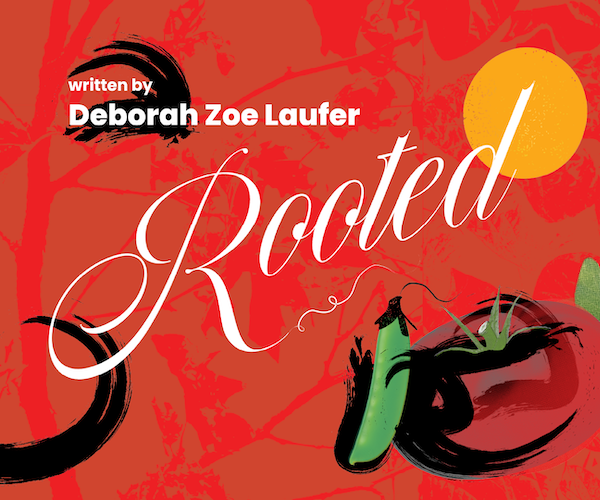
Rooted is a small play with some big ambitions. Playwright Deborah Zoe Laufer aspires to explore a wide range of issues: the power of the internet to create faux community and foster groupthink; the epidemic of loneliness that infects our culture; the appeal of parasocial relationships; and climate crisis and our place in the natural world. The play also asks us to consider a new question (at least to me): Are plants sentient beings?
That is a lot to take on in a 90-minute play with just three characters. The aspirations are impressive; the results, less so.
Emery (captured in all her frenetic quirkiness by Lisa Stathopolos) has lived by herself in a treehouse she named Mabel for a dozen years. She is surrounded by plants. They are her loved ones. She never leaves the treehouse; hers is an entirely hermetic life. Emery does, however, conduct experiments, streamed over the internet, to determine whether plants can learn and communicate, and she is beginning to cultivate a following.
Emery’s only human connection is with her sister, Hazel (Grace Bauer), who visits on a regular basis and brings her sister food. Hazel, who is dissatisfied with her own small-town life, dismisses Emery’s streams as “the new cat videos.”
Although Emery seems delighted with her growing number of “followers” on the internet, she is unnerved when a large group of them show up at the base of the tree in which she lives. It is one thing to be an influencer and something quite different to encounter those you have influenced. What happens when distance is breached and the people who used to reside only on the screen become the people outside your home?
The crowd, which remains offstage, becomes something of a fourth character in the play. They are not a Greek chorus commenting on the action of the play. Rather, they react to the action with the indistinct sound of a madding crowd. The aural portrayal of the crowd benefits greatly from the work of the sound designer, Seth Asa Stengel. Although very few of the crowd’s words are distinguishable, Stengel is able to give their wordless expressions meaning and even nuance.
Through the pleadings of the crowd, it becomes clear that they view Emery as something of an oracle who is capable of healing. When one of the crowd, a sweet and naïve young woman named Luanne (Sarabell Wigley), infiltrates the treehouse, all three characters must adjust their assumptions about how to be in the world.
The three actors are excellent—both individually and as an ensemble—which is a good thing because they make the weaknesses of the script less glaring. We are told nothing about why Emery ended up in a tree and precious little about why Luanne ended up there. Only Hazel, who litigates her grievances about her own life as if she were delivering a closing argument, approaches being a fully formed character.
The set, designed by Anita Stewart, is cluttered and quirky in a way that reflects Emery’s character well. The props, particularly the animated ones, are given improbable star turns at key moments.
The play is at its stongest when it is not trying to take on Big (with a capital “B”) issues, when it speaks to the simple and powerful longing for connection—in the crowd, in an online “community,” perhaps even with plants and, ultimately, with another human being.
P.S. The character of Emery is so wacky, and the phenomenon she is exploring—the sentience of plants—is so seemingly off-the-wall that we might dismiss it as a mere narrative conceit or a touch of magic realism. In fact, the play draws on scientific studies conducted by ecologist Monica Gagliano, whose research indicates that, under some circumstances and in limited ways, plants can learn and communicate. Is she a visionary or a nut job? I am quite sure the author of Rooted would not want us to answer that question too quickly.
Martin B. Copenhaver is a retired pastor and seminary president who lives in Woodstock, Vermont, and Cambridge. Once upon a time, he studied theater criticism with Stanley Kauffmann.
Tagged: "Rooted", Deborah Zoe Laufer, Human Connection, Loneliness, Maine theater, Parasocial Relationships, Plant Sentience, Portland Stage