
Concert Review: Beat Marches to a Different Drummer at the Wang
By Paul Robicheau
With Terry Bozzio replacing Danny Carey, the King Crimson offshoot expands its repertoire and lets its guitars roam, but finds mixed results in the rhythm.
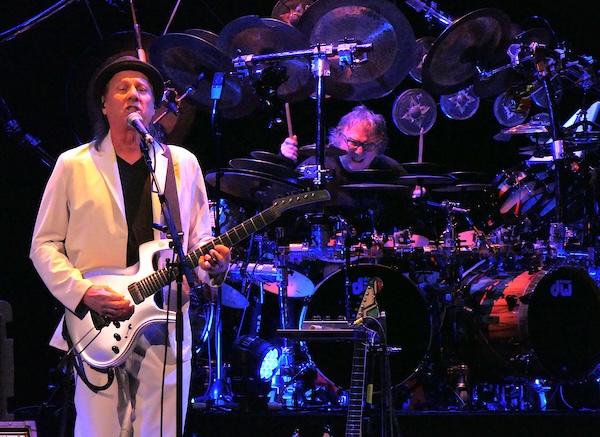
Adrian Belew and Terry Bozzio of Beat at the Boch Wang Theatre. Photo: Paul Robicheau
King Crimson came and went through decades of music and lineup changes under the direction of guitar guru Robert Fripp, the prog-rock institution’s sole constant. So why shouldn’t it come to pass that Beat—a likewise virtuosic offshoot featuring two Crimson alumni and blessed by the retired Fripp—would evolve a little as well, at least in repertoire?
Specifically, Beat sought to perform music that guitarist/singer Adrian Belew and bassist Tony Levin played in the group’s three-album 1980s incarnation. Rounded out by Fripp-endorsed guitarist Steve Vai and Tool drummer Danny Carey, Beat packed the Boch Shubert Theatre in 2024 but returned this past Friday with a jump to the Boch Wang Theatre, twice its size, yet sold only about half as many seats.
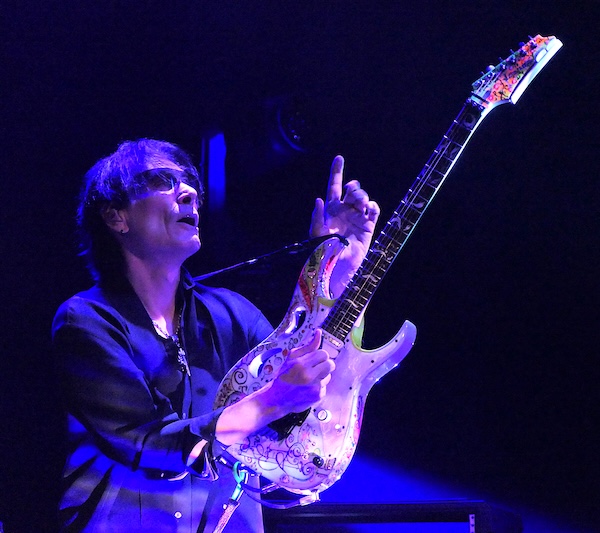
Steve Vai of Beat at Boch Wang Theatre. Photo: Paul Robicheau
Beat fatigue? Or was it the fact that Carey (one of the few drummers talked about as a viable heir to the late Neil Peart in Rush) passed on Beat’s supposed final U.S. tour to refocus on Tool? His hot seat was filled by onetime Frank Zappa/Missing Persons drummer Terry Bozzio, who clearly lacks Carey’s contemporary cachet.
In addition to that big personnel change, Beat dropped four songs from its 2024 tour and added three from 1995’s heavier Thrak, on which Belew and Levin were part of a double trio. The first, “Dinosaur,” was an ironic opener for an ever-older rock outfit (Belew is now 76, while the seemingly ageless Levin is the eldest member at 80).
“I’m a dinosaur, somebody is digging my bones,” sang Belew, who made his guitar roar and whine like a mythic beast. Then he blew a whistle to launch “Neurotica,” a sonic traffic jam beneath his prerecorded ramble that fit the title. Bozzio plied shifty beats at his fortress of percussive playthings before leaning into the groove of “Neal and Jack and Me,” while Vai and Belew locked into a lattice of guitar lines.
Ah, let’s consider Bozzio and his self-described “sick jazz kit” (actually scaled down from his usual setup, which is better suited to solo clinics). His monster battery boasted three bass drums, a dozen chromatically tuned toms, an overhead arc of china cymbals, layers of bell cymbals, and a smattering of Thai gongs to the rear.
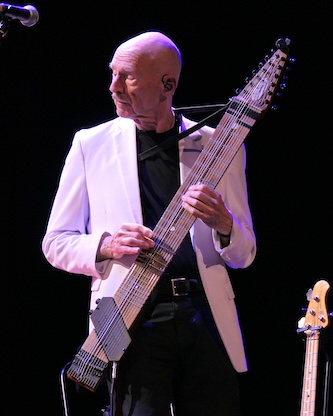
Tony Levin of Beat at the Boch Wang Theatre. Photo: Paul Robicheau
Sure, Bozzio used his collection to advantage on a few songs, primarily the second-set closer, “Indiscipline,” which began with a five-minute solo in which he spread pinpoint rolls and double-fisted pummels between the drums and upper cymbals. But for most of the show, he really didn’t need all that stuff, especially when playing fairly straight rock beats between his snare and a hi-hat cymbal stack. The drums were also poorly mixed at the Wang, with some tones blurring into flurries of flat thuds (the kit sounded better in a more spirited Saturday show at the Hampton Beach Casino Ballroom).
On the first Beat tour, Carey and Vai were more reverential toward their predecessors in the ’80s quartet, Bill Bruford (a model of drumming finesse) and Fripp. Vai still echoed Fripp’s processed tone at times at the Wang, notably in his rubbery initial lead line to “The Sheltering Sky,” still the show’s stunning centerpiece, with Bozzio returning to a log drum like the one Bruford used for its minimalist pulse.
Yet Vai and Belew took a looser team approach, expanding that instrumental to 17 minutes with improvised trade-offs and pushing every trick beyond the book, with sonic snatches ranging from whammy-bar quivers to trebly headstock swipes. Then Vai brought his own flamboyance to the table, from snake-charmer speed runs and demonic dive-bombs to lifting and waving his guitar by the whammy bar as he swooped into a feedback ritual (he got more carried away at Hampton Beach).
The jovial Belew more than held his own as the resident sculptor of those 1980s and ’90s Crimson albums. In a menacing “Industry,” Belew manipulated eerie sounds from his guitar podium to the point that he flinched as if startled. He also showed he could convey a dreamy ballad on the gorgeous “Matte Kudasai” (rubbing strings with an overhand slide) and the Beatlesque “Walking on Air.” The latter floated the lullaby intro “Close your eyes” and, along with the perkier grind of “People,” rounded out the night’s Thrak inclusions. “People” was stoked by Levin’s drumstick-like “funk fingers” on bass.
But Brookline native Levin left the biggest impressions from his side of the stage on the guitar/bass hybrid Chapman Stick, from his rubbery fingering in “Sartori in Tangiers” to loopy note slides in “Elephant Talk.” The latter was also a showcase for frontman Belew, who drew stylistically from his pre-Crimson stint in Talking Heads.
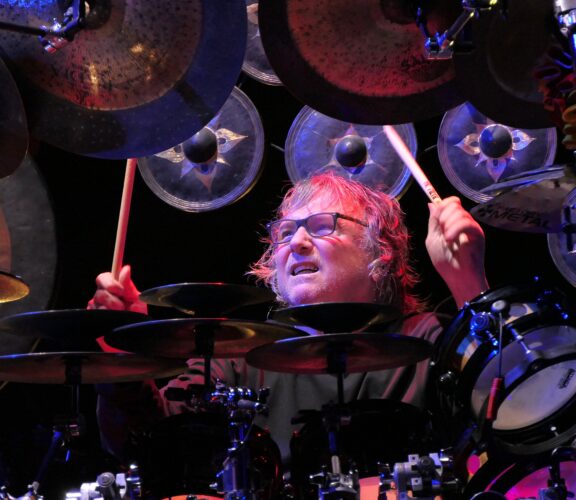
Terry Bozzio of Beat at Boch Wang Theatre (c) 2026 photo Paul Robicheau
Everybody in the band but Levin also apprenticed with Zappa, so perhaps it was appropriate to replace the ’70s Crimson warhorse “Red” with Zappa’s Belew-sung “City of Tiny Lights” to start the encore, even if it seemed a bit off-script and less than remarkable.
Otherwise, the show was similar in repertoire to Beat’s 2024 tour, particularly in the second half. Bozzio and Belew came face-to-face for the interwoven percussion prelude of “Waiting Man.” Given its deceptively complex gears, “Frame by Frame” suffered from Bozzio’s simpler, more lumbering beat, before the drummer redeemed himself within the chaotic folds of “Indiscipline.”
In that song, Belew teased the audience as a creator wondering whether he still liked a work of art. After one fake-out toward the mic, he exclaimed, “I did!” And even though this wasn’t King Crimson or the Carey-honed Beat, fans likely agreed with that statement.
Paul Robicheau served more than 20 years as contributing editor for music at the Improper Bostonian, in addition to writing and photography for The Boston Globe, Rolling Stone, and many other publications. He was also the founding arts editor of Boston Metro.
Tagged: Adrian Belew, Beat, Bill Bruford, Boch Shubert Theatre, Boch Wang Theatre, Boston, Danny Carey, Frank-Zappa, Hampton Beach Casino Ballroom, King Crimson, Progressive Rock, Robert Fripp, Steve Vai, Terry Bozzio, Thrak, concert review, live music