
Theater Review: “An Addition of One” — An Imagined Encounter Between JFK and Jamie Wyeth
By David Greenham
At Maine’s Waldo Theatre, Shannon A. Mullen plays both men in an engaging world premiere that hints at deeper possibilities for exploring art, privilege, and truth.
An Addition of One, written and directed by Shannon A. Mullen. Technical direction by Eddie Holm. Produced by Jeff Wiseman and the Waldo Theatre, in partnership with Broad Reach Production. Performing at the Waldo Theatre in Waldoboro, Maine, through November 22.
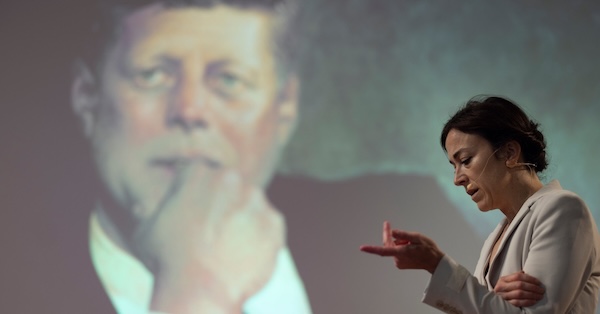
Shannon A. Mullen performing An Addition of One. Photo: Dina Rudick.
In 1966, twenty-year-old Jamie Wyeth was approached by John F. Kennedy’s family to paint a portrait of the late president. He declined the commission: He wanted the freedom to destroy the painting if it failed to satisfy him. Instead, with the support of Kennedy’s widow, Jackie, and his brothers, Bobby and Ted, he agreed to paint an unofficial portrait.
Wyeth immersed himself in film and photographs, even persuading JFK’s brothers to sit for sketches, as he sought to understand the president’s private character. “I wanted the President’s face so engraved on my mind that I could place him in any situation I wanted,” he said at the time. Eventually, he began imagining visits from Kennedy. Now 80, Wyeth still recalls envisioning a limousine outside the Chadds Ford, Pennsylvania, studio he shared with his father, Andrew.
That imagined encounter is the premise of An Addition of One, a one-act play by writer, journalist, and film producer Shannon A. Mullen, developed through conversations with Wyeth and research into Kennedy’s private life. In its world premiere production (there was an earlier workshop staging), Mullen, who also has a theater background, performs both roles, taking inspiration from solo artists such as Anna Deavere Smith.
An intense but polished JFK arrives at the studio and notes the irony of the sign outside: “In my house we shoot intruders.” Nervous and astonished, Wyeth welcomes him with unmistakable admiration. What follows is a 45-minute exchange between two sons of privilege at opposite ends of their careers.
Kennedy is unflappable as he explains that his older brother, Joe, was supposed to carry the family’s political ambitions. When he died in a wartime plane crash, that responsibility fell to JFK. He is curious about Wyeth and his father, despite the elder painter’s Republican leanings. Their conversation touches on Nikita Khrushchev, which supplies a welcome flash of humor when Wyeth suggests that the Soviet leader resembles Kennedy’s father, Joseph.
There are few revelations in this imagined “chin wag,” as Kennedy calls it, but there are poignant moments. The president is particularly interested to learn that Wyeth has spoken with Kirk “Lem” Billings, his closest boyhood friend. Billings’ homosexuality was among the secrets protected by the Kennedy White House. Kennedy acknowledges that his friend had a room there and frequently served as a companion and behind-the-scenes organizer. When the conversation turns to considerations of sexuality, however, he changes the subject.
Kennedy, not the painter studying him, drives the encounter, probing the young artist’s life and process. Wyeth, meanwhile, acknowledges the awkwardness of the undertaking. “I’m not sure anybody likes their own portrait,” he says with a laugh.
The painting that emerged from Wyeth’s efforts divided critical and popular opinion when it was unveiled in 1967. Some viewers thought it made the president look too vulnerable. Jackie Kennedy loved it. The picture has now become one of the most recognizable images of JFK– it is part of the collection of Boston’s Museum of Fine Arts.
The Maine production, staged near Wyeth’s home, is spare: a Windsor chair, an easel, and a wash of light that throws shadows across an otherwise bare stage. In a striking off-white pantsuit, Mullen distinguishes her characters through subtle shifts in posture and speech. After Kennedy departs, Wyeth takes his sketch pad from the easel and begins to draw as the finished portrait slowly appears on an upstage screen.
Well-written and engaging as it is, An Addition of One would benefit from a dramatic and thematic expansion. Its conversation is concise and tightly focused—perhaps too tightly. What does this president notice in a painter’s studio? What unsettles him? What interrupts the practiced composure of either man? A detour or two from the familiar would give these characters more room to surprise each other — and us.
Writer Mullen is credited as the director. The play’s exchange of ideas might become a fuller theatrical encounter if the artistic team were extended, bringing in alternative perspectives. For example, the richest possibilities may lie less in revisiting Kennedy’s secrets than in probing Wyeth’s process. The protective silence of the Kennedy-era press corps and the president’s infidelities are familiar territory. More compelling is the young painter’s dilemma: how to see a revered figure clearly, and how to paint what he sees rather than deliver how others want the president memorialized.
At one point, Kennedy himself points toward that deeper drama. “We need artists to show us the unromantic truth that humanity can serve as our greatest strength and our greatest weakness,” he tells Wyeth. “Seems to me that you’re reckoning with what’ll happen to you if you keep telling the truth. I would urge you to consider what would happen to us if you don’t.”
David Greenham is an arts and culture consultant, adjunct lecturer on Drama at the University of Maine at Augusta, and is the former executive director of the Maine Arts Commission. He can be found at https://davidgreenham.com/
Tagged: An Addition of One, Art and politics, JFK, Jamie Wyeth, John F Kennedy, Maine theater, Shannon A. Mullen, Waldo Theatre, Waldoboro, one-act play, portraiture, solo performance, theater review