Book Review: “The Black Shield” — A Family’s Reckoning with Policing and Power
By Bill Littlefield
Wilbert L. Cooper examines the paradox of Black police officers seeking safety and status inside an institution shaped by racial violence.
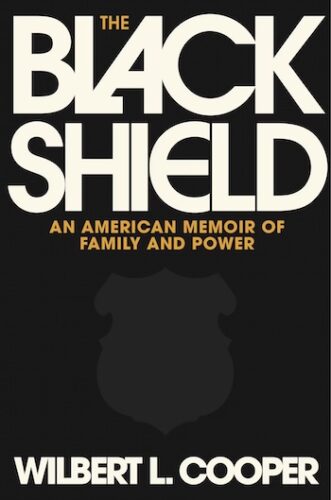
The Black Shield: An American Memoir of Family and Power by Wilbert L. Cooper. Farrar, Straus and Giroux, 400 pages, $32.
Many of Wilbert L. Cooper’s family members, including his father and his mother, found that working as police officers was a way to live comfortably as Black folks in this country, at least as regards economic security. But Cooper began to have doubts. He was growing up in a land where Black folks are shot and killed by police officers at a far greater rate than their white counterparts; a land where Black men and women are arrested and incarcerated in numbers that make no sense unless you take into account persistent, vicious, and deadly systemic bias against them. Cooper began to question how his parents and the other members of his family who joined the police force reconciled their positions of authority with the daily business of the organization that paid them: the harassment, targeting, arrest, conviction, and incarceration of members of their community.
In one conversation, Cooper’s mother explains that, after the Cleveland police department was forced by law to begin hiring Black candidates, she saw an opportunity to free herself from a husband who was beating her and endangering their children. She also believed that police work served a vital need: it was a means of protection for “those that have from those that don’t. It came about when you had people who owned things and people who didn’t own nothing. We — the police — are the ones who can stop those that don’t have anything from taking what’s yours, what you’ve worked for, what you’ve earned.”
Cooper understands these points. How can he not? He’s grown up in relative comfort and attended good schools because his parents have been able to afford to leave the neighborhoods where he might have been robbed of his lunch money, sucked into a gang, or shot by the police. Still, he says, “I want to tell Mom that in the beginning it was slavery that begat our policing.” One of the “things” owned by the “people who owned things” was other people. When those people tried to escape enslavement, the police brought them back, dead or alive.
Cooper’s journalism has appeared in The Guardian, The New York Times, and The Marshall Project. His writing in this, his first book, is clear, compelling, and fearless. Cooper’s examination of his own family’s history in policing draws on interviews with, and about, such characters as his great uncle Lloyd. The official story was that Lloyd joined the force because of the prevailing wisdom that more Black police officers would mean less brutality against Black members of the community. This is a stubborn rationalization in which the author places little faith. Cooper’s research leads him to doubt seriously that “this worthy dream was at the forefront of his (Lloyd’s) mind.” He suggests that Uncle Lloyd “was mostly concerned with living his life unencumbered” in America, where “the guns and money that come with policing should make you whole, make up for what’s lost, make you free.”
Throughout The Black Shield, Cooper provides numerous instances indicating that Uncle Lloyd was not alone.
The title of Cooper’s book refers to an organization of Black police officers in Cleveland. The purpose of the group appears to have varied, according to the times and who was in charge. Often, The Black Shield operated as a social club, where Black officers could discuss with each other the challenges of working beside white officers, many of whom filled the walls of their workplaces with racist graffiti. At times, the organization stood up for members of the Black community who’d been harassed or worse by white officers. But far more often The Black Shield was more concerned with ensuring that their members received the same immunity from investigation or prosecution that white officers enjoyed. It did not matter whether or not the Black officers had committed acts that exceeded their authority and that they should have been investigated. The son of two police officers, Cooper was welcomed into The Black Shield’s gatherings and was often asked if he intended to follow in the footsteps of his parents.
But Cooper was interested in other matters. He quietly investigated the question of the ways in which members of The Black Shield might have been more protective of the Black community in the face of “the terror inflicted by (their) peers in the police department.” Why wasn’t that direction taken? Cooper writes that “digging deeper into the world of cops — the world of my family, the world of The Black Shield — has tempered my reaction…. Many of these officers are afraid of the institutions they serve, even more afraid than the average Black person, because they have intimate knowledge of the arbitrary and life-shattering power that they wield. They only come to this knowledge after they’ve thoroughly ensnarled their lives, and the lives of their families, inside the institution’s grinding gears.”
Cooper also has much to say about the attraction of the gun, not only for those who aspire to become police officers, but for much of our population, especially young men. Of his parents and other Black officers whose lives he came to know, Cooper writes, “They hold up those guns and their power to use them as symbols of our freedom in a country that will not stop killing or incarcerating Black folks.” Of course, in our culture the perverse attraction of the gun, its aura of strength, extends far beyond the precinct walls.
Though Cooper maintains that he wrote this extraordinary and powerful book “to solve the paradox of my parents,” The Black Shield reaches beyond that personal goal. Cooper’s review of the challenges, insults, dangers, and murders Black men and women have endured in this country over the centuries, often at the hands of the police or the government, is particularly necessary now. The current administration is trying to obscure or to erase much of what is unattractive in our nation’s history, attempting to establish a dangerous and infantile myth in its place.
Toward the end of The Black Shield, Cooper returns to a focus on his father, with whom he has established a relationship based at least in part on what the son feels his father has come to understand in retirement. “He knew the job couldn’t free us from being swallowed by the system,” Cooper writes. He goes on to acknowledge with convincing power that “policing is the lifeblood that has helped my family and me not merely survive but thrive.… underneath that superficial survival, the fear remains. And this fear is a power and a violence unto itself, a form of immense and invisible control that deforms and shrinks the spirit.… (the badge) is a shield that can never completely protect us from our fears, but will always sever us from our kin.”
Bill Littlefield’s most recent novel is Mercy (Black Rose Writing).