
Classical Album Review: Two More Captivating Symphonies by Ferdinand Hiller
By Ralph P. Locke
A “Song of the Pirates” and feather-light scherzo movements stand out in world-premiere recordings led by Howard Griffiths—a welcome rediscovery of a composer admired by Mendelssohn and Schumann.
Ferdinand Hiller: Symphonies in E minor (early) and C major. Brandenburg State Orchestra, Frankfurt an der Oder, cond. Howard Griffiths. CPO 555-582—63:49 minutes.
To purchase or to try a track, click here.
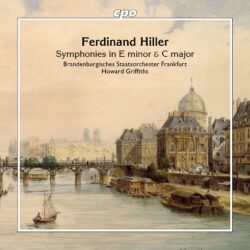 This CD is a follow-up to a recording, which I greatly admired, of two of the four surviving symphonies by Ferdinand Hiller (1811–85). Hiller, a renowned pianist, composer, and conductor, was a close friend of Mendelssohn and Clara and Robert Schumann. He ended up heading the Cologne Conservatory for 34 years, teaching Max Bruch and Engelbert Humperdinck (the opera composer, not the pop singer). His music was widely published and performed. Then, for the most part, it vanished, like that of other composers (e.g., Joachim Raff) deemed too “conservative” by followers of Liszt and Wagner.
The new recording contains the other two surviving symphonies, and they prove to be as engaging and beautifully crafted as those on the first disc (one in F minor, completed when he was 22, and the “Spring” Symphony in E minor, Op. 67, completed when he was 44).
Here we have a work that he started at age 18 and finished revising in 1831, at age 20, and one that he completed in 1876, when he was 65. The early one is in E minor, the same key that he would later use for Op. 67 (on the first disc). It is full of fire and delicacy, as one might expect from someone who had been well trained by Johann Nepomuk Hummel (Mozart’s most important student) and who was devoted to revealing to the world the greatness of Beethoven. (Hiller was the soloist in the first performances in France of the so-called “Emperor” Concerto.)
Mendelssohn, to whom Hiller had sent the manuscript (or a copy), wrote to a mutual friend that the work contains “the prettiest things in the world.” I agree that the music is enormously attractive and fresh, moment by moment, and I would add that Hiller keeps the thread of musical thought going quite effectively.
There is no true slow movement, since the second is a scherzando, the third a march, and the fourth a bustling quasi-programmatic piece entitled “Song of the Pirates.” Berlioz, reviewing a performance, noted that a striking slow passage heard several times in the finale (and treated somewhat differently each time) might represent the sorrow of the women whom the pirates have taken captive aboard their ship.
The Symphony in C major was completed in 1876 (a full 45 years later!), and improvements in wind and brass instruments allow for more varied interweavings here. The layout is relatively traditional, with an Adagio ma non troppo as the second movement and no apparent programmatic intent anywhere. But Hiller’s expertise in handling melodic and motivic development and in exploring fresh rhythmic possibilities is ever-present.
The performance and recorded sound are nearly faultless, except for a few rhythmically tricky passages in which conductor Howard Griffiths could have done more to help me keep track of the bar lines (or, put differently, the first beat of each notated measure).
The immensely informative booklet, by Hiller authority Bert Hagels, is available online for free at eclassical.com. Further details can be found in the substantial Hiller entry in Oxford Music Online and in two important books (alas, not yet translated): one by Michael Gehlmann on Hiller’s imaginative (sometimes, in this respect, near-Brahmsian) treatment of rhythm and meter, and the other by Florian Ilge on how Hiller’s works were judged by music critics of his day.
For an account of Hiller’s attempt to bridge the gap between the so-called Leipzig School (composers modeling themselves in part on Mendelssohn) and the Weimar School (headed by Liszt), the reader might look at a chapter that I co-authored with Jürgen Thym in the recently published book Perspectives on Mendelssohn: Essays in Musicology (SUNY Press, 2026).
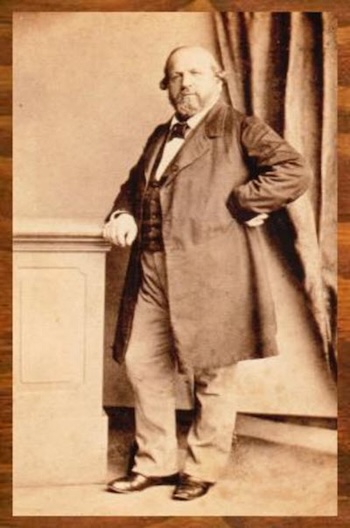
Ferdinand Hiller, pianist, conductor, and composer (1811-85). Photo: ca. 1860s.
Hagels writes in vivid detail about the formal characteristics of each movement, noting departures from then-normative sonata-form procedures. Less often does he compare and contrast passages with those in other composers’ works with which Hiller was likely familiar. Many experienced listeners will note a family resemblance between the third movement of the C-major symphony (Intermezzo—Vivace, much like a scherzo but in 2/4 meter) and the equally bustling second movement, likewise in 2/4, of Schumann’s splendid Second Symphony (Allegro vivace). A jolly recurring passage in that same Hiller movement is described by Hagels as “draw[ing] on hunting fanfares in the horns and trumpets,” but one might compare it more specifically to folk-tune-like moments in relatively well-known (then and now) works of Haydn or Beethoven (e.g., the first contrasting episode in the finale of Beethoven’s First Piano Concerto) or, indeed, to music typical of comic operas of Hiller’s day. (Hiller was a great admirer of Rossini and himself wrote six operas. He also composed a suite of twelve short movements for piano four hands entitled Operetta without Text; this colorful work has just been recorded for the first time, on a Toccata release entitled Four Hands on Stage.)
More comparisons: I noticed a near-quotation from The Magic Flute (Monostatos’s “Nur stille, stille, stille, stille”) in the second movement of the E-minor symphony (Andante scherzando). And the main theme of the “Pirates” finale is clearly a “galop,” a quick dance whose very name evokes the rapid motion of horses’ hooves. Three better-known examples of a galop are the final section of the William Tell Overture (familiar to older radio listeners and TV watchers from The Lone Ranger), Liszt’s Grand Galop chromatique, and the “Tous les trois réunis” number from Donizetti’s The Daughter of the Regiment.
If there had been room for further discussion, Hagels might also have explained that Hiller’s decision to compose a “Pirates” finale reflects cultural fashion. Pirates, as well as brigands (armed robbers who were active on land rather than at sea), were obsessively evoked by writers of the day. For example, the pirate Bluebeard is at the center of a marvelous, disturbing 1789 comic opera by Grétry, Raoul Barbe-Bleue. Hiller’s friend Berlioz included a song for brigands (baritone and male chorus) in Lélio, the astonishingly varied sequel (1831, rev. 1855) to the Symphonie fantastique. Berlioz would evoke brigands again in the forward-hurtling finale to his 1834 symphony Harold in Italy (with the viola soloist finally deciding not to join the energetic gang of thieves but instead to continue his doleful wanderings). James Fenimore Cooper’s The Red Rover (named after that novel’s pirate character) and Byron’s verse tale The Corsair are both part of the background for Berlioz’s marvelous overture Le Corsaire (1844, rev. 1851).
For those curious to try the Hiller symphonies, I should add that the ones on the first disc would seem a natural starting point, especially given that Op. 67 was the only one of the four that Hiller published in his lifetime and thus the one that was most widely performed. But I wouldn’t want to be without the vivid “Pirates” finale of the E-minor symphony on this second disc, either of the two scherzo-like movements, or the vigorous, forward-thrusting passages in various other movements of the C-major symphony—a work that, despite being written in late middle age, does not sound the least bit “autumnal.” It is very encouraging to see someone maintaining such a youthful spirit throughout his long creative life!
In short, this is a delightful disc for people wishing to explore what a strong, if now lesser-known, creative mind was capable of doing during the era of Schumann and the young Brahms. And, for any conductors out there, all four symphonies are now available in admirable editions by Bert Hagels. Performing parts can be rented from the same publisher (Ries & Erler).
Ralph P. Locke is emeritus professor of musicology at the University of Rochester’s Eastman School of Music and senior editor of the Eastman Studies in Music book series (University of Rochester Press), which has published over 200 titles over the past thirty years. Six of his articles have won the ASCAP–Deems Taylor Award for excellence in writing about music. His two most recent books are Musical Exoticism: Images and Reflections and Music and the Exotic from the Renaissance to Mozart (both Cambridge University Press). Both are now available in paperback; the second is also available as an e-book. Locke also contributes to American Record Guide and to the online arts magazines New York Arts, Opera Today, The Boston Musical Intelligencer, and Classical Voice North America (the journal of the Music Critics Association of North America). His articles have appeared in major scholarly journals, in Oxford Music Online (Grove Dictionary), and in the program books of major opera houses, e.g., Santa Fe (New Mexico), Wexford (Ireland), Glyndebourne, Covent Garden, and the Bavarian State Opera (Munich). The present review first appeared, in a somewhat different version, in American Record Guide and is posted here by kind permission.
Tagged: Bert Hagels, Brandenburg State Orchestra, CPO, Classical Music, Felix Mendelssohn, Ferdinand Hiller, Howard Griffiths, Ralph P. Locke, Robert Schumann, Romantic music, classical album reviews, orchestral music