
Doc Talk: Women Who Refuse to Back Down at the Boston Jewish Film Festival
By Peter Keough
At the Boston Jewish Film Festival, three films follow women who persist in the face of prejudice, buried secrets, and unjust laws.
The Boston Jewish Film Festival. November 4–15 at the Brattle Theatre, the Museum of Fine Arts, and other venues.

A scene from Udi Nir and Sagi Bornstein’s The First Lady. Photo: Boston Jewish Film Festival
“My name is Efrat Tilma,” a woman riding a train recites at the beginning of Udi Nir and Sagi Bornstein’s infuriating, ebullient, and triumphant The First Lady (2025). “In recent years it seemed the direction was positive. But then came this dark government. In the end light will overcome darkness.”
The dark government we recognize as that of Israel’s Prime Minister Bibi Netanyahu. The woman is septuagenarian Efrat Tilma, who, as a boy growing up in Tel Aviv in the early 1960s with an abusive father, knew from an early age that she was really a woman. Insisting on dressing up as Esther for a Purim celebration, she was so taken with the transformation that she continued to wear women’s clothes in public. But such behavior was not tolerated, and after being harassed, beaten, and raped, she finally decided to leave the country for Paris after a police officer told her that if he saw her dressed in women’s clothes again, he would drown her in the sea.
Ironically, when Tilma returned to Israel decades later, she would herself volunteer to become a police officer, the first transgender woman to do so. For a brief period, it seemed like tolerance and individual freedom would prevail, until Bibi was reelected and the old era of oppression returned. And so Tilma becomes politically involved, delivering speeches like the one she is seen rehearsing at the start of the film.
Nir and Bornstein tell Tilma’s tale with a mix of whimsy and outrage, as Tilma visits the locations of her adventures — from Tel Aviv to Paris and Morocco, where she had her gender reassignment surgery — and recounts them with rueful humor. But she resists showing the filmmakers her apartment, and when she finally relents, it is revealed to be buried under the debris of years of hoarding and neglect — a physical manifestation of her inner pain. The filmmakers then insist on cleaning out her home, an act that serves as a metaphor of sorts for her confrontation with the past and parallels the more daunting task of restoring justice to the nation.
[The First Lady screens November 8 at 1 p.m. at the Museum of Fine Arts and will be followed by a conversation with Idit Klein, VP for public engagement at the New Israel Fund and former president of Keshet, and Kaden Mohamed, talent and culture specialist at Protect Democracy and community activist for transgender rights.]
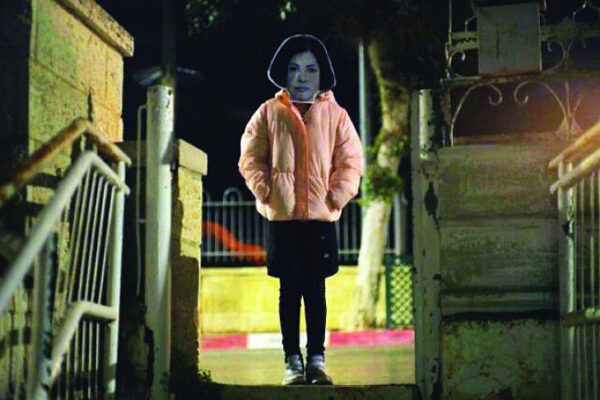
A scene from Israela Shaer-Meoded’s Looking for Yadida. Photo: Boston Jewish Film Festival
Israela Shaer-Meoded’s relatives warned her that trying to find out what happened to her Aunt Yadida, who disappeared over 70 years ago along with hundreds of other infants in a camp for Yemenite refugee children, would not end well. She was “entering the lion’s den,” they said. It was “a dark abyss” and “an addiction.” Nonetheless, she persisted. The result of this obsession is Looking for Yadida (2026), a labyrinth of leads, false clues, and dead ends that might not have solved her own mystery but sheds light on a sad chapter in the early history of Israel.
In 1948, thousands of impoverished Jews from Yemen, Shaer-Meoded’s family among them, as well as from other Middle Eastern countries and the Balkans, fled to the newly established state of Israel seeking refuge. They were put in primitive camps, and hundreds of their children were taken from them, including Shaer-Meoded’s Aunt Yadida. What happened to these children is unclear. Yadida’s family was told that she died not long afterwards, but Shaer-Meoded’s attempts to track down a death certificate and burial location take her to a small, blank headstone over a mass grave. She enlists a PI and other assistants and pores over sketchy records and videos of commission inquiries, but to no avail.
What she does uncover, though, is an apparent human rights violation of unknown scale similar to the Magdalene Sisters scandal in Ireland. Was it incompetence, lack of resources, indifference, or something darker that led to the disappearance of these children? Statements by those involved are not reassuring. “Their approach to children was different from ours,” says one doctor about the Yemenites. “For them it was one child more, one child less.” As to the possibility that the children were being sold to adopting parents, a nurse comments, “There were so many kids for adoption from the Holocaust in Europe. Blond with green eyes. Why would they want to kidnap Yemenite children?”
[Looking for Yadida screens November 5 at 7 p.m. at the Jewish Community Center Greater Boston Riemer-Goldstein Theatre and will be followed by a conversation with Shoshana Madmoni-Gerber, chair of the Communication, Journalism & Media Department at Suffolk University, moderated by Lily Rabinoff-Goldman, president/CEO of JCC Greater Boston.]
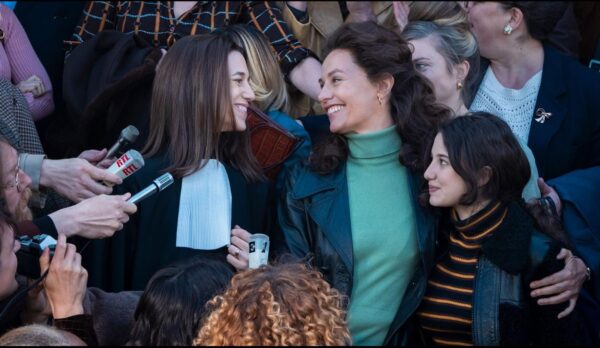
A scene from Lauriane Escaffre and Yvo Muller’s Woman On Trial. Photo: Boston Jewish Film Festival
Lauriane Escaffre and Yvo Muller’s Women on Trial (2025) is not a documentary per se but an assured and potent docudrama recounting one of the most important cases in the struggle for a woman’s right to choose.
In 1972, in a small provincial French town, a classmate raped 16-year-old Marie-Claire Chevalier. She discovered she was pregnant and convinced her mother to arrange an abortion, a criminal act at the time that could result in a five-year prison sentence. The rapist, however, informed on Marie-Claire. The police arrested her, her mother, and two other women, including the abortionist, and put them on trial.
Representing the accused women in court was the renowned lawyer, writer, and feminist firebrand Gisèle Halimi (Charlotte Gainsbourg). Rather than follow the traditional strategy of having the defendants confess their guilt and throw themselves on the mercy of the court, Halimi decided to put the law itself on trial and show that the women — all women — were its victims. To do so, she needed to muster media attention and popular support and enlist the testimony of doctors and other professionals. And if she could convince her conservative Jewish mother that the cause was just, all the better.
A solid though conventional courtroom procedural with all-too-germane contemporary resonance, Women on Trial is ignited by a passionate performance by Gainsbourg. It is reminiscent of another film about a notorious French abortion case featuring a powerhouse performance — Claude Chabrol’s The Story of Women (1988), with Isabelle Huppert — though with a [spoiler] happier outcome.
[Women on Trial screens on November 7 at 7 p.m. at the Brattle Theatre, followed by a conversation with Professor Kelly Colvin, associate professor of history at UMass Boston, and Professor Julian Bourg, associate professor of history at Boston College.]
Peter Keough writes about film and other topics and has contributed to numerous publications. He was the film editor of the Boston Phoenix from 1989 to its demise in 2013 and has edited three books on film, including Kathryn Bigelow: Interviews (University Press of Mississippi, 2013) and For Kids of All Ages: The National Society of Film Critics on Children’s Movies (Rowman & Littlefield, 2019).
Tagged: Boston Jewish Film Festival, Charlotte Gainsbourg, Doc Talk, Documentary Films, Efrat Tilma, French cinema, Gisèle Halimi, Israeli Cinema, Jewish Cinema, Looking for Yadida, Peter Keough, Reproductive Rights, The First Lady, Transgender Rights, Women on Trial, film reviews