
Theater Reviews: Monsters and Mirrors — “Downstate” and “Here There Are Blueberries”
By Chris Caggiano
Bruce Norris’s Downstate and Moisés Kaufman’s Here There Are Blueberries both dare audiences to see the perpetrators of monstrous acts as human beings without excusing their actions.
Two plays on Broadway this season ask audiences to do something most of us would rather avoid: look at people who have done monstrous things and recognize them as human beings.
Bruce Norris’s Downstate arrives at that recognition through fiction. It places four men convicted of sex crimes against children in a run-down group home in downstate Illinois and asks the audience to spend an evening in their company. Moisés Kaufman and Amanda Gronich’s Here There Are Blueberries arrives there through evidence. It builds a work of documentary theater around a photo album in which the staff of Auschwitz relax and play between shifts at the camp.
Both plays force the audience to confront the humanity of the perpetrator, but toward different ends. Norris asks us to recognize that humanity, if not to forgive the perpetrators. Kaufman uses it to reveal the true horror of how ordinary people can justify atrocity.
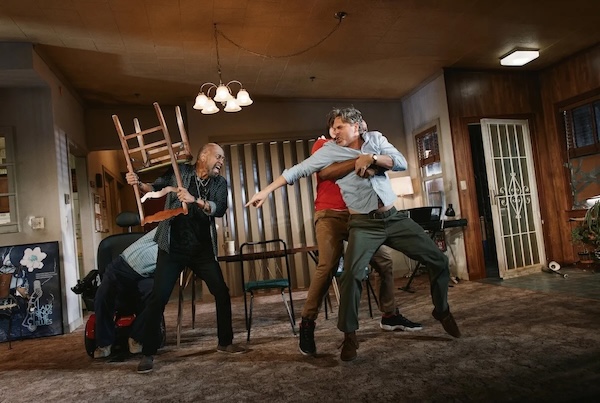
K. Todd Freeman, Al’Jaleel McGhee, and Thomas Sadoski in Downstate. Photo: Emilio Madrid
Downstate begins with a question American society would rather avoid: What are we supposed to do with these people? If men convicted of sex crimes against children don’t merit the death penalty or life in prison, presumably they have to live somewhere. But where will that somewhere be? And under what conditions? Registries and residency restrictions push them into places like the dreary house onstage, with its duct-taped window and the aluminum baseball bat by the front door, where punishment continues long after the sentence ends. Norris doesn’t ask the audience to forgive the men who live there. He asks whether they deserve compassion, and he declines to supply an easy answer about punishment, rehabilitation, forgiveness, or vengeance.
Some might blanch at the idea that Norris sympathizes with offenders, but that isn’t really what’s happening here. Norris refuses to let anyone in the play become a type. The four residents emerge as fully realized individuals rather than one-dimensional monsters, and the dramatist never excuses their crimes. He simply insists that the audience acknowledge them as people, which turns out to be far more uncomfortable than condemnation.
Two of the residents anchor the play. Fred, a soft-spoken man in his 70s who uses a motorized wheelchair, seems almost childlike, a gentle, grandfatherly figure who admits his crimes and insists he will never forgive himself. Francis Guinan plays him with a tenderness and apparent sincerity that make him more troubling rather than less, since the audience can never quite reconcile the man onstage with what he did.
Fred’s languid, acid-tongued housemate Dee looks after him and leaps to his defense when the confrontation with Andy escalates. K. Todd Freeman masterfully balances Dee’s caustic wit with the damage it protects. He is one of the script’s sharpest comic presences—and one of its most wounded characters.
Norris disarms the audience before he unsettles it. In the opening scene, Andy, now in his 40s, sits with his wife nearby and reads a prepared statement to Fred, who abused him as a boy. As Andy works up to calling him a fundamentally evil person, Fred keeps gently offering him coffee. At the performance I attended, the audience laughed throughout the scene—and the scene is funny. But that uneasy laughter is the point: Norris’s caustic comedy keeps one feeling from taking hold before another intrudes.
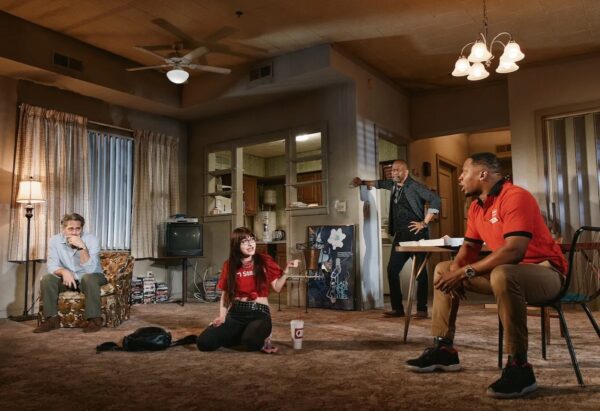
Thomas Sadoski, Ivy Wolk, K. Todd Freeman, and Al’Jaleel McGhee in Downstate. Photo: Emilio Madrid
The humor owes much to the precision of Norris’s dialogue. The Pulitzer Prize and Tony winner for Clybourne Park has a sharp ear for conversation, gives each character a distinct voice, and lets histories and motives emerge gradually. Ordinary domestic exchanges build, scene by scene, into devastating confrontations. Director Joe Mantello’s naturalistic, measured staging makes the men’s circumstances seem disturbingly ordinary, even as the mounting tension becomes almost physically unbearable.
The play focuses squarely on the perpetrators and society’s treatment of them; Andy is the only victim represented. His isolation, coupled with the anger, rigidity, and contradictions Norris allows him, may leave some viewers feeling that the play puts victims on trial. But Andy’s complexity is not an argument against him. Norris grants him the same messy, credible humanity he grants the four men, and Thomas Sadoski finds the fragility beneath his fury.
The play’s central argument surfaces in a brief exchange between Andy and Dee:
ANDY: He deserves to be punished.
DEE: He’s already been punished.
Neither man is wrong, and Norris leaves the audience suspended between them. Admittedly, the play keeps the full horror of the crimes at a distance, which makes sympathizing with the men somewhat easier than it might otherwise be. That distance is deliberate, because Downstate concentrates on the aftermath rather than on the offenses themselves. But that approach carries its own risk, and audiences will differ on whether Norris fully controls it. Either way, the play is haunting, and its questions linger long after the performance.
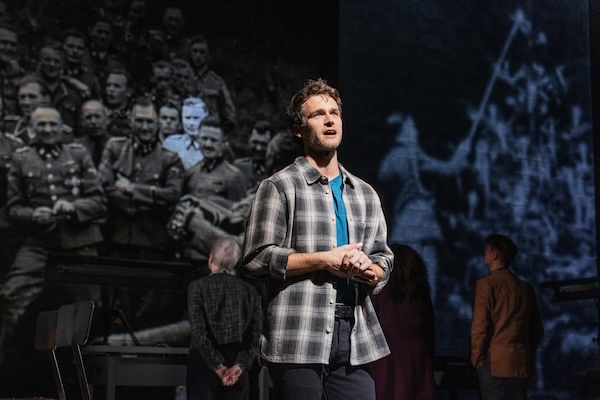
Brandon Flynn in Here There Are Blueberries. Photo: Matthew Murphy
Norris invents his perpetrators; Kaufman finds his in the historical record. Here There Are Blueberries follows archivists at the United States Holocaust Memorial Museum as they investigate an album of photographs sent to them by a retired American Army officer. The pictures belonged to Karl Höcker, adjutant to the commandant of Auschwitz, and they show SS officers and the young female auxiliaries known as Helferinnen going about their daily lives, including enjoying themselves at a nearby retreat. In one sequence, Höcker hands out bowls of blueberries on a sunny deck — a caption gives the play its title.
The central question is whether Kaufman transforms this extraordinary material into compelling theater or relies on the photographs to do the dramatic work. The images remain the production’s most powerful element, deepening in meaning as the researchers identify the people and circumstances they depict. But Kaufman and Gronich give the investigation the momentum of a series of small mysteries, as seemingly ordinary details turn sinister in their emerging historical context. Kaufman’s precise, understated staging never sensationalizes the material. Projections, lighting, sound, and a spare set create an atmosphere of quiet menace, largely avoiding overt sentimentality and making archival scholarship absorbing without flattening the history.
The play’s exploration of the banality of evil is hardly new, but the specificity of its evidence makes that idea difficult to hold at a comfortable distance. As the investigation reveals how much even the camp’s peripheral staff knew, the reassuring distinction between ordinary bystander and knowing participant steadily erodes.
The actors, too, contribute something essential that the photographs alone cannot, particularly when they deliver testimony. Kathleen Chalfant is marvelous, as always, bringing great humanity and restraint to her roles. Michael Cerveris does some heavy lifting as the descendant of a Nazi official. His portrayal, along with the other actors’ portrayals of descendants, raises pointed questions about inherited guilt, responsibility, and denial.
Brandon Flynn handles some of the most overtly emotional material as Rainer Höss, grandson of the Auschwitz commandant Rudolf Höss. Rainer chillingly describes the inherited chain of violence that haunted his own life, from his father’s beatings to his own years of brutality on the streets, as well as his fear that cruelty ran in his blood. He arrives at a hard-won conclusion: “I am the grandson of a mass murderer. I can’t change that. But I am who I choose to be.”
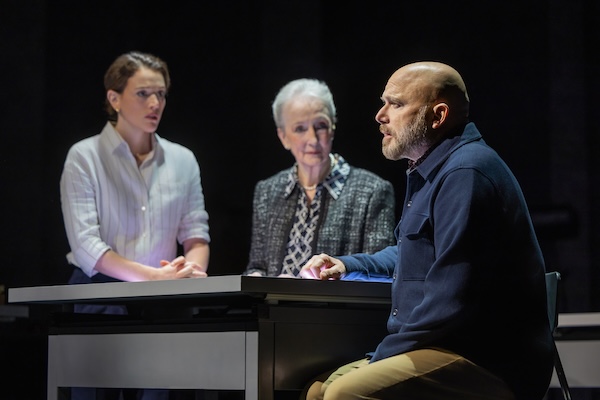
Delia Cunningham, Kathleen Chalfant, and Michael Cerveris in Here There Are Blueberries. Photo: Matthew Murphy
The researchers fare less well dramatically. Kaufman seems to have made a deliberate decision to avoid portraying their inner lives. Much of their dialogue consists of explaining historical information and interpreting photographs, often at the expense of dramatic interaction, so the interpersonal stakes are low. Granted, the researchers aren’t the subject here, but exploring their work, their personalities, and the effect of these images on their emotional lives might have given the production the dramatic tension it sometimes lacks.
That thinness may also explain why the actors sometimes overplay material that would land harder with greater understatement. Delia Cunningham, as the central researcher, is a terrific performer, but she often seems on the verge of tipping into melodrama, and she acts with her hands far too frequently. The actors excel as witnesses and descendants but, because the script gives them so little to work with, struggle to make the researchers real people.
The production reserves its most powerful moment for the victims. Late in the play, the perspective shifts to Lili Jacob, a survivor who found an album documenting her own transport’s arrival at Auschwitz. She arrived one day after Höcker, and the people in his album are the same people who received and processed her and murdered the rest of her family. The juxtaposition is devastating: Höcker’s photographs of smiling faces and carefree leisure become more sinister still when set beside the record of those same people’s work.
Seen together, the two plays make a similar demand: that we recognize the humanity of people whose acts we abhor without mistaking recognition for absolution. Both largely succeed. Late in Here There Are Blueberries, a historian at the Auschwitz-Birkenau State Museum explains why the album shocked even his colleagues: “We want to think of them as monsters so we don’t have to look in the mirror.” The line could serve as an epigraph for Downstate. Neither play lets us retreat into that label and its false reassurance that we are a different species, that we share nothing with these people, that we could never commit such acts—or allow them to happen.
Christopher Caggiano is a freelance writer and editor living in Stamford, CT. He has written about theater for a variety of outlets, including TheaterMania, American Theatre, and Dramatics magazine. He taught musical theater history at the college level for 16 years and is an active member of the Outer Critics Circle.
Tagged: Amanda Gronich, Auschwitz, Broadway, Bruce Norris, Documentary Theater, Downstate, Here There Are Blueberries, Holocaust, Joe Mantello, Moises Kaufman, Morality in Theater