
Opera Album Review: An Engaging and Long-Unperformed 1887 Opera by a Black American, Now on CD
By Ralph P. Locke
A spirited recording, led by two outstanding sopranos, makes a persuasive case for Edmond Dédé’s Morgiane—the earliest surviving opera by a Black American composer—and for its long-neglected creator.
Edmond Dédé: Morgiane, ou Le Sultan d’Ispahan.
Mary Elizabeth Williams (Morgiane), Nicole Cabell (Amine), Chauncey Packer (Ali), Joshua Conyers (Hagi Hassan), Jonathan Woody (Beher), Kenneth Kellogg (Kourouschah).
OperaCréole Ensemble, Opera Lafayette Orchestra, cond. Patrick Dupré Quigley.
Delos 3628 [2 CDs] 143 minutes.
Click here to purchase or to try any track.
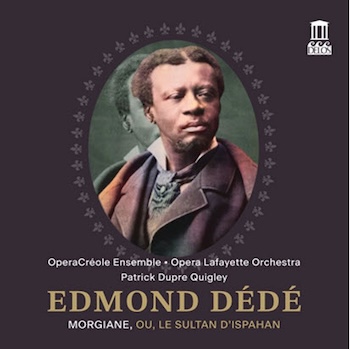 The fascinating opera Morgiane has a great backstory. It was apparently completed in 1887 by Edmond Dédé (1827-1901), a “free person of color” from the state of Louisiana who emigrated to France in order to escape the legal restrictions of the antebellum South and to have a wide sphere for his impressive musical talents. He studied with Conservatoire professors (but privately, because of his age, not his race) and eventually became a prominent conductor in the main theater in Bordeaux and in venues offering lighter musical entertainment in that important city. In the course of his long career, he published some 200 songs as well as many short instrumental pieces.
A Naxos album, still available, contains a sampling of Dédé’s pops-concert pieces (as I might call them) for orchestra, plus lighthearted, orchestrally accompanied vocal items. A respected record critic (in American Record Guide) praised the works’ “inventiveness,” noting that one waltz “could easily have been written by Johann Strauss—though he probably wouldn’t have given such lavish parts to the piccolo and trombones.” I’d add that the music on that CD tends to be conventional in harmony and square in phrase structure but, nonetheless, delightful in melodic shape and, yes, imaginatively orchestrated. Gerard Schwarz recorded one of the same pieces, the lively and intriguing Méphisto Masqué, in an arrangement by the renowned, multitalented Gunther Schuller. It was rereleased in Naxos’s 30-CD “Gerard Schwarz Collection.”
These traits stand the composer in good stead in his longest stage work, whose title would likely, in English, have been given as Morgiana, or: The Sultan of Isfahan. This is a “grand opera,” in the sense that the plot is largely serious, but with some intentionally amusing situations and a happy ending—all features typical of many other operas likewise set in the Middle East, such as Mozart’s The Abduction from the Seraglio or Bizet’s Djamileh. And, typical of grand opera (and thus unlike those other two just-mentioned “Oriental” operas), there is no spoken dialogue.
Yet another feature that links Morgiane to French Grand Opera and the more elaborate works in the opéra-comique genre is that it contains numerous scene-setting numbers involving chorus, orchestra, and dancers. (The work lasts a half-hour longer than, say, Tosca, and would be even longer if the conductor of this recording hadn’t removed some dances.)
Morgiane surfaced in 2008 at Harvard University when a sharp-eyed librarian, Andrea Cawelti, noticed it in a massive and diverse collection of musical and theatrical manuscripts (donated by musicologist and manuscript expert John Milton Ward). Cawelti did some basic research and figured out that this manuscript was the earliest surviving opera by any Black American composer. In an entertaining video, she tells the story of her discovery and displays the bound manuscript.
To be accurate, the label “first opera by a Black America composer” could equally well be assigned to a very different one from 1780—a whole century earlier!—namely L’Amant anonyme, by Joseph Boulogne, Chevalier de Saint-Georges. It all depends on whether the adjectives “Black American” can be allowed to extend to someone born on the French-owned island of Guadeloupe who never visited the United States but instead ended up making a splendid career as violinist, composer, swordsman, and military leader in France. (See my enthusiastic review of L’Amant Anonyme.)
According to the three helpful essays in the booklet, there are many inconsistencies in the manuscript. Several editors, including composer Maurice Saylor, helped to reconcile these.
Not surprisingly, Morgiane is, like other works by Dédé, tuneful and smartly orchestrated. The plot is complicated, as often in opera. Fortunately, the booklet contains the libretto in French and English. Less fortunately, the printed translation is sometimes too literal. “Superbe résistance!” doesn’t mean “Superb resistance!”—as if it were admirable—but something like “Cease this stubborn/haughty refusal [to bend to my will]!”
Even worse, the layout is confusing: when people are singing different words in a duet or larger ensemble, no attempt is made to distinguish which lines are sung by whom. And somebody should have created simple stage directions, in brackets, to clarify, for example, which of the two women the Sultan is apologizing to in the Act 4 finale for having offered her his kisses. Answer: it’s Amine, who, he now admits, is too young for a man whose hair has, as he puts it, “already gone white.” (When he had her abducted, earlier in the opera, he of course did not yet know that she was his long-lost daughter.)
Also, the CD booklet offers neither a plot summary nor a track list. I finally found a first-rate synopsis online (it’s by noted musicologist Candace Bailey) in the program book for the 2025 New Orleans premiere, though with an annoyingly long URL.
The libretto is by a nearly unknown writer (perhaps writing under a pseudonym), and it suffers from longwindedness and unnecessary complications. Even the work’s double-title could easily be misleading since Morgiane is not the sultan (she can’t be, as such rulers in Persia were always male) but 1) the wife of the rich merchant Hagi Hassan and 2) the mother of the young woman Amine, whom the sultan, named Kourouschah, has captured, and wishes to bed. Clarification: Morgiane was a single mother and a kind of refugee, with baby Amine in her arms, when Hagi Hassan welcomed her into his household, married her, and helped raise Amine.
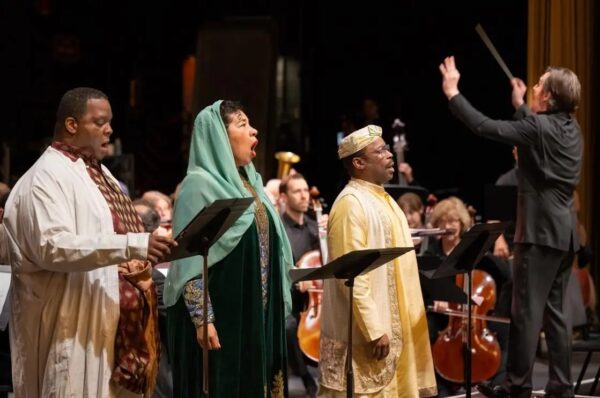
Joshua Conyers, Mary Elizabeth Williams, Chauncey Packer, and Patrick Quigley in a performance of Morgiane. Photo: Jennifer Packard , courtesy of Opera Lafayette
Act 2, set in a market square, is slowish, because of several (musically attractive) scene-setting choral and dance moments, finally kicking up some steam when Amine is heard calling for help as she is being abducted. Act 3, a bit too similarly, involves a long entertainment in which Morgiane, her merchant husband, and Amine’s devoted young husband—the soldier Ali—arrive in disguise as entertainers and, bit by bit, tell (in song) an allegorical tale of a rich shepherd who steals a poorer shepherd’s beautiful young ewe. This tale, it gradually becomes clear, accuses the sultan of having captured Amine. The three whistle-blowers are thrown into prison, where, at the beginning of Act 4, they lament their fate.
The opera ends with Morgiane’s revelation that Amine’s father is actually Sultan Kourouschah himself. The explanation arrives: Morgiane got pregnant two decades earlier, when she was—surprise!—the sultan’s wife (or favorite concubine) until, no longer able to bear his drunkenness and cruelty, she fled his court with their young child (Amine) and found a welcoming home with the merchant. Sultan Kourouschah now forgives them all, and he returns Amine to the couple who raised her and to Amine’s devoted husband Ali.
Dédé’s music is consistently engaging, making us care about the various characters and their desires and fears. It shifts in style according to the situation but always has a nice forward-moving energy, even in more reflective passages.
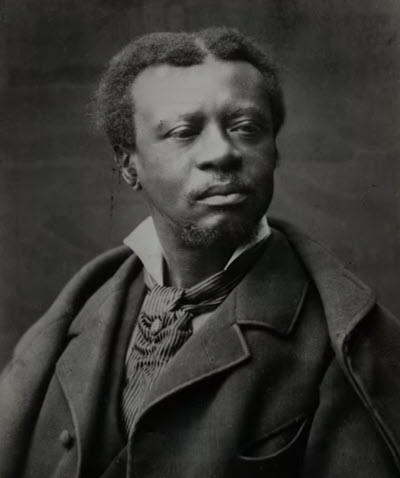
Composer Edmond Dédé at about age 50. Photo: courtesy of Opera Lafayette
Given that the work is so rooted in opéra-comique tradition, we would be wrong to look for extended passages of great intensity or passion. Still, there are moments when the music becomes notably dramatic, as in the Act 1 duet for the young married couple. Particularly effective are the Act 2 and 3 finales, in both of which various characters take positions against each other in highly contrasting music. The Act 4 finale gains depth in a glorious solo passage for Morgiane, at the moment when she shows the Sultan the diamond ring that he gave her as a token of his devotion years ago, namely when their child (Amine) was born.
The performance is, in general, remarkably good, especially considering that the work was totally unknown until now, so there existed no tradition to guide the performers in making interpretive choices that might help give this or that section its full effect.
The recording was made during a single performance, in a concert (at the University of Maryland in College Park) without sets or much onstage movement, but no doubt with extensive gesturing, sideward glances, and so on. The preceding performances (by the same performers, mostly) in New Orleans, Washington DC, and New York were likewise unstaged but used costumes, as can be seen in photos in the booklet and online. Because the rediscovery is so resonant historically, this recording has already been getting a lot of airplay on FM radio stations.
The strongest of the singers are the two main women: Mary Elizabeth Williams and Nicole Cabell. This is unsurprising, given their respective careers in international opera houses. Cabell won the Cardiff “Singer of the World” competition in 2005, had the leading role in the Saint-Georges recording mentioned above, and has sung leading roles at the Met and other eminent houses. Williams, equally stellar, has triumphed in such roles as Abigaille, Aida, Tosca, and Gershwin’s Serena, and is currently essaying Isolde.
You can enjoy Williams singing her aforementioned Act 4 aria in this video:
Alas, the camera does not let us see the hornist as he plays, with great elegance, the aria’s eloquent countermelody.
The leading male singers state their cases sturdily and with nicely individualized character. Of the four, Chauncey Packer (as Amine’s young husband) stands out for me, thanks to his bright, solid vocal production. His somewhat pinched tone reminded me, not unpleasantly, of some famous French tenors from the past. He also knows how to go into a well-controlled “head voice” (falsetto) for high passages, a practice that is historically attested.
Kenneth Kellogg offers a vivid characterization of the desirous, devious sultan. Alas, his tone as captured on this occasion is often marred by a slow vibrato, but this lessens as the performance goes along. Joshua Conyers, as the merchant Hagi Hassan, is caught slightly under pitch many times, though, again, the voice warms up and improves by Act 4, even allowing him to convey real eloquence at times. Such purely vocal-technical shortcomings would surely have been less evident if the recording had been made under studio conditions, over a period of days.
In the secondary yet substantial high-baritone role of the sultan’s henchman Beher, Jonathan Woody displays a nicely focused tone from first note to last and well conveys the character’s harshness.
The Opera Lafayette Orchestra, playing period instruments (as it always does), adds heft and sonic variety, thanks to spiffy conducting by Patrick Dupré Quigley. The whole production was organized by OperaCréole, a New Orleans-based organization founded in 2011 by Givonna Joseph and Aria Mason for the specific purpose of reviving works by composers of African descent. The OperaCréole chorus sings dandily throughout. I should perhaps add that all of the singers in the solo roles and apparently most or all of those in the chorus have African-American ancestry.
In short, I was pleased to discover a work of great appeal that I hope will find its way to the stage in many lands. At times, the plot moves ahead rather slowly (as in the long accusatory “entertainment” in Act 3), and I suspect that it could profit from some judicious trimming. “Standard cuts” have, of course, helped many operas establish themselves in the repertory, e.g., La Traviata, Der Rosenkavalier, and—to mention a work that, like Morgiane, was not seen through to performance by its composer—Offenbach’s The Tales of Hoffmann. Yet I also hope that the dances that had to be cut in these world-premiere performances will get recorded soon—Dédé was, after all, a recognized master at composing dances!
Readers interested in learning more about Dédé will want to look into Sally McKee’s The Exile’s Song: Edmond Dédé and the Unfinished Revolutions of the Atlantic World, and will eagerly await Candace Bailey’s forthcoming Cambridge University Press book on Morgiane.
Ralph P. Locke is emeritus professor of musicology at the University of Rochester’s Eastman School of Music and Senior Editor of the Eastman Studies in Music book series (University of Rochester Press), which has published over 200 titles over the past thirty years. Six of his articles have won the ASCAP-Deems Taylor Award for excellence in writing about music. His most recent two books are Musical Exoticism: Images and Reflections and Music and the Exotic from the Renaissance to Mozart (both Cambridge University Press). Both are now available in paperback; the second, also as an e-book. Locke also contributes to American Record Guide and to the online arts-magazines New York Arts, Opera Today, The Boston Musical Intelligencer, and Classical Voice North America (the journal of the Music Critics Association of North America). His articles have appeared in major scholarly journals, in Oxford Music Online (Grove Dictionary), and in the program books of major opera houses, e.g., Santa Fe (New Mexico), Wexford (Ireland), Glyndebourne, Covent Garden, and the Bavarian State Opera (Munich). This review first appeared in Classical Voice North America and is republished here, lightly revised, with kind permission.
Tagged: Black composers, Chauncey Packer, Delos, Edmond Dédé, Jonathan Woody, Joshua Conyers, Kenneth Kellogg, Mary Elizabeth Williams, Morgiane, Nicole Cabell, Opera, Opera Lafayette, OperaCréole, opera recordings
1 Comment
Leave a Comment

A very interesting read. I had only heard the name but nothing else. Now my curiosity will lead me to explore more about Edmond De’De’.