Doc Talk: “Remake” — A Filmmaker Ponders a Career and a Life
By Peter Keough
Documentarian Ross McElwee’s most profound film folds four decades of self-portraiture into a threnody for his son — and a meditation on memory, guilt, and cinema’s solace.
Remake and Sherman’s March, directed by Ross McElwee. At the Coolidge Corner Theatre, Brookline, July 31 through August 6.
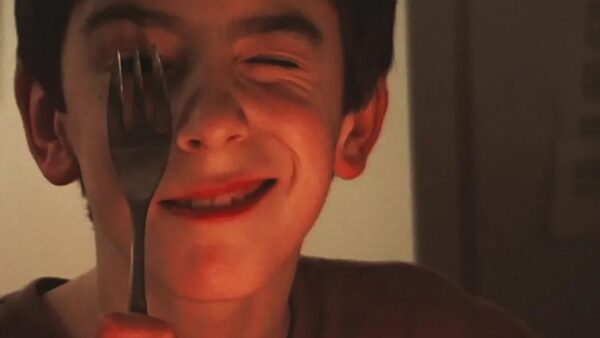
A scene from Remake. Photo: Coolidge Corner Theatre
Two giants of the local documentary community, both Harvard professors, have recently released works that summarize their careers and lives. Robb Moss’s The Bend in the River draws on past films that focus on friendships over the course of nearly five decades. Ross McElwee, by contrast, has mostly turned his camera on his family. At what cost — and to what benefit — is in part the subject of his profound, poetic, elegiac Remake. It is a masterful reflection on the passage of time, the vagaries of memory, the inevitability of loss, and the solacing role of cinema. Most importantly, it is a memorial to his late son Adrian, who died on Christmas Eve 2016 at 27.
“I used to call myself a filmmaker,” says McElwee, paradoxically, at the beginning of this protean, diaristic essay, which, as in his previous works, artfully combines excerpts from his past films. Doubts about the motivation and value of his profession have always been part of his self-deprecating strategy: in his breakthrough feature, Sherman’s March (1985), he adopts a nebbishy persona — a kind of North Carolinian Woody Allen, if you will — as he attempts to trace the path of the despised (in the South) Yankee general’s swath of Civil War destruction and its impact in the present day. This ambition repeatedly devolves into failed attempts — arranged mostly by friends and family, though with the occasional serendipitous encounter — to set up the thirty-something bachelor with a girlfriend and potential wife.
As some participants point out, McElwee’s biggest handicap in achieving this goal may be his insistence on filming everything. Recognizing this problem, he laments, “It seems I’m filming my life in order to have a life to film — like some primitive organism that nourishes itself by devouring itself, growing as it diminishes.” Nonetheless, he eventually marries and starts a family, but the filmmaking continues as he tries to combine the two. His favorite subject is his adorable, bright, funny son Adrian, who, along with McElwee’s then-wife, Marilyn Levine, and soon-to-be-adopted daughter, Mariah, makes In Paraguay (2008) such a delightful portrait of a fascinating family. That is, if you can overlook the fact that overshadowing all the fun is Dad with his ubiquitous movie camera. As McElwee recalls, it was while shooting this film that he felt he had achieved true happiness, fusing family life and filmmaking into what he thought was a harmonious ideal.
But McElwee failed to recognize his family’s growing discontent with the constant filming. His wife and children grow estranged, as seen in excerpts from Photographic Memory (2012). He was also in denial about his son Adrian, who, though showing promise in filmmaking, writing, and entrepreneurial projects, began experiencing mental-health and behavioral problems, including depression, substance abuse, and self-destructiveness.
“For Adrian, it may have been poison,” McElwee reflects, on the impact of involving his son so intimately in his art. “I now worry that filming my son and then letting him travel with me to film screenings somehow contributed to his destabilization — maybe even gave him a distorted sense of reality.” Whatever the reason, Adrian would die of an overdose, and the shadow of that tragic loss looms over every frame of Remake.
Though the deceptively free-associative style of Sherman’s March achieves consummate expression in this film, its rueful whimsy is channeled through a reflective threnody spanning decades. In a brilliant segment, McElwee talks with his son about how beautiful the images of him as a child were, because they were shot on film rather than digitally. Adrian asks to reverse roles, takes the camera, and starts to film his father — one of the few images of McElwee in his films, other than sly mirror shots. Then the doc cuts to a similar scene years earlier, when the child Adrian also turns the camera on his father. As the film returns to the original scene, Adrian asks his father why he seldom turns the camera on himself in his films. “People don’t want to see a film about me,” he explains, “but about what I see.”
McElwee sees such things as Adrian jogging along a beach away from the camera into the vanishing point, which, in a way, inverts the famous freeze frame at the end of Truffaut’s The 400 Blows. And what did Adrian see? Perhaps more than his own images of his son, McElwee is comforted by Adrian’s videos, in particular, his point-of-view shots of him skiing. By watching them, the director explains, he can almost inhabit his son’s body. It is a consolation of sorts; and though filmmaking may at times have detached McElwee from the experience as it happened, it has also preserved it.
Peter Keough writes about film and other topics and has contributed to numerous publications. He was the film editor of the Boston Phoenix from 1989 to its demise in 2013 and has edited three books on film, including Kathryn Bigelow: Interviews (University Press of Mississippi, 2013) and For Kids of All Ages: The National Society of Film Critics on Children’s Movies (Rowman & Littlefield, 2019).