Doc Talk: Two Films about Time, Diminishment, and Redemption at the Woods Hole Film Festival
By Peter Keough
Director Robb Moss’s latest revisits countercultural lives in later years, while Amazing Live Sea Monkeys probes a bizarre empire shadowed by exploitation and extremism.
The Woods Hole Film Festival. July 25 to August 1 at various venues.
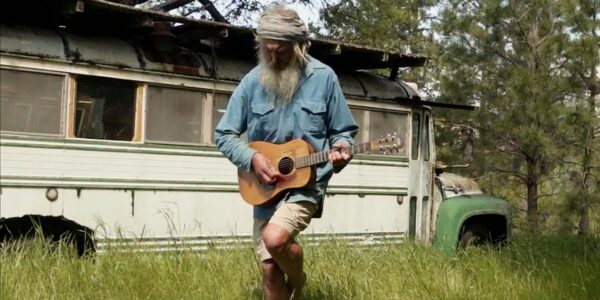
A scene from Robb Moss’s The Bend in the River. Photo: Courtesy of the Woods Hole Film Festival.
One of the highlights of this year’s Woods Hole Film Festival is the latest film from one of the doyens of our great local documentary community. Revered Harvard film professor Robb Moss’s The Bend in the River (2025; screens July 29 at 7:30 p.m. at the Meigs Room at Swope Center followed by a Q&A with filmmaker) picks up the story of his band of nature-loving countercultural friends that began with Riverdogs (1982), a short about a 1978 rafting trip down the Colorado River, and continued over two decades later with The Same River Twice (2003), in which he checks in with his companions to see how their lives are going. The new film follows the pattern, revisiting the five friends, now in their 70s, as they take one more rafting trip. It’s a kind of Seven Up! (1964) series for aging hippies, a poignant and unflinching portrait of a generation and its ideals, achievements, and disappointments.
So how are the five stalwarts doing in this true-life sequel? The sardonically witty Barry Wasserman, having recovered from his testicular cancer in The Same River, is now retired. The relative predictability of his life, he notes, is epitomized by the fact that both women he married were named Deborah, both had the same middle name, both were from Santa Clara County, and both had a father named Bill who had only one eye. Such synchronicity aside, Barry in a meta-moment shows his filmmaking savvy when he tells Moss, “I know all your tricks” and analyzes the shot in which he is then being filmed.
In Riverdogs, Jeff Golden and Cathy Shaw are in love. They are both politically active and seem bonded for life, but in the second film Jeff laments the infidelity which ended their marriage. This confession comes back to haunt him in the new film because he is running for Oregon state senator and the opposition has gotten a hold of the clip and are using it against him. So he and Cathy – who surprisingly is working as his campaign manager – have to come to grips with the turmoil of the past as they work out a strategy to turn it to their advantage.
But the real river dog – or god – is Jim Tickenor, seen back in 1978 flaunting his nude beauty as the group’s charismatic leader. An unselfconscious narcissist and hedonist and true embodiment of the spirit of an already waning era, he possesses an aura of pagan divinity. Danny Silver, his then girlfriend, recalls that he was the perfect summer boyfriend, but not so much in the winter. Brokenhearted when their relationship ended, Danny would bounce back, get a job in a genetics lab, and drop that to pursue what she loved – dance, music, and teaching. But as the decades passed Jim blithely went his own way, becoming a virtual hermit living in the woods in a dilapidated trailer, the only one perhaps to fully uphold their ideals – being one with nature and living in the moment.
Cutting fluidly from film to film, from decade to decade, Moss evokes the process of memory itself – free-floating, immersive, transient, yet seemingly eternal. At the end Jim stands inside his derelict house, a lifelong project he never finished (“It’s perfectly half finished,” he claims). A bit derelict himself with his long grey hair and beard and sketchy wardrobe (in an earlier scene Moss asks him, “Are you missing teeth?”) Jim says that he doesn’t think he has much longer to live. Then he adds, “And yet, who knows? Maybe we’ll live forever.”
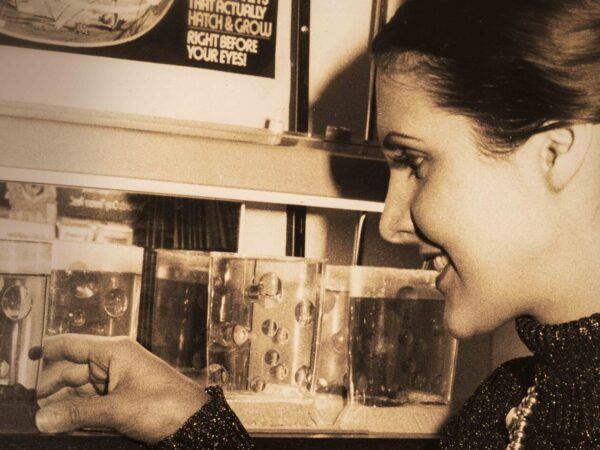
A scene from Amazing Live Sea Monkeys. Photo: Courtesy of the Woods Hole Film Festival.
Needham native Mark Becker and Aaron Schock’s Amazing Live Sea Monkeys (2026; screens July 25 at the Clapp Auditorium in the Lillie Building followed by Q&A with the filmmakers) begins with similar scenes of seeming decline. In a deteriorating mansion, Yolanda Signorelli von Braunhut ferrets about in dark cluttered rooms. The electricity has been turned off and the only light is from candles.
Among the debris are cartons of Sea Monkeys packets, the novelty item advertised in the 1960s and 1970s in comic books. The eggs of brine shrimp that would hatch (or not) into tiny swimming crustaceans to the delight or disappointment of generations of kids, they would prove a lucrative commodity for Yolanda’s late husband, the flamboyant entrepreneur Harold von Braunhut. But not for her, because when Harold died, canny operators for the Big Time Toys corporation took advantage of her business naivete. They cheated her out of ownership of the company, leaving her penniless. Undaunted, for years she sought justice with a lawsuit.
A straightforward tale of good versus evil, perhaps, but the film takes an unsettling turn. It turns out that Yolanda’s husband, though Jewish, led a not-so-secret life as a member of the neo-Nazi organization Aryan Nations, a terrible truth that Yolanda has trouble acknowledging. Penny Lane relates this disturbing story in her 2016 short Just Add Water: The Story of the Amazing Sea Monkeys but here the filmmakers try to make sense of what could have driven Harold to such perverse political beliefs. He was, they learn, crippled as a child with a bone disorder, was bullied by children at school, and when his mother died his father put him away in an orphanage where he endured further abuse. Becoming a Nazi – less popular then than now – was one way to fight back and deny his own victimization.
Yolanda, though, seems untainted by her husband’s history – plus you can’t help but root for someone who feeds all the local birds and raccoons and other critters who visit her. Wisely, like Lane with her film, the filmmakers employ whimsical (though with barely glimpsed darker details) comic book-like animation that evokes the medium in which Sea Monkeys were advertised. One hopes that, like the brine shrimp eggs which are dormant until water is added, Yolanda will spring back to life, her lawsuit a success, the electricity restored, the ugly truth about her husband confronted and resolved, and the Sea Monkeys franchise returned to its rightful owner.
Peter Keough writes about film and other topics and has contributed to numerous publications. He was the film editor of the Boston Phoenix from 1989 to its demise in 2013 and has edited three books on film, including Kathryn Bigelow: Interviews (University Press of Mississippi, 2013) and For Kids of All Ages: The National Society of Film Critics on Children’s Movies (Rowman & Littlefield, 2019).
Tagged: "Amazing Live Sea Monkeys", "The Bend in the River", Aaron Schock, Mark Becker, Robb Moss, Woods Hole Film Festival