Book Review: Immigrant Songs: Stories of Refugees, Borders, and Brutal Grace
By Michael Londra
In The Age of Migration, Kai Maristed follows displaced characters through political danger, private desperation, and unexpected acts of survival.
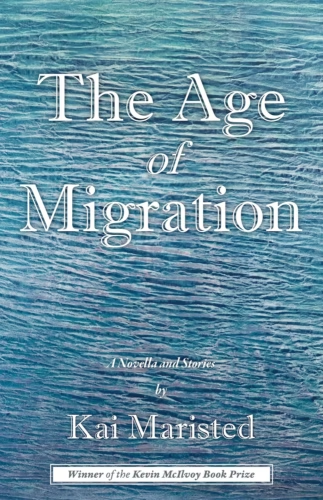
The Age of Migration: A Novella and Stories by Kai Maristed, WTAW Press, 242pp, $19.95
André Dubus II once explained he preferred short stories “because I believe they are the way we live. They are what friends tells us, in their pain and joy, their passion and rage, their yearning and their cry against injustice.” A graduate of the Iowa Writers’ Workshop, Dubus (1936-1999) was a prolific storyteller. Author of novels and essays, his considerable reputation rests on a cache of award-winning short fiction. Renowned for unflinching narratives of folks in despair confronting impossible choices, Dubus poetically juxtaposed violence and betrayal alongside forgiveness and grace. In fact, his oeuvre might be summed up in this aphorism from his non-fiction collection Broken Vessels: “I believe in love’s possibility, in its presence on the earth.”
Co-dedicated to Dubus, Kai Maristed’s The Age of Migration: A Novella and Stories hews closely to his compassionate worldview. Where Dubus mostly focused on the domestic lives of working-class New Englanders, Maristed’s literary concerns stretch far beyond her mentor’s Merrimack Valley. Several of the ten pieces here, to be sure, are indeed set in the Boston area. But, true to her title, Maristed’s characters also find themselves on the move in Haiti, Paris, and Senegal, among other locales. Enduring hardship and privation—along with the consequences of poor judgment, selfishness, and plain bad luck—her men, women, and children traverse geographic boundaries as well as transgress social norms. Without sounding like a textbook, The Age of Migration explores weighty themes of political violence, financial precarity, and physical abuse.
A good example is “Bwa Teneb.” Set in Haiti, the novella’s title is Creole for “forest of shadows.” It is also the name of an expanse of flatland along the island’s southern coast. A van with three people has traveled for hours attempting to get there, but the driver is lost. The two passengers are a woman from Boston named Scobie, a journalist in search of a story that might win her a Pulitzer; and a Catholic priest, Père Emory, who runs a children’s home. Behind the wheel is Ti-Bo, who carries a Glock. A sympathetic church bishop has told them about “twenty hectares of high fertile land” Emory can “transform into a farm, refuge, and workplace for the kids overflowing his orphanage.” However, given Haiti’s political instability and lawlessness, they are far from safety in a literal forest of shadows as sundown approaches At one point, Ti-Bo warns Scobie: “It’s never smart to be out at night.” Unable to continue because of the implacable darkness, they are trapped in the van until morning. Intimacy develops between Scobie and Emory, ineluctably adding
Demonstrating her versatility, “The Age of Migration” is based in Paris. A white Parisienne strategizes her escape from a relationship where her fiancé wields absolute control. She is not even allowed to possess a single penny that he does not give her first. A rich American businessman offers her a possible way out. Yet, if she goes with him to New York, she could be exchanging one cage for another. The slick Manhattanite is just as sexist and domineering as her betrothed. By contrast, “The Investigations” seems as if it will be a lighter story, but it has a similarly dark heart. Two adolescent girls—Kirsty, the narrator, “almost fourteen;” and Clio, fifteen—secretly spy on individuals through an open window. Hanging out at Clio’s house later on, they have sex. Kirsty’s mother is a broke and suicidal single parent. Clio, however, has a mom, dad, and sister. Things might be comparatively worse for her, though, since it is suggested Clio’s father (a professor and poet) may be a predator and abusing Clio. As with the other stories in The Age of Migration, a sudden and unanticipated act of violence upends everything.
“Evangeline, or Theories of Childhood Development,” has the eponymous young girl at its center, one who, we learn, has experienced a horrific catastrophe. Her bravery is contrasted with her father’s machismo, the probable cause of her hospitalization. “The Catamount” is Maristed’s timely take on birthright citizenship. A doctor is asked to fake a birth certificate, a moral choice that remains undecided at the end. On a more comedic note, the funniest tale is “Far Bangalore.” Here a browbeaten white American wimp falls in love with the voice of a female call-center phone agent in India. He empties his bank account in the fool’s errand of flying around the world to pursue her: “The plane is descending faster and faster. Sooner or later, somewhere below in glowing Bangalore, he will find her. And she will teach him her name.”
The Age of Migration’s best contribution is “The Toubaab.” The moniker is a West African phrase for “a lumpy European, outlandish in his paleness,” who on a whim scoops up a Senegalese child named Malik N’Deye—”the way other foreigners might smuggle a charming parrot or a bright-patterned snake”—and brings him to France. Malik had been born to parents who don’t love him: “All his family suffered the shame of his existence…He carried a curse, the mark of a devil’s passing: a shriveled right leg.” Malik’s father taunts his son, calling him “Leg-and-a-half.” When a teacher known as “Marabout” discovers Malik, he buys the child with a “she-goat” to bring him to the Marabout’s school for “religious education.” His goal instead is exploitation. Malik is sent into the streets to beg. This is the infamous “talibé” system that Amnesty International considers child trafficking and modern-day slavery. By a stroke of luck, the Toubaab is a wildcard seaman on a ship “manned by sailors of all tongues and colors” who smuggles Malik to Marseille, where over time, he secures counterfeit papers, survives instances of police harassment, and hitchhikes north “with a couple of older fellows” to Paris. He finds employment on the margins of the City of Light, and acquires a prosthetic leg that enables him to walk better. Doubling as a club, he also uses it to defend himself from thieves. His only goal is to “find plenty of work and live a practically invisible life.” I will not reveal more. Suffice to say, I was deeply moved. There are tears in my eyes as I write this. Why? Maristed’s ability to present a searing, insightful portrait that is not sentimental, but brutal in its relentless fidelity to the truth, sticks in the heart of the reader.
Stylistically, Maristed’s prose is multifaceted. She is adept at clear-eyed description: “Our home is a split-log, brown locust wood. Everything in the long hills is brown. The leaf litter underfoot, the streams eeling through that spongy mattress, the ponds down low where slopes come together to make a funnel, and an upwelling pool round as a chestnut eye gazing skyward” (“Ursa Major”). But she is also lyrical: “In the lobby the lights are smashed out. Shards of glass sparkle everywhere, fallen stars. The blue rotors of a fleet of police cars bloom on the walls” (“The Age of Migration”). In truth, memorable imagery can be found on almost every page: “My heart slammed like an unlatched gate in a storm” (“The Catamount”); “Like a black pirate ship the hearse crested the hill road and sailed down toward Amber’s house into the empty driveway” (“Mrs. Trefoil’s Parlor”); “Suits ringed a long mahogany table reflective as a koi pool” (“The Philanthropist’s Daughter”).
Reminiscent of the expatriate fictions of Michael Ondaatje and Mavis Gallant, The Age of Migration, the inaugural winner of the Kevin McIlvoy Book Prize, is a diorama of human beings struggling to transcend the hardscrabble realities fate has imposed on them. For Maristed—like Ondaatje and Gallant—the idea of national borders is a sham. Indeed, her humanitarian vision is further echoed in musician Eric Bibb’s song “Refugee Moan” from his 2017 album Migration Blues. We all come from somewhere else, no exceptions. It’s a stance that Bibb articulates in these lines, which in turn aptly describe The Age of Migration: “Deliver me from this place I know / Desecrated by the madness of war. / If there’s a road to a peaceful country / Where the people have pity on a homeless man / Lord, make that highway my way…Send us a song to keep us strong / Lord, keep us singin’ as we carry on.”
Michael Londra—poet, fiction writer, critic—recently introduced the Poets Confront AI and Surveillance Capitalism event at Poets House, available on YouTube. He also talks New York writers in YouTube indie doc Only the Dead Know Brooklyn (dir. Barbara Glasser, 2022). “Time is the Fire,” the prologue to his soon-completed novel of Delmore Schwartz and Lou Reed, appears in DarkWinter Literary Magazine. His poetry was translated into Chinese by scholar-poet Yongbo Ma. Two of his Asian Review of Books contributions were named Highlights of the Year for 2024 and 2025, one of which was translated into Vietnamese. “Life in a State of Sparkle—The Writings of David Shapiro” from The Arts Fuse was selected for the Best American Poetry blog. He can also be found or is forthcoming in Lana Turner: A Journal of Poetry & Opinion, Restless Messengers, The Fortnightly Review, spoKe, Cha: An Asian Literary Journal, and The Blue Mountain Review, among others. He added six essays and the introduction to New Studies in Delmore Schwartz, coming next year. Born in New York City, he lives in Manhattan.
Tagged: "The Age of Migration: A Novella and Stories", Kai Maristed, Kevin McIlvoy Book Prize, immigrants