Jazz Musician Interview: “It’s About What’s Real” — Fred Hersch in Conversation
By Steve Elman
The acclaimed pianist-composer reflects on a newly unearthed duet with Mick Goodrick, the art of deep listening, and a life shaped by resilience and risk.
I spoke with Fred Hersch from his home in the Catskills via Zoom on June 27. I used Zoom’s transcription function for the raw material, and then edited and rearranged the interview excerpts for clarity.
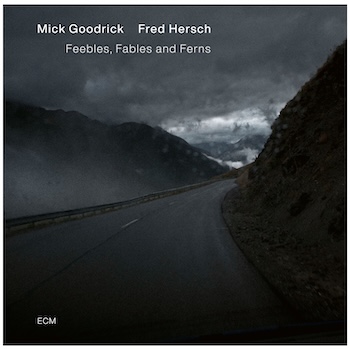
We first talked about his new release, Feebles, Fables & Ferns, a duet session with the late guitarist Mick Goodrick (1945 – 2022), which was recorded in 1988 and released this year for the first time (on ECM). Then we moved on to discuss his work (including the experience of making music for an audience), and his life as it has been and as it is today.
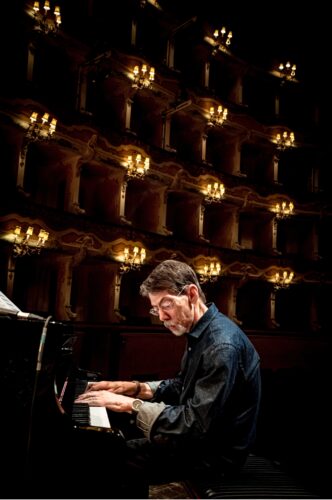
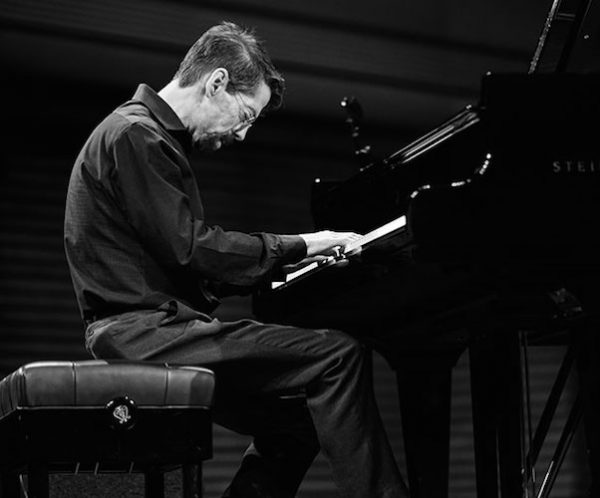
Pianist Fred Hersch. Photo: Roberto Cifarelli
Fred Hersch: Well, [the guitar duets with Mick Goodrick were] the first [duets with guitar that] I did. [Now that it’s been released, it’s] the last one to come out. I think it was one of the early duo albums that I made. I think the only [duo album] I had made previously was with [soprano saxophonist] Jane Ira Bloom [As One, JMT, released 1985, recorded September 1984, in Hersch’s loft studio in NYC].
That happened very organically. [Jane and I] were on a tour. And we played a duet each night, just as an organizational device, and the guy driving the van ended up having a record label and it was just organic. I think the best things that have happened [in my recording career] have all been organic.
Obviously, Mick and I didn’t set out to make a lot of money or do anything commercial. We just said, “Hey, you know, we have this opportunity; let’s do something.”
Arts Fuse: At the time, you were 33 and Mick was 43, ten years older. Can you compare how you felt as a “junior” artist working with Mick and how you feel now when you’re sort of the “senior” artist in so many contexts?
Hersch: Yeah, that’s very interesting. You know, I never thought of Mick as, like, an older guy. He was just a lovely person to be with. You could tell that he had a lot of deep ideas, deep feelings about music [and a deep] philosophy of life. He probably could have had a large or large-ish career as a bandleader or as a soloist. And he chose to be what I call the guitar whisperer, you know? He mentored or taught Pat Metheny, John Scofield, Bill Frisell, Wolfgang Muthspiel, and Julian Lage [among others], and he wrote one of the seminal books on jazz guitar. [He] just chose to be a little behind the scenes.
We met on pickup gigs around Boston, and I was in the last days of having a recording studio at the loft in Soho in New York [City], where I still live, and I invited him down. We recorded for four or five hours [in August 1988] and got two hours’ worth of music. It was just a quirk of fate that [Mick’s] executor, David Lee, called me [recently], and said, “Mick always liked that [session], and maybe you should give it a listen.” One thing led to another, and Manfred [Eicher, head of ECM Records] was very enthusiastic [about the recording] from the beginning, and said, “I want to put it out [commercially on my label].”
AF: Well, you certainly got great sound in your studio. The ECM engineers probably did some magic, but it sounds really lovely.
Hersch: Well, it’s a live-to-two-track mix. We were able to do a little bit of rebalancing [in pre-release production] with the piano and guitar, but it’s pretty much as we recorded it. And listening to myself 37 years ago . . . I had a little different energy, obviously. Now I’m 70; [then] I was in my early thirties, my career was just starting, [and] I [had] just made my first album as a leader.
[In fact, Hersch had recorded two sessions as a leader before the Goodrick duets. Both were trio dates – Horizons, Concord Jazz, released 1985, with bassist Marc Johnson and drummer Joey Baron; and Sarabande, Sunnyside, released 1987, also with Baron, but with Charlie Haden on bass.]
I think the highlight to me of the [Goodrick session] is the way that we play together, all the timing. I think both of us are very generous performers, if I may say.
AF: Can you compare the experience of working with Mick Goodrick with the later experiences of working with other guitarists, Julian Lage and Bill Frisell? Are there distinctly different things that come out in your feeling and in your playing when you compare the experiences?
Hersch: With [Bill] Frisell [Songs We Know, Nonesuch, released 1998, recorded in San Francisco], I remember going out to Seattle, where he was living, and rehearsing some of his music and my music. We had three rehearsals, [and] at the beginning of every rehearsal, we’d play a standard [“It Might as Well Be Spring,” “I Got Rhythm,” “Wave,” “Blue Monk,” etc.] And when we got to the studio, we realized that [those tunes were] the best stuff, and also that people had never heard Bill in that context. So, not that I’m some big cheese, but if I have a chance to shine a light on an artist in a certain way . . . if I can do that, I will [and this was the chance to do that with Bill].
[It was similar to my experience] with Nancy King, [when I] recorded her [at the Jazz Standard in NYC], without her knowing it, and got her some recognition, well-deserved recognition. [Live at Jazz Standard, MaxJazz, released 2006]. I did that with Jay Clayton also [Beautiful Love, Sunnyside, released 2006].
With Julian [Lage], I was teaching at NEC [the New England Conservatory] and [I was at] a coffee place across the street. He just came up to me and said, “Are you Fred Hersch?”
I said, “Yes.”
And he said, ‘I’d like to get a composition lesson.”
So [when we met for that,] he brought his guitar and brought some tunes and we started playing. [At that time,] for 12 or 13 years running, I’d had a duo invitation week at the Jazz Standard in New York, where I’d do six duos [with different musicians] over six nights. It was kind of exhausting, but it happened every May, and it became kind of a thing. I asked Julian to play [one of those duo nights], and we had a great time. One thing led to another, and, lo and behold, we had a record [Free Flying, Palmetto, released 2013, recorded February 2012, Kitano, NYC]
[Comparing the experiences,] Julian and Mick can play a lot of notes. There’s a lot of possibility for harmonic clashes with two chordal instruments.
 AF: My colleague at the Fuse, Michael Ullman, wrote about your gig with Julian at Scullers [in November 2013] and he noted that you made a similar comment from the stage there, when you said how difficult it was for a pianist and a guitarist to work together.
Hersch: But the way that [Julian and Mick] do it, not only does it not bother me, but I like it. Frisell, on the other hand, plays very few notes, kind of like a Jim Hall approach [but] with a very different sound. If he’s gonna accompany me, he might just play two notes together, or a little comment. It’s not a lot of texture. But I think with Mick and Julian, sometimes when I played with them, it felt like It was one gigantic instrument. The two instruments kind of merged.
In a duo, you know, [for example,] piano and clarinet is just a different animal than piano and guitar, or two pianos, or piano and alto saxophone, you know? It’s all about the combined sounds. And a lot of it is just experience and knowing how to react. And deep listening. I mean, that’s the key to all music. It’s the key to life, you know?
I mean, if people listened to each other these days, we wouldn’t be in such a mess. But people don’t listen, you know? They’re just very quick to make their own opinion.
AF: When you sit down at the piano in a performance situation, you know that right now, at that moment, it’s you and the music you’re gonna make. Is there something in your consciousness that says “I’m playing something that would be different if I were just sitting alone at home playing for myself”?
Hersch: I don’t play at home a lot for myself anymore. I’ve been playing jazz professionally for 52 years. I’ve spent my 10,000 hours. I know that I’m gonna get out there, and if I’m warmed up, and the sound is good, and the piano’s okay, I’m gonna be cool. When I sit down at the beginning of a gig, if it’s a solo concert, I don’t have a plan. I’ll decide what I want to start with on the spot.
When I’m with the trio, I have to organize the music so they’re not ruffling around [with their sheet music] and stuff. So we plan a set. But it’s like planning a very nice menu, you know, of different moods and keys and tempos and making sure that I get to feature my bassist and my drummer in ways that make them happy and that the whole set kind of adds up. I have a tradition of always ending with a ballad and a Monk tune. I don’t know when it started, but it’s been at least twenty years. And so I know that at the end of the set, that’s going to happen.
I just played a week at the Vanguard the week before this [June 16 – 21, 2026] with [bassist] Drew Gress and [drummer] Peter Erskine. And there were some sets where the audience was kind of sitting on their hands and just sort of a little blah. And it affects you, you know, you want them to love you, and some nights, it’s just not possible.
Then there are these other nights where everybody’s screaming and enthusiastic, and you feel the good vibe from the moment you step on the stage. They’re with you. You know, it really helps. And in this fragmented life that we live, to be in a community of listeners, especially at a place like the Village Vanguard, 120 seats, in a small, intimate room, sharing the same experience without their phones, there’s something that’s extremely special about it.
When I was at school in Boston, 1975 to ’77, a lot of my fondest memories were being with the really brilliant students that I was in school with, coming back to my place on Westland Avenue and sitting and listening to music together. And, you know, even arguing about it, but saying, “Okay, check this out, check this out,” just that shared experience.
And now, in the era of headphones and music on the computer while you’re doing email, there’s just something that’s almost sacred about [putting] the trust [in a performer] to go somewhere for an hour and a half, sit down [and listen]. And as a performer, I feel like it’s my responsibility to make it worth it, to take you somewhere, not just escape, but to make you feel something. And it’s not about showing off. It’s not about “Me, me.” It’s about what three musicians (or one musician solo) can do together. And if the feeling isn’t there, I’m just not interested in it. I’m not interested in people who just shred, you know, they play what they know how to play, and it’s loud and fast, and I just check out, you know.
AF: Steve Lacy once said something like, “There are some jazz musicians who play jazz like others play golf.” They’re doing it as sort of a recreational and exercise activity. But he said the really great ones are thinking about what they do all the time. I perceive you to be one of those thinking players. And it’s part of my job when I’m in the audience to listen to what you do with that same kind of attention.
What epitomizes the jazz experience for you? What says “This is it, this is the thing that makes it jazz”?
Hersch: Well, to me, what has kept me going in this music for all these years is that it’s guaranteed – good concert, not good concert, okay concert, amazing concert – it’s guaranteed that I’m gonna play something I’ve never played before, and usually lots of it. So that’s one thing. You know, the old saying, “Jazz is a sound of surprise.”
AF: Yes, Whitney Balliett [Balliett, The Sound of Surprise: 46 Pieces on Jazz (New York: Dutton, 1959)].
Hersch: Right. But it can be very subtle. There’s certain ways that I articulate a theme that are similar from time to time, but I’m always wiggling the details. I don’t want it to be locked in stone. I have an idea: “Okay, I’ve thought about this tune, this is how I want to play it,” or “I wrote this, this is what I want to share with you.”
When I go to hear jazz. I want to know that the musicians are playing something real. And [that] they’re not playing stuff they know. I mean, you learn all this stuff – I had a wonderful piano teacher for 35 years, Sophia Rosoff, and she said, “You learn everything, you practice everything. When you get on the stage, you forget it all.” She defined music as “sound in rhythm.” That covers pygmy music, John Cage, hip-hop, Beethoven. But sound comes first. That’s your voice. So, as a pianist, I’m predominantly concerned with color and sound.
But once you put three notes together or two notes together, then you have a rhythm. There can be an emotional rhythm, which is without a meter or a groove, you know, stuff that just kind of goes by its own way, kind of like walking through a garden and stopping and looking at stuff. [On the other hand,] there’s stuff that has a pocket, has rhythm.
I could define jazz as Sonny Rollins at the Village Vanguard, okay? Or [Miles Davis’s] Kind of Blue, or…[Rollins’s] Alfie, or [Wayne Shorter’s] Speak No Evil. Or Earl Hines! I mean, there are a lot of ways to look at jazz. But what they all have is that they’re really doing something in the moment that’s real, that may or may not actually surprise [the players] as they do it.
So, that happens [with me]. I’m doing stuff, and it’s like, “Wow, where did that come from?” That’s the best, when you’re just kind of in it, and the piano is cooperating, and you’re just feeling like, “Wow, this is just flowing,” . . . that’s the best feeling.
As [trumpeter] Enrico Rava told me, he said, “It’s not what you play, it’s how you play it. Nobody cares about the tunes; it’s what you bring to them. They want to hear something real. I want to give them something real.”
AF: But the audience also has perceptions of what your life is like. Are you aware that these people who are listening, they have a perception of the person you are? How much of that is involved in what you actually play?
Hersch: People may look at me, you know, obviously, I’m 70, I’m looking older, and my face is a little hollowed out from all the drugs [I have to take], and I’m a little thin. I hope they’re not taking pity on me or they’re there because it’s some kind of freak show. I know I have a story and that story has been out there circulating for quite a long time.
Right around the time I made my first album as a leader, in 1985, I was diagnosed with HIV. And I’m quite sure I was infected even a few years before that. So I’m looking at 45 years with this thing. And, naturally, at that time [when I was diagnosed], there was no treatment. It was not . . . if not a death sentence, certainly something hanging over my head. And I can remember in my thirties and early forties, just wanting to leave some nice things behind, you know? It’s like, “I don’t know if this is the last record, but I’d like to be remembered or heard.”
I think a lot of artists, even though some deny it, [feel that] there is something about wanting to have some little immortality or a legacy, what you will.
I’ve had three complete life interruptions. I had dementia for three months in early 2008, and then [a medically-induced] coma for two months in 2008. I had COVID, which [lasted for] 14 months, which was traumatic for everybody. And then, two summers ago, I had a major depression and ended up in a psychiatric hospital, and at that time, I thought, “I don’t want to play anymore. I’m done.” I was in a very dark place. I had stopped eating. It was really a bad situation.
But each time I’ve bounced back. And I know that I play differently [after those traumatic experiences]. All I can say is that each time that I’ve come back, I’ve really wanted to play. And also, [another] thing that ties them all together is that I just loosened up. It’s like, “Dude, just take it easy,” you know?
I’m just not stressing about anything. It’s not like I’m so grateful to be alive that I say, you know, “Praise the Lord” every morning. I still bitch and whine about the travel and different conditions on the road. But the bottom line is I’m alive, I’m healthy, I have energy. I’m spreading some joy. I’m having a great time. And I just keep it simple.
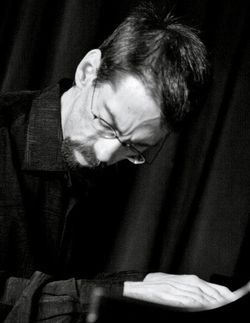
Pianist Fred Hersch. Photo: courtesy of ECM
AF: It strikes me once again, as I’ve thought so many times before, that you have a remarkable honesty. A lot of people would hold their personal lives very close, but you’ve been out there with your heart on your sleeve for 50 years. And it’s tremendously moving, speaking as a member of the audience now, it’s tremendously moving for me to say, “Oh, here’s another record by Fred. . . . isn’t that great?” Because you’re a friend through your music now, because you’ve been so honest. How do you think that honesty comes out in the music itself?
Hersch: Well, where do I want to start? I came out in a big way in 1992, ’93, about being gay in the jazz community, having HIV-AIDS, and I saw people dying, and I saw their families disown them. And I felt like if I can come out about all this, people will see, “Hey, Fred’s doing pretty well.” Maybe people will get the idea that they need to tell people what they’re dealing with, because when the chips are down, their blood families may not be the people that are going to be there for them. And if you keep everything in the closet, they’ll never get to know you as they are.
And also, if you want to be a musician or an artist, you have to be comfortable with who you are. And I was just getting sick of who knew what. I just decided this is a chance to do some good for [myself], and maybe inspire some other people.
And I was doing a lot of activist work, raising money, banding together lots of famous jazz musicians for benefit concerts and recordings. And it was something that I felt I could do, and when we’re in a helpless situation where I really did not know . . . I mean, I was making friends with my 48 remaining T-cells . . . and you just don’t know when the shoe’s gonna drop. It’s important to feel like, “Okay, if I’m going to go out, I’m going to go out swinging, and I’m going to break the mold.” It’s terrible that people go through their lives, not letting people know who they are. And that’s different than saying, “Oh, hey, I’m Fred, I’m gay, and I have HIV.” It’s just . . . it’s one part of me, you know? But being a sort of a quiet activist is just something that dropped into my lap. It’s nothing I set out to do, but when it appeared, I just said, “Yeah, of course, I’m going to go with this.”
AF: How does it feel to be a survivor, to recapture your skills after a health disaster, when some of your pianist contemporaries – Geri Allen, Mulgrew Miller, Kenny Kirkland, Frank Kimbrough, Kenny Drew – they’ve all passed away?
Hersch: Yeah, it’s not lost on me that I’m 70 and that Bill Evans was 52 when he died. I find it surprising slash ironic that of all of the posse of piano players that were sort of my elders when I came to New York – the guys a few years older than me who were already playing with name bands – that I’m kind of the one in the end with the biggest career. I mean, I’m just surprised by that fact sometimes.
Yes, there have been too many that have died too young. That’s an interesting question. I think as long as I have things to look forward to, I don’t feel like I’m in survival mode.
AF: On the other hand, there are some of your contemporaries – bassist Christian McBride, saxophonist Joe Lovano, keyboardist Billy Childs, trumpeter Wynton Marsalis, pianist Brad Mehldau – Mehldau even was one of your students – these are people who are “bigger draws” these days than you are, and maybe they command bigger performance fees. Does it feel like you should have more status than you do have?
Hersch: Well, at this point, I’m more or less as busy as I want to be. I’m playing at major venues and festivals. Nobody is telling me, “Oh, you know, in order for you to get some gigs, you have to do some kind of concept thing,” or “[You] have [to have] Jesus Christ in the rhythm section,” or “[You need to do] some kind of special thing for the performing arts community,“ you know? I’m lucky in that I can kind of just do what I do.
I think I got kind of freaked out, especially early on when Brad kind of exploded, and there I was, his teacher, and now Sullivan [Fortner] is exploding, and I was his teacher. But in the end, you know, in the end, it’s all good. I mean, both of them are technically incredible, you know.
I saw Jim Hall’s business card once, and it said, “Jim Hall, guitar. I don’t play fast. I don’t play loud.” I mean eighth notes are cool, you know? It worked for Lee Konitz, [it] worked for Chet Baker, and, you know, it’s not about who plays more or fast or who’s more of a badass.
 AF: A lot of people would want to know: how is your health today? Are you doing okay?
Hersch: I’m doing great. Since my [70th] birthday in October, I’ve had six stents put in my heart, and I just keep patching it up and moving forward. My friend Michael Wolff – he’s a little older than me, but he’s been through a terrible health thing with cancer, a very rare cancer – we call each other tough Ashkenazi motherfuckers. You know, we’re the cockroaches of Europe, and they can’t kill us, so . . . we keep coming.
AF: Is your mindfulness meditation part of your ability to be centered on where you are as a person?
Hersch: Absolutely. It’s been, well, intermittent because of health, but kind of a constant in my life since ’99. And, you know, I mean, when you sit down to meditate, you’re just checking in with yourself, really. Like, “Okay, what is appearing?” and “What am I aware of?” Even being aware you’re not aware is still being aware. So it’s not about being a great meditator or being in a zone for half an hour.
There are days when you sit down and you’re just kind of immediately in this relaxed zone, and your breath is available to you, and you’re not distracted, but that can change on a dime when all of a sudden [you tnink], “What’s for dinner?” or, “I’ve got to send that email,” or “Will I make my plane connection in Chicago?”, monkey-mind, all these things come up. It’s the function of the mind to think, so they’re not bad. What you want to do is observe them and not get hooked with them. So when I first started formal meditation, I realized I’ve been meditating on a piano bench since I was four or five years old. That’s my place, you know? And I close my eyes when I play, and it’s kind of my place. So yeah, it was not a stretch.
AF: You’ve had the experience of real drug issues. I wonder whether there is anything you can cite as a recording or experience where you were playing under the influence, and comparing that with a time that you were not playing under the influence, and maybe you said, “Oh, there’s something important here.”
Hersch: Yep. Well, I can recall it directly. In the summer of ’82, I was playing at the Village Vanguard with [saxophonist] Joe Henderson and [bassist] Ron Carter and [drummer] Al Foster. And I was in the habit of recording gigs on a big Marantz cassette deck, which is the size of a phone book. Nobody was giving me a hard time about doing it. They knew it was just for my personal use.
[It was] probably a Friday night or something, and the dealer hadn’t showed up. As a junior member of a band, especially with Joe, I always felt like I needed to come and have a little coke for the boss . . . anyway, the dealer hadn’t showed up, we played the first set, [and I thought] “Eh, it’s all right.” And then, between the first and second set – those were the days of three sets. 10 [PM], 11:30 [PM] and 1 [AM] – the dealer came, and we did some blow and I did [the next] set, and I thought, “Killing.”
And then, the next week, I listened to both sets [on tape] back to back, and it was totally reversed. You know, the second set, I was pushy. I was rushing. I played too long. It was annoying. And the first set was much more connected.
And that was the last time I did drugs. I just said, “That’s it. “
I’ve never had alcohol on the bandstand, never even had a drink [there]. In my early days, I smoked pot on the bandstand, but it’s a terrible drug to perform on. It’s great for listening, but not great for playing. I outgrew that, but the coke thing was everywhere in the late ’70s and early ‘80s.
But that was the last time I did any kind of drugs and played. You know, other . . . I mean, maybe an extra espresso, or once in a while an Adderall, but it’s not . . . I just want to know that it’s me up there. And if it’s good, I don’t want to think, “Oh, it was good because I had this,” or “I snorted that.” And if it’s not good, well, okay, I’ll just deal with that.
I only did heroin once, and that was with Chet Baker at a jam session. I snorted it, and it was really good. And it was so good, I said, “I can never do it again because it’ll never be that good again, never be that good. I’ll be chasing that for the rest of my life.”
I was around a lot of guys, some who died, and some who just were reduced to – it really harmed their career and their health. And I’ve been around a lot of guys who got sober too.
So anyway, I’m a pretty clean liver at this point. Most people I know are. Very rarely does anybody bring alcohol [to] the bandstand. I haven’t played with anybody who does drugs in decades.
AF: You’ve lived with your physical vulnerability for a long time. You were quoted in one interview saying, “I take 26 pills a day.” But now, as you look forward, what worries you most about growing older? I mean, Keith Jarrett and Steve Kuhn both retired from playing because they said, “We can’t do it anymore.” And that’s got to be scary for a piano player.
Hersch: I feel terrible for Keith. I know he’s unhappy and you know, it just . . . What can you say? He came back from chronic fatigue and had a fantastic second act. So, I don’t know. But it’s hard to be grateful when you’re not able to do what you love. It’s easy for me to say, “Oh, be grateful,” but I’m not him, you know?
Look, if I get to the point where I don’t feel I’m able to give a quality performance, that would be one thing that would get me to either stop or slow down. Another thing would be that travel just became impossible, or even more heinous than it is now. I don’t see anything that would make me stop. But I may someday do [as] Paul Motian [did], and say, “I’ll do whatever I can do within driving distance, but I’m not going to fly,” or “I’m not going to go to Europe.”
This December coming up, I turned down an offer to play in Tokyo and Taipei. It would have been [necessary to fly from] New York to Paris, Paris to Taipei, Taipei to Tokyo, Tokyo to New York, going around the globe. And I thought, “I just don’t need to do this. So I’m gonna go to Paris, play my concert, have a good time, and come home.”
I’m fortunately able, financially and otherwise, to not have to do everything. I don’t have kids in college or a mortgage. I mean, I need to earn a living, but it’s not . . . crazy. I have a lovely rent-stabilized loft in Soho [in NYC], and we [Hersch and his partner Scott] have this beautiful house we just built in the Catskills [in upstate New York].
I think, though, mainly it would be just the quality of the work. If I just felt like it was really just not to the level that I would expect of myself [then I would have to consider what I would need to do]. You know, [there are] all these stories about opera singers who have a hard time getting off the stage. I think I would not have a problem getting off the stage. That’s what I’d like to think anyway. Maybe.
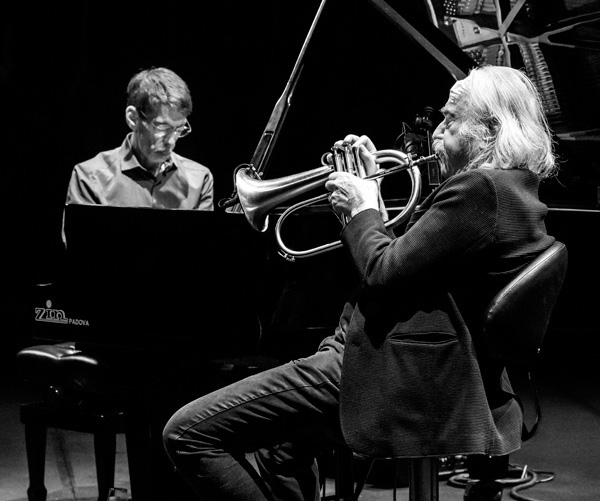
Pianist Fred Hersch and trumpeter Enrico Rava. Photo: Michele Giotto
AF: You know, the days grow short when we reach September. What goals do you have for tomorrow or next year or the next decade, if you can think that far ahead?
Hersch: Well, I’d like to get back to writing some music, writing tunes for myself to play. Not so much classical composing, I’ve kind of stopped that. I’m considering some study, perhaps music study. You know, on my good days, I’d like to brush up [on] my French and do things like that, but, just to get up and have a good day, meditate, swim in the pool, do some music, cook a nice meal, read a book, and just keep things simple.
I’m going to have about seven weeks from late July to mid-September where I’m off the road completely. And I just plan to be up here in the Catskills. I now have a music room. I’ve never had a music room before, a separate room for the piano. So, you know, I want to try to write some more music. That would be the immediate goal, and just develop the next record project, which I’m really not sure what it [will be]. A lot of it depends on what Manfred Eicher wants to do. That’s how I feel about it.
AF: Are you exclusive with ECM now?
Hersch: I think [Manfred] feels that way. I feel very much at home there. You know, it’s a kind of a lovely family to be part of.
[Another idea I have:] it’s always bothered me that pianists often graduate from music school in debt, and all of a sudden they don’t have a place to practice and they don’t have an instrument. If you’re a saxophonist, you have one, or a bassist, you have one.
So I have a concept for a nonprofit called “Play It Forward,” which would provide pianos on some basis for a period of time to deserving and financially needy graduating pianists, so that they don’t have to regress by playing an electric keyboard, so they have some kind of acoustic instrument to play. People right now are giving away pianos, and it just seems to be something that I could do.
My partner Scott is in a global health nonprofit, but he can set up a nonprofit in his sleep. I’m just kind of nosing around to see if this seems to be a worthy enough idea to pursue. I’d like to make some kind of contribution like that. I’m not sure what form it’ll take, but it’s just something that’s always bothered me, and maybe it’s something that I can do something about, and it would also be a way to give back.
AF: I don’t want to take any more of your time. It has been, as they say, a blessing, to have the opportunity to speak with you. I feel like I’ve had a close encounter with somebody I’ve admired for a long, long time.
Hersch: Oh, thank you. And thank you for the excellent questions, for letting me rattle on when I needed to.
AF: Well, cross your fingers that the Zoom transcript of this will come out well – otherwise I’ll have to rely on my memory, which will be a challenge these days . . .
Hersch: Yeah, I know. Jazzheimers.
AF: Yeah. Well said.
Fred Hersch’s Leaves of Grass is a milestone in the history of projects blending jazz and poetry. Photo: Wiki Commons.
MORE:
Hersch’s management, Unlimited Myles, has made available several beautiful performance videos, including this one, of Fred playing Thelonious Monk’s “’Round Midnight.”
Hersch will be one of the featured artists performing in Boston at the Vivo Jazz Festival in April 2027, a four-show series that has become an annual event for the venerable concert producer Vivo Performing Arts, formerly known as the Celebrity Series of Boston. This year, Vivo is presenting the four concerts on successive days at the start of April in a new venue, the Museum of Science’s Public Science Common. Hersch’s show, on April 1 at 8 PM, will be a trio date, with bassist and drummer to be named later.
Much of Ferd Hersch’s work is available to hear through the various streaming services, although it is always better to support the artist by purchasing his or her work.
Here are seven recent Fred Hersch releases of note:
Feebles, Fables & Ferns (ECM, 2026; recorded August 1988) – duets with guitarist Mick Goodrick. I have reviewed this recording for The Fuse.
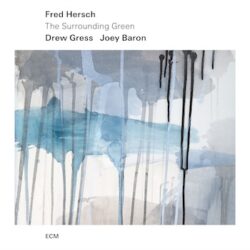
The Surrounding Green (ECM, 2025; recorded May 2024) – Hersch’s most recent trio recording, with bassist Drew Gress and drummer Joey Baron. Named by my colleague Michael Ullman as one of the best records of 2025.
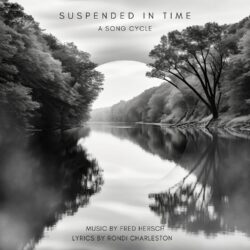
Suspended in Time (Resiience Music Alliance, 2025; recorded 2020 – 2023) – an original song cycle, with music by Hersch and lyrics by Rondi Charleston, sung and spoken by Kate McGarry and Gabrielle Stravelli, with clarinetist Bruce Willliamson, drummer Kush Abadie, percussionist Rogerio Boccato and the Crosby String Quartet.
ETC (Red Records, 2024; recorded 1988) – remastered version of an early date by ETC, a cooperative trio of Hersch, bassist Steve LaSpina and drummer Jeff Hirschfeld.
Silent, Listening (ECM, 2024; recorded May 2023) – solo piano. Named as one of the top 60 jazz albums of 2024 in the annual Francis Davis Jazz Poll.
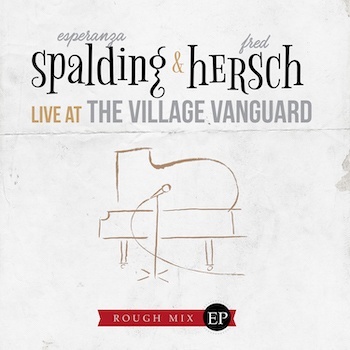
Alive at the Village Vanguard (Palmetto, 2023; recorded October 2018) – duets with vocalist esperanza spalding.
The Song is You (ECM, 2022; recorded November 2021) – duets with trumpeter Enrico Rava. The album was reviewed in the Fuse by my colleague Michael Ullman.
And four personal favorites from Hersch’s back catalog:
Passion Flower: Fred Hersch Plays Billy Strayhorn (Nonesuch, 1996; recorded 1995) – with bassist Drew Gress, drummer Tom Rainey, and string orchestra conducted by Eric Stern.
Thelonious: Fred Hersch Plays Monk (Nonesuch, 1998; recorded February 1997) – solo piano.
Songs & Lullabies (Sunnyside, 2003; recorded July 2002) – exquisite duets with the great British poet-singer Norma Winstone, on songs Hersch and she co-wrote, with vibraphonist Gary Burton on three tracks.
Leaves of Grass (Palmetto, 2005; recorded October 2004) – a song cycle by Hersch on poems of Walt Whitman, with Kurt Elling and Kate McGarry, singing and recitation; Ralph Alessi, tp; Mike Christianson, tb; Bruce Williamson, as; Tony Malaby, ts; Erik Friedlander, cel; Hersch, p; Drew Gress, b; John Hollenbeck, dm. I wrote about this work and a related Boston concert for The Arts Fuse in 2019.
Steve Elman has contributed to The Arts Fuse since its early years in the late 2000s, writing on jazz, classical, and related art forms. Since the 1970s, he has contributed articles on music to The Boston Globe, The Boston Phoenix, and The Schwann Record & Tape Guide, where he served as Editor of Jazz and Popular Music. His four decades in Boston public radio include hosting music programs, producing arts programming, and management at WBUR, and several years as a fill-in classical host on WCRB.
He is co-host (with John Redman) of JazzAve, a podcast / website based on his sixty years of listening to music and engaging with the people who make it. The monthly podcasts, exploring personalities and topics in jazz, are available at https://jazzave.net/.