
Jazz Album Reviews: Two Duets — One Language of Trust
By Steve Elman
Separated by 35 years, new releases from Ran Blake & Dominique Eade and Mick Goodrick & Fred Hersch illuminate jazz at its most intimate—where interpretation, history, and shared sensibility converge.
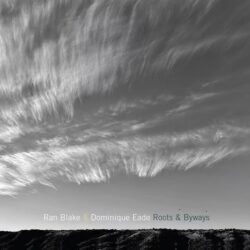
Roots & Byways by Ran Blake and Dominique Eade
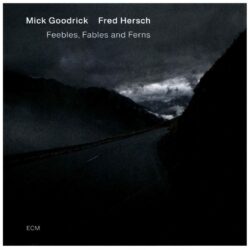
Feebles, Fables & Ferns by Mick Goodrick and Fred Hersch
Musical duets are akin to verbal conversations. They mirror all the kinds of discourse humans have with one another. The best ones enlighten, reveal, enrich. And because they have the special resonances of communication via music, these kinds of exchanges can explore depths of feeling that mere talk can only suggest.
You can hear two of the best conversations in music I know of on two recent releases, recorded 35 years apart, both with intimate connections to Our Home Towns, the triple cities of Boston, Cambridge, and Brookline. Neither shows its age; the conversations are so fresh and alive that they might have been recorded yesterday.
This, despite the fact that one of the conversationalists, guitarist Mick Goodrick, a figure revered and celebrated as a teacher and performer here, died in November 2022. And his partner in that effort, pianist Fred Hersch, has long since left Beantown for Big Town.
But much of Hersch’s heart is still here — his memories of student and teaching life, his kinship with fellow students who’ve gone on to bigger things, and even his regard for the partners in the other duet album, Ran Blake and Dominique Eade.
Reciprocally, both Goodrick and Hersch are dear to the heart of Dominique Eade, who performed in duet with each of them.
Although these two conversations took place in different eras, in different spaces, and with different purposes, the overall impact of each of them is similar: an expression by two musicians of their mutual regard and their commitment to mutual accomplishment.
The most recent duets by pianist Ran Blake and singer Dominique Eade, collected in the new release called Roots & Byways (Sunnyside, 2026), were recorded in Jordan Hall in August 2023. This one is a logical follow-up to Town and Country (Sunnyside, 2017), their previous duet recording, with important differences. The Town and Country session was an eclectic collection of material that Eade and Blake selected separately, ranging from film score themes to Bob Dylan to Blake originals to pure folk music. In the newly released session, Blake chose all of the material, and, while still eclectic, Roots & Byways is more focused on jazz-related tunes, with bits of country, soul, French chanson, and traditional Americana as well.
I could simply say that this is yet another demonstration of the extraordinary and complementary gifts of two fearless musicians who happen to make the Boston area their home. Taken together with Town and Country and their first duet recording, Whirlpool (Jazz Project, 2012), their recorded work now encompasses 47 carefully crafted small-scale gems. The two longest pieces among them are found on the first recording, Whirlpool, running 5:45 and 4:50 respectively, but they are exceptions. Only three of the 47 are longer than 4 minutes, and most accomplish their purposes in less time.
Eade said this, when I asked her about working in duet with Ran Blake:
Working with every pianist is different. [It’s been proven scientifically that] the same piano played by different pianists, even if [they are] playing the same thing … is measurably different. When I jump into the mix, our sounds combine into something unique again…. No matter who I am playing with, it’s that combination of sounds that I am reveling in, even if the material is melancholy, nostalgic, or, should I say, in Ran’s case, noir. I am still listening for the joy of our sounds combined, and I feel I am at my best expressively when we find each other, rather than trying to impose my point of view solely.
Like Town and Country and Whirlpool, Roots & Byways demands close attention for full appreciation. If your focus wanders, you will miss something exciting, although the excitement here is aesthetic rather than visceral. That’s why it’s better to take each of the pieces individually, to let one breathe a little in your mind before you hear another. Blake and Eade have thought carefully about the paths they want to illuminate and they deserve your respectful listening.

Ran Blake and Dominique Eade. Photo: Ingrid Monson
I think each listener will first gravitate to the music in this set that he or she already knows, because the Blake-Eade versions are most revelatory when the listener already has impressions from more conventional interpretations. So take the gifts these musicians offer you, and find your own way into the music.
Nonetheless, I do want to point to some of my favorite moments in Roots & Byways, in the hope that they will be doors through which you might enter this very distinctive musical world.
The first track on the release, “Mood Indigo,” is so well-known from the original Duke Ellington recording and from numerous covers, that you might think nothing new can be done with it. You would be wrong. As in many other cases here, Ran and Dominique reach deep into the song to bring out dark nuances that we may have ignored or forgotten, nuances that even the composer may not have intended. Ellington’s original, even before lyrics were written for it, was consciously theatrical in tone — more “Mood” than “Indigo” — but Blake and Eade emphasize the second word in their interpretation. Here, Dominique shows off her melismatic skills, drifting around the notes atmospherically, and Ran provides reharmonizations under her that are Monkishly misterioso. One favorite moment: just before the lyric says, “Down to my shoes,” Dominique chooses a high note and then illustrates those words with steps down through them.
They also take another familiar song into the dark: the traditional tune “On Top of Old Smokey.” You may have to play back the lyrics from your memory (or read them on the net) to realize that, at its heart, this is not a jolly ditty for kids to sing, or even a late-night drinking song, but a song about abandonment and bitter regret; it has lost a lot of its juice through endless repetition. Ran puts a surprising gospel feel into it, which is even more surprising for how successful an idea that is. Dominique sings it elegantly, letting real emotion come into each line. As the lyric moves closer and closer to its final lines of despair, Blake and Eade move more darkly with it: “Never place your affection in a green willow tree / For the leaves they will wither, the roots they will die / And you’ll be forsaken and never know why.”

Singer Dominique Eade. Photo: courtesy of the artist
There are tiny moments of genius: Dominique’s long pure note at the very end of “Saving All My Love for You”; Ran’s use of stop-time in a variety of ways, each time with different impact (in “Mood Indigo,” “Mendacity,” “Saving All My Love for You” and “Lost Highway”); Dominique’s free approach to the closing chorus of “What’s Your Story, Morning Glory?”; Ran’s dramatic left-hand chords near the end of his half-chorus solo on Thelonious Monk’s “Pannonica”; Dominique’s word “snow” at the end of Charles Mingus’s “Portrait,” which Ran wisely leaves hanging in the air, undecorated; and Ran’s great solo, one of the best in his discography, on “Who Cares?”
Perhaps the three political songs will get the most attention from first-time listeners. They give the album contemporaneity without resorting to the obvious. Each of them resonates on multiple levels, and each of them lingered in my mind long after the music was over:
Max Roach’s “Mendacity,” originally sung by Abbey Lincoln in the midst of the civil rights struggle in 1961, now sounds prophetic, and the duo plumb it pointedly: “The winner’s not the one who’s straight / But the one who lies the most.”
“Who Cares?” is from the Gershwin / George S. Kaufman / Morrie Ryskind political-satire musical Of Thee I Sing (1931), in which the President of the United States runs afoul of public opinion and campaign realities when he chooses to love a woman he really cares for instead of a woman who will give him political advantage. This song is the President’s defiant snub of others’ opinions, and Ran and Dominique work it ironically, especially enjoying the line, “Who cares how history rates me / As long as your kiss intoxicates me.”
And finally, there is Ran’s solo-piano interpretation of “Les Grognards,” a song associated with French diva Edith Piaf. The singer takes the voice of dead infantry soldiers, the “grunts,” the cannon fodder, the groaners (“… like old beggars under sacks / Knock-kneed, coughing like hags …” – Wilfred Owen), resolving to march into Paris without their grenades, without their guns, without their shoes. As he plays, Ran interpolates “Under Paris Skies” and “Mademoiselle from Armentières.” Is it possible that he has seen the modern war-game resuscitation of les grognards as action figures in Wargames Atlantic’s Death Fields, where the company’s website proclaims, without a hint of irony, that “the greatest game is war”?
 It may be clear from my comments above that Roots & Byways is a multifaceted adventure and that each track can and does stand alone, although as a collective recital, they speak eloquently about the talents on display.
Feebles, Fables & Ferns, by guitarist Mick Goodrick and pianist Fred Hersch, is a distinctly different set of duets, because the individual tracks (although they can be enjoyed separately) are parts of an interrelated whole which has taken on a special shine with the passage of time.
Again, Dominique Eade has a pointed comment: “In addition to my early days with Ran, the person who I probably learned from first [about “finding the joy of sounds combined”] was Mick Goodrick, who was my duo partner in many settings as well as playing in many bands with me. He was extremely sensitive to every aspect of timing and dynamic, and had a multidimensional response to it all. Because of his harmonic prowess on the guitar, it was very powerful, sometimes almost overwhelming.”
38 years ago, Hersch invited Goodrick to come to his loft-studio in Soho, where they recorded this material, maybe (they thought) for commercial release, or maybe just to memorialize their friendship and their musical rapport. Goodrick always liked the session, and after his death three years ago, his executor urged Hersch to listen to those old tapes once again. Hersch and his home label, ECM, saw new timelessness in the music, and it has finally appeared on CD, with Goodrick getting top billing — an appropriate redress for an artist who stayed out of the spotlight for much of his life.
In the years since he recorded this music at age 23, Hersch has become almost a completely different person physically, but he has remained the same artist spiritually. He has survived cocaine, HIV-AIDS, hospitalization with Covid, a medically-induced coma, severe depression, and heart disease. But the Hersch of 1988 is the same artist as the Hersch of 2026. You might look for him to be more optimistic in Feebles, less tempered by the curves life has thrown at him, but I don’t hear either of those qualities. Instead, what I hear is his enduring regard for a contemporary musical friend (albeit one 10 years older) and his pleasure in their shared artistry — qualities that have also marked his many duet recordings and performances with others in the succeeding years.
Some of those duets, by the way, were encounters with Dominique Eade. She says:
[Fred and I] did a duo concert in Jordan Hall, and two [dates] at the Regattabar. And he [plays piano] on my recording, When the Wind Was Cool [RCA, 1997]. The track “When the Wind Was Green” is a duet with just the two of us, [which you could hear alongside Roots & Byways] for comparison. He may not throw [in] as many dissonances or rhythmic curve balls as Ran [does], but he is still exacting in his way.
“Exacting” is one word that applies well to Hersch’s work (as well as to Goodrick’s) in Feebles, Fables and Ferns. I might add “intuitive,” and “telepathic,” and “sublime.”
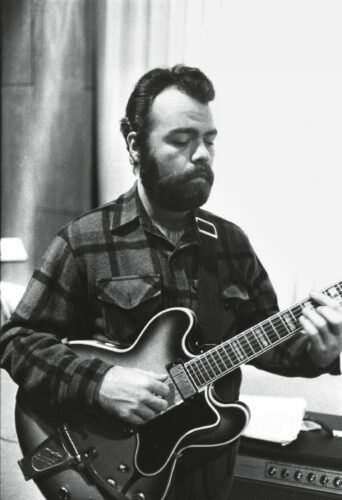
Guitarist Mick Goodrick. Photo: courtesy of ECM
Many listeners will be struck by the beauty of the duo’s exploration of Hersch’s “Heartsong,” one of his most lyrical tunes — one that deserves to become a jazz standard, IMHO. And others will love the impressionistic meshing of the Goodrick original “Away 10” (played by Hersch as a solo piano introduction) with Steve Swallow’s “Amazing.” The two pieces are so harmonically compatible that their interweaving here cannot be untied.
To add to those, I was particularly taken with these tracks:
“Falling Grace,” one of bassist Steve Swallow’s most-recorded compositions, with more than 20 years of interpretations behind it in 1988 and today nearly 150 recordings, is home ground for Hersch and Goodrick — their friend Swallow was a colleague in the Boston music community at the time and a performing companion later on (Example: Swallow’s Always Pack Your Uniform on Top [XtraWatt, 2000; rec. London, 1999], with Goodrick). The interpretation unfolds in a lovely parallel structure. Hersch opens it solo, and states the theme gorgeously, with rich decoration. Goodrick enters quietly and it quickly becomes a contrapuntal interweaving of voices (shades of Bill Evans and Jim Hall in Undercurrent [United Artists, 1962]). Hersch gradually becomes more of an accompanist to Goodrick, and then he drops out completely as Goodrick plays single notes solo for 15 seconds. Hersch re-enters, and the counterpoint resumes, moving sure-footedly toward the final theme statement with both voices in equal strength. They come to a perfect conclusion.
I also have to point to a tune that neither Hersch nor Goodrick has recorded elsewhere — pianist Mal Waldron’s “Soul Eyes.” Since its original recording by Waldron with John Coltrane and trumpeter Idrees Suleiman in 1957 (Interplay for Two Trumpets and Two Tenors, Prestige), it has not exactly been neglected; to date, there are 256 versions of it shown on Second Hand Songs, a site that tracks cover versions. What we hear on Feebles is is an especially rewarding demonstration of Goodrick’s way with a melody. In the first chorus, Hersch provides a gentle rhythmic cushion and Goodrick plays the line with penetrating sincerity. His solo is a model of what might be called economic eloquence — there is not one extraneous note, and every note he plays seems ideal. In his solo, Hersch takes a richer approach harmonically, edging it toward impressionism, but Goodrick calls it home, reemphasizing the purity of the tune, and the two conclude in a misty cloud.
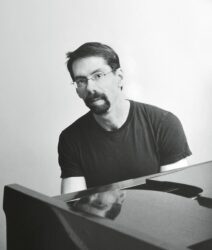
Pianist Fred Hersch. Photo: David Bartolomi
It was perhaps inevitable in the context of this hearing that I was reminded of Ran Blake in the Hersch-Goodrick version of Johnny Green’s “Out of Nowhere,” a song Blake himself has not recorded, insofar as I can determine. A chord of indeterminate tonality from Goodrick starts the proceedings here, and then Hersch goes alone into Nowhereland for about 25 seconds, with long held notes, misterioso chords and Blake-like spaces. Goodrick joins in the same spirit. The familiar chords emerge gradually through a stunningly simpatico passage of counterpoint. By the halfway point of the tune, the chord structure is firm underneath them, and Goodrick has a slightly more forward role for a bit. Then Hersch takes the lead, and he knows exactly when to lead the two into a full statement of the theme for the first time. The spirit of Blake returns at the end, as Hersch concludes with a polytonal echo of the “You came along from out of nowhere” motif, which simultaneously recalls Ellington’s “In a Sentimental Mood.”
When I spoke with Hersch, he remarked on Blake’s importance and his influence on Hersch’s thinking:
“When I moved to Boston in August of ’75 … that fall, Ran Blake did a solo concert in Jordan Hall. And it profoundly influenced me. Just sonically, the way he used the pedals…. The hardest ear training I ever had to do was [with Ran;] he made me lip-synch to three Billie Holiday tunes, and it was really hard … and his book is amazing, The Primacy of the Ear.… and so many great musicians have come through him.”
Let Dominique Eade have the last word: “I am so glad this Fred and Mick record came out. I heard it when it was recorded and to hear it again is to hear a deep conversation between two people I love.”
More:
I was particularly fortunate to communicate with both Dominique Eade and Fred Hersch about these recordings, and I am very grateful for their time and thoughtfulness.
I interviewed Hersch at length in June, and he not only spoke about Feebles, Fables, and Ferns, but talked expansively about his life and his work. The transcript of that conversation appears in a separate post on The Fuse.
In our discussion, he confirmed that “Feebles, Fables and Ferns” is a contrafact of “Baubles, Bangles and Beads,” a tune written for the musical Kismet (1953) by Robert Wright and George Forrest, who took their theme from the scherzo (second movement) of String Quartet No. 2 in D by Alexander Borodin.
My colleague Jon Garelick reviewed the second Eade-Blake collaboration Town & Country for The Fuse in 2017, with many cogent observations.
I wrote a piece for The Fuse in 2012 about a Dominique Eade quartet date that year and her first album of duets with Blake, Whirlpool.
Steve Elman has contributed to The Arts Fuse since its early years in the late 2000s, writing on jazz, classical, and related art forms. Since the 1970s, he has contributed articles on music to The Boston Globe, The Boston Phoenix, and The Schwann Record & Tape Guide, where he served as Editor of Jazz and Popular Music. His four decades in Boston public radio include hosting music programs, producing arts programming, and management at WBUR, and several years as a fill-in classical host on WCRB.
Tagged: "Roots & Byways", Dominique Eade, Fables & Ferns, Feebles, Fred Hersch, Mick Goodrick
2 Comments
Leave a Comment
Just to add that Mick Goodrick was also an important teacher in Boston. I’m not a guitarist, but a close friend and musical collaborator who did play guitar studied with him and told me how unique and even startling Goodrick’s teaching style was. In my recollection, it was not about practicing scales, etc., but about clearing your musical palette, as it were, so that new ideas could more easily surface in your playing.
Such a great close reading of all these performances. I want to listen again to the Ran/Dominque record, this time with Steve’s guidance…. And I need to check out the Hersch/Goodrick. I was always impressed with Goodrick’s playing live — taste and tact, he knew exactly what to play and when to play it.