Concert Reviews: Chamber Ensembles at Rockport Trace Music’s Shadow and Light
By Aaron Keebaugh
A pair of concerts at the Shalin Liu Performance Center paired elegy, bite, and virtuosity in vividly different ensemble settings.
Delirium Musicum and the Balourdet and Terra Quartets appeared at Rockport’s Shalin Liu Performance Center as part of the Rockport Chamber Music Festival on July 1 and 9.
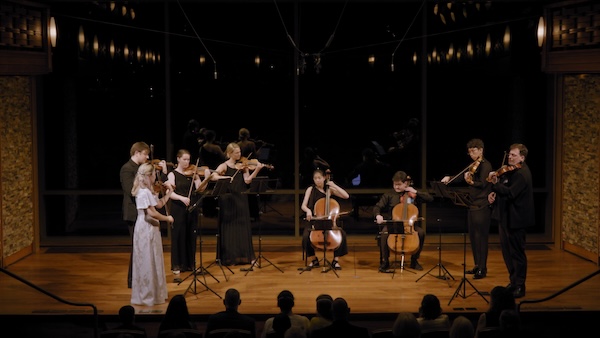
Balourdet and Terra String Quartets combined at the Shalin Liu Performance Center. Photo: Courtesy of Rockport Music
Known for his melodic gift, Argentine composer Osvaldo Golijov recognized he had something special when violist Barry Shiffman and others first read through his sketches for a film about Elie Wiesel.
With its liberal quotations of Hebrew melodies, Golijov’s music provided an ideal backdrop for Elie Wiesel: Soul on Fire, a documentary that recounted the experiences of the Nobel laureate and Holocaust survivor. The experience proved so moving that the composer turned the work’s themes into a concert work. The result was Tintype, which paints a sonic picture of a man who witnessed some of the world’s darkest horrors. Heard in one of the latest concerts at the Rockport Chamber Music Festival, the piece reflects a world that is slowly vanishing from memory. But Shiffman and the Balourdet String Quartet made its haunting auras feel as emotionally immediate as any beloved artifact.
Tintype opens in a shudder. Tremolos in the strings generate a ghostly scene as Joseph Achron’s beloved “Hebrew Melody,” made famous by Jascha Heifetz, gradually comes into focus. Throughout, the music moves with agility between the ethereal and the tangible. The second movement conjures memories of Wiesel’s father through quotations from Schubert’s posthumous Piano Trio in E-flat. The finale is built upon a musical reference to the “Ani Ma’amin” (Hebrew for “I believe”), a statement of faith and courage spoken by Jewish prisoners as they headed to the gas chambers. The musicians conveyed the music’s heavy sadness while evoking fleeting moments of levity. The performance of this piece suggested that some memories were too painful to linger over for long.
The rest of the program, which paired the Balourdet and Terra Quartets, explored greater contrasts between shadow and light.
The Balourdet Quartet rendered Ravel’s String Quartet in F major with subtle intensity. The opening harmonies shimmered, and the pizzicato phrases of “Assez vif” danced with folklike verve. Dusky harmonies generated sonic gravity in the third movement before the players tore into the fiery finale.
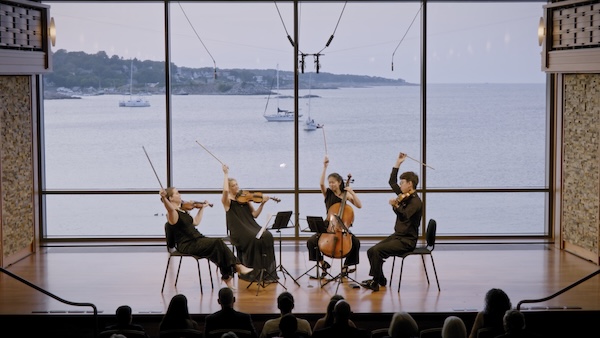
The Terra Quartet at the Shalin Liu Performance Center. Photo: courtesy of Rockport Music
In contrast, the Terra Quartet made Aleksandr Borodin’s String Quartet No. 2 feel calm and cool, though somewhat detached. Borodin composed this lyrical score as a 20th-anniversary present for his wife, but there was little warmth in its opening phrases here. The players worked together with firm concentration; the music was clean and clear, but somewhat lacking in commitment. That changed in the second movement, where the lines swept by gracefully and supplied gentle flourishes. Mystery haunted the finale, as the musicians leaned into every enigmatic gesture. The famous Notturno unfolded soulfully. Audrey Chen’s cello complemented the silvery resonance of violinists Harriet Langley and Amelia Dietrich as they wove lines around each other.
Dmitri Shostakovich’s Two Pieces for String Octet, which brought the ensembles together, coursed with seismic vigor. Though this was a teenage effort, the octet remains one of Shostakovich’s most arresting early scores, bearing elements that would later become part of his mature style. Phrases propelled forward like a freight train. Other passages almost shocked the air around them. The rendition was tinged with a hint of sarcasm throughout.
Drawing on the combined strings, the opening Prelude sounded like a Russian Orthodox choir, dark and assured. A sudden explosion of vitality allowed the pent-up tension to run free, and the music never settled into a passive equilibrium. The Scherzo continued along its stormy course, the strings trading a series of dissonant shrieks.
The robust performance reminded me of the approach of Delirium Musicum, a Los Angeles-based string orchestra that made its East Coast debut at the Shalin Liu Performance Center earlier this month. A so-called self-conducted ensemble, Delirium Musicum blends the old and the new with a power and panache that make everything feel fresh.
The newest work on their program was Cactus-Yucca Scrub from Gabriella Smith’s Desert Ecology. Written for Delirium, the score blends aggressive rhythms with unusual performance techniques; the musicians place paper clips over their strings to create wheezy sonorities. Pizzicato figures galloped through its prickly textures, as if one were strumming the needles of a cactus. Elsewhere, dissonances evaporated into harmonious vapors. This music was, in the best sense, a play of colorful gestures.
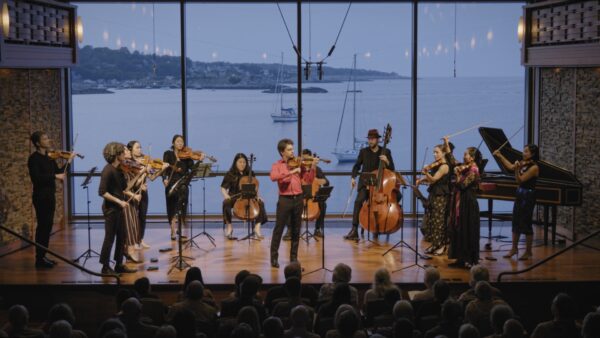
Delirium Musicum at the Shalin Liu Performance Center. Photo: courtesy of Rockport Music
Max Richter’s Recomposed conveyed an eerie solace. Built upon themes from Vivaldi’s Four Seasons, Recomposed is that rare work of classical music that has achieved enormous popular appeal — it has garnered hundreds of thousands of clicks on streaming platforms. Why the success? The piece’s pleasant sonority, crafted from repetitive gestures, simple rotating harmonies, and moments of sheer pizzazz.
In Delirium’s performance of “Summer,” the strings struck a balance between the familiar and the otherworldly, shifting between the opening sighing gestures and the propulsive onslaught of the middle and final movements.
Philip Glass’s Enchorus struck a more emotional chord. Crafted from simple gestures, this short work moves from the inside out: a solo violin joins a small group of strings to bounce lines at the full ensemble which, in turn, sends the phrases back. The musicians played the score with hushed sensitivity.
Delirium played Saint-Saëns’s familiar Danse Macabre with devilish ferocity. They did the same for the Intermezzo from Zoltán Kodály’s Háry János. A transcription of Schubert’s Erlkönig, the performance bounded as vigorously as the poem’s midnight horse ride.
Jessie Montgomery’s “Banner,” a riff on the national anthem and “Lift Ev’ry Voice and Sing,” see-sawed between mournful elegy and celebratory zeal in an Ivesian collage. By contrast, Erik Satie’s Gnossienne No. 1 flickered like distant candlelight.
What lingers most is Delirium’s intensity: their “Winter” from Vivaldi’s Four Seasons had the verve of a dance band, a reminder that — even beside the “latest thing” — Vivaldi may be the original def jam.
Aaron Keebaugh has been a classical music critic in Boston since 2012. His work has been featured in the Musical Times, Corymbus, Boston Classical Review, Early Music America, and BBC Radio 3. A musicologist, he teaches at North Shore Community College in both Danvers and Lynn.
Tagged: Balourdet String Quartet, Barry Shiffman, Delirium Musicum, Rockport Music