Visual Arts Review: Paul Klee’s Lines of Resistance at the Jewish Museum
By David D’Arcy
A rare, must-see gathering of Paul Klee’s satirical and prophetic drawings reveals how his angels, dictators, and “degenerate” visions saw Nazi Germany all too clearly.
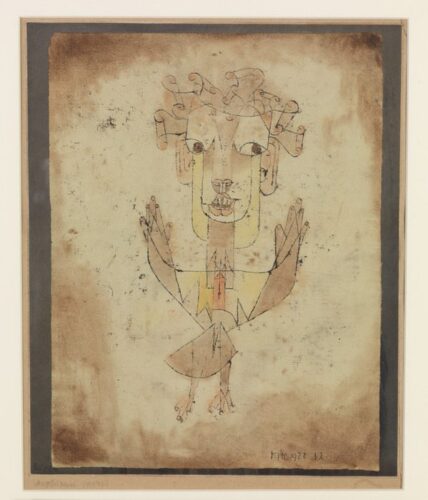
Paul Klee’s Angelus Novus, 1920. Walter Benjamin bought the work in 1921 and kept it with him through moves from Germany into exile. He used the image as a touchstone in several of his writings. Photo: courtesy of The Jewish Museum
To say that Paul Klee (1879–1940) was an original is like saying that Ingres could draw. Klee could do that, too.
“Art does not reproduce the visible; rather, it makes visible,” he said. Not known for vanity, he nonetheless still understood his gifts.
Klee was a satirist who could also exult in pure form—a master of grotesquery and of elegance. He pioneered visionary abstraction while also rendering figures with exactitude. His range of color can feel infinite, yet he probed the ominous depths of monochrome. His figures can be wildly comic—even angels, a perennial subject—while others are sublime.
In the catalogue for Paul Klee: Other Possible Worlds, at The Jewish Museum in New York through July 26, curator Mason Klein writes, “Beyond being nonconformist, Klee had the audacity to paint like a child, be sexually explicit, foreground the imaginary in the construction of reality, and reject all hierarchies other than morality.”
The current show includes another side of Klee: drawings he showed to colleagues in 1933, the year Hitler came to power in Germany. These sketches bear witness to what he called the National Socialist revolution. Not known for political pronouncements, he operated up to then more by wit than by accusation.
“The demoniacal,” he wrote, “shall be melted into simultaneity with the celestial; the dualism shall not be treated as such but in its complementary oneness. For truth asks that all elements be present at once.”
Up to a point, his drawings from the 1930s suggest. These pen-and-ink and chalk sketches show Klee at his most literal—paradoxically terse and resonant—and uncompromising in their engagement with threatening subjects.
The first work visitors are likely to see and remember is Drinking Companion (“Stammtischler”), a 1931 portrait of a bar regular. A beer-hall rabble-rouser gives more context. Some might see an unflattering likeness of Hitler or one of his followers in the messy mustache. Look closer, at the faint lines of a blotched face, and you see the kind of frustrated character that the director Rainer Werner Fassbinder played in his films of the ’70s. Klee (in the Nazi era) and Fassbinder (later) were both looking at Germany itself.
In another image, Violence (1933), one figure shoots another who appears to be raising his hands in surrender. Amid the swirls of ink, the attack is unmistakable.
In its snarl of black chalk lines, Crawling Man (1933) is a study in persecution: a figure on the ground is lifting his eyes upward—pleading for mercy?
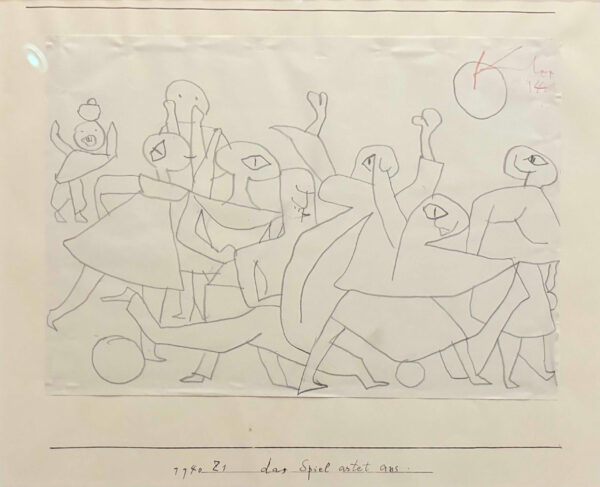
Paul Klee, The Game Is Getting Out of Hand, 1940. Photo: courtesy of The Jewish Museum
Emigrating (1933), in chalk on paper, may have been painfully personal. A weary couple, their bodies worn down and burdened with fear and shame, walk on, the man leading a woman with her head down.
Two later works are faint but foreboding. Battle Among Children (1938) presents a scramble of body parts with no guide to reassembly. The Game Is Getting Out of Hand (1940) is a deliberately crude line drawing of a dance—or a brawl—among one-eyed women, carefully choreographed despite its dismaying subject, which could have led to Klee’s arrest. “A line is a point that went for a walk,” Klee liked to say. Quite a walk indeed.
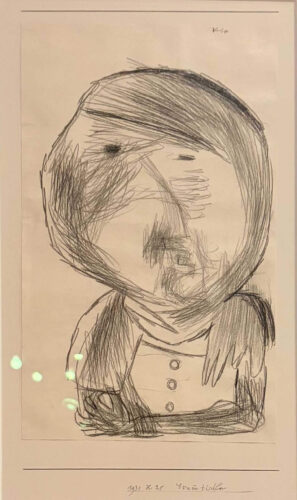
Paul Klee, Drinking Companion, 1931. Photo: courtesy of The Jewish Museum
Klee had already been stigmatized as an opponent of the Nazi regime in 1933 and was fired from his position at the Düsseldorf Art Academy. Not long before, he had left the Bauhaus, where he initially built his reputation. Though he wasn’t Jewish, Nazi propagandists maligned him as a Galician Jew. A lampooner of authority and a practitioner of abstraction, he was denounced in the Nazi exhibitions of “Degenerate Art” that showed his work in 1937. Klee also suffered from scleroderma, a then-incurable disease that causes severe internal damage; complications from the condition contributed to his death in 1940. His illness alone could have marked him for confinement and euthanasia, had he not fled Germany for Switzerland in 1933.
By 1929, Klee’s satire had already turned political. Monument in Progress, in mixed media, is a mock-up on cardboard of a massive bald head in pink marble, with ladders and scaffolds supporting a team of workers completing it. A dictator in pink? The head resembles that of Il Duce, Benito Mussolini.
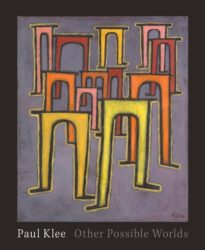
Landscape provided another opportunity for mockery. In Revolution of the Viaduct (1937), Klee, in Swiss exile, imagines bridges standing on legs, gently ridiculing Nazi promotion of highways and infrastructure. The image, from the year his work was declared “degenerate,” appears on the exhibition catalogue cover.
Visitors this week will also have the chance to see Angelus Novus (1920), Klee’s drawing of a winged figure with tousled hair and outstretched appendages, strikingly lifelike in its ambiguous, wide-eyed expression. The yellowed work—described by one scholar as “radically uncolorful,” especially for Klee—is in the collection of the Israel Museum in Jerusalem. It did not arrive in New York until early May, owing to the risks of wartime travel; a copy had previously stood in.
The drawing was owned by the critic and philosopher Walter Benjamin, who was prevented from crossing from France into Spain in 1940 and took his own life. Benjamin, a German Jew, feared capture by the Nazis. His death came only months after Klee’s.
Angelus Novus reaches back to the 16th century—Klee attached a copy of a portrait of Martin Luther behind it—and forward into contemporary art. The many angels in Klee’s work, several on view here, remain a focus for scholars. He sought a place for religious imagery in a troubled age; art historians are still mulling the reasons behind that mission.
The catalogue for Paul Klee: Other Possible Worlds, by Mason Klein, with reproductions of more than 100 works, is available from The Jewish Museum and Yale University Press.
David D’Arcy lives in New York. For years, he was a programmer for the Haifa International Film Festival in Israel. He writes about art for many publications, including the Art Newspaper. He produced and co-wrote the documentary Portrait of Wally (2012), about the fight over a Nazi-looted painting found at the Museum of Modern Art in Manhattan.