Book Review: A Soundtrack for a Warming World?
By Scott McLennan
Recomposed finds music poised between imaginative possibility and the entrenched economics driving environmental harm.
Recomposed: Music, Climate, Crisis, Change by Kyle Devine. Verso Books, 256 pages, $19.95 (paperback).
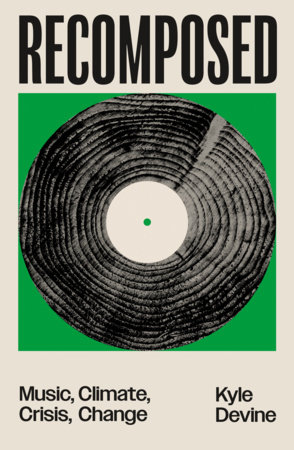 After outlining the social, economic, and environmental harms caused by the production of music in his 2019 book Decomposed, Kyle Devine next decided to investigate what people are doing to mitigate the problems that arise from the manufacture, distribution, and presentation of your favorite songs.
Recomposed: Music, Climate, Crisis, Change illuminates the doggedness of a selection of musicians, record companies, concert promoters, and activists embedded in arts and environmental movements trying to make music a sustainable venture. Yet the more Devine learns and shares with readers, the more Sisyphean the task seems to become, given the economic forces that like things the way they are and whose enticements can beguile even the most committed eco-warrior.
Devine has divided the book into three parts: first, he looks at what music makers are doing on the technical end to build a better platter for your turntable and to come up with greener deliverables for the streaming service of your choice. He then examines institutional campaigns to support the greening of music, and concludes with a discussion of how music’s immense cultural currency can be used to influence behaviors in ways that reduce our ongoing damage to the planet.
In each of these arenas, Devine’s heroes face a common villain: capitalism. If the current system remains locked in a production-consumption model limited to only nibbling at source materials, waste streams, carbon reduction, and energy use, then music makers will achieve nothing of consequence despite their best intentions regarding ending the degradation of the planet caused by creating music for personal, on-demand listening.
Devine, though, is no bearer of hopeless bad news. He argues that the music industry, despite formidable obstacles, has the cultural force, at least potentially, to play a significant role in encouraging effective action on the climate crisis.
One of the merits of Recomposed is how well it cuts through fashionable “green marketing” BS. The book offers a sobering assessment of just how small a dent we make in the climate crisis when we buy eco-friendly products or support arts that are fighting for the cause of the environment. He cautions that these actions alone will not come close to combating the climate crisis.
Without that crucial step toward class recompositing and majority coalition, without that affirmative yet additive political gesture, music’s own recomposition, along with everything else in mainstream climate politics, will be stuck with half-measures and partial answers instead of well-formed questions and definitive actions.
As economic conditions tighten the vise on climate discourse, Devine argues that the movement’s narrow fixation on carbon reduction is a con job by capital, designed to shut down any reckoning with the wider ecological devastation wrought by production and consumption.
Devine knows that music is only a bit player in the global drama of climate catastrophe, so he opens by pulling back to the wide shot: why has carbon become the master metric, what tensions arise between personal responsibility and collective action, and what happens when boutique “green” fixes are scaled up into systems.
Sometimes he loses the thread of his argument, veering into tangents laden with the worst kind of academic jargon—lines like “Responsibilization comes with an implicit theory of change, an implicit structure of political engagement”—before drifting further into discussions of radical behaviorism, consumption as fetish, and the politics of prefiguration.
Despite these digressions, Devine consistently returns, chapter by chapter, to music and the people who make it. He highlights those working to build a better record through unconventional manufacturing processes, using recycled PVC and plant-based plastics, and elevates artist-led initiatives that link musicians to clean-energy investments as well as the sweeping ambitions behind the recording industry’s Music Climate Pact. Though he acknowledges that “the revolution will not be philanthropized,” Devine nonetheless champions EarthPercent, which channels donations from music industry workers and companies into direct action—supporting strikes, labor organizing, and other efforts to loosen capital’s grip. Musician Brian Eno, an active participant in the project, tells Devine “that finding ways to solve the climate crisis will be tied to the alleviation of other social inequalities and injustices.”
That grip—and the many forms of human misery it sustains—will not be easily loosened. Part of its endurance, Devine argues, lies in a “crisis of the imagination”: an inability to envision the world otherwise. It is here that he locates music’s political force, as an art capable of shaping a collective sense of a world in which environmental destruction is no longer business as usual.
Scott McLennan covered music for the Worcester Telegram & Gazette from 1993 to 2008. He then contributed music reviews and features to The Boston Globe, Providence Journal, Portland Press Herald, and WGBH, as well as to The Arts Fuse. He also operated the NE Metal blog to provide in-depth coverage of the region’s heavy metal scene.
Tagged: "Climate, "Recomposed, Climate Crisis, Climate Warming, Crisis, Kyle Devine, Music, Music-making