
Classical Album Review: Thomas Adès and the Hallé Find Fresh Perspectives on Kurtág, Tippett, and His Own Music
By Jonathan Blumhofer
Vivid performances and an exceptional cast of soloists distinguish a rewarding album, with Michael Tippett’s Triple Concerto emerging as the real discovery.
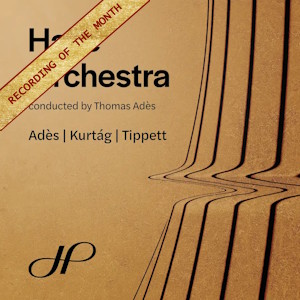 As Boston audiences are well aware, Thomas Adès knows how to curate a good program. His long association with the BSO has been conspicuously fresh in this department and, if anything, the recorded first fruits of his partnership with Manchester’s Hallé Orchestra, where he’s the ensemble’s first principal guest conductor, follow a similar template. For proof, take the pairing’s new recording of concertante items by Adès, Michael Tippett, and György Kurtág.
The latter—still with us and active in his 101st year—is represented by his Double Concerto for cello, piano, and a pair of chamber ensembles. Premiered in 1990, the score makes for a packed fifteen minutes. By turns explosive, roiling, and lyrical, it has an Ivesian quality to its anarchic shifts of mood and texture. Yet it’s also touchingly beautiful.
In this reading from cellist Nicolas Altstaedt and pianist Dénes Várjon, the Concerto’s wildness certainly comes across—the closing part of the opening movement sounds downright zany. But the duo and the Hallé players also tease out the deep wells of pathos that underlie the second part’s brooding lament. Here the music floats and drifts, like fog across a moor, seemingly trying to grasp an anchor but never quite succeeding.
As such, the Kurtág stands as an inviting lead-in to Adès’s Air. Written for Anne-Sophie Mutter in 2022, this 16-minute-long number is a study in purity and stratospheric violin playing. Anthony Marwood brings an impressive mix of clarity and warmth to that high-lying part, and the composer draws an accompaniment of notable tonal depth and musical space from the Hallé. Suffice it to say, the piece is a gem, and this recording is anything but a carbon copy of last year’s debut release from Mutter.
Similarly, Altstaedt brings his own point of view to Lieux retrouvés, Adès’s 2016 orchestration of his 2009 cello sonata. Despite their allusive titles, its four sections each go off in unpredictable directions, as though following musical threads to see where they lead.
The opening part, “Les eaux,” might, in fact, flow imperceptibly out of Air’s last bars, so subtly does Altstaedt articulate its ethereal opening phrases. “Les champs,” the beguiling third movement, is likewise hypnotic. At the same time, “La montagne” and “La ville – cancan macabre” are jagged and agile, with Offenbach given an acid bath in the latter, as it were. Though the cello sometimes sits a bit too far forward in the mix, there is, again, an enchanting depth to the Hallé’s contributions.
But it’s Tippett’s Triple Concerto that proves the album’s real discovery. Premiered in 1980, the score’s three connected movements depict a progression from night to day; the opening “twilight” episode is, somewhat surprisingly, often a bit spastic. Nevertheless, there’s a remarkable degree of lyricism and variety on offer in its pages, including the influence of Balinese gamelan, which lends both color and sensuousness, especially to the work’s latter parts.
This recording brings together violinist Marwood, cellist Altstaedt, and violist Lawrence Power, who prove an electrifying, simpatico combination. Their performance of this rarity sounds and feels perfectly attuned to its nuances of articulation, dynamics, and ensemble. The Hallé’s playing is likewise secure and balanced, with some especially fine woodwind playing in the second movement.
Jonathan Blumhofer is a composer, violist, teacher, and music writer who has been active in the greater Boston area since 2004. In addition to the Fuse, his work has appeared in the Boston Classical Review, Worcester Telegram & Gazette, Notes, and other publications.
Tagged: " Michael Tippett, Anthony Marwood, Classical Music, Concertos, Dénes Várjon, Gyorgy-Kurtag, Halle Orchestra, Lawrence Power, Nicolas Altstaedt, album reviews, contemporary classical music, orchestral music