
Poetry Review: The Sensationally Intense Music of Marina Tsvetaeva
By Jim Kates
In “Vega’s Fugitive,” translator Alyssa Dinega Gillespie brings the Russian poet’s fierce sound and emotional intensity into English.
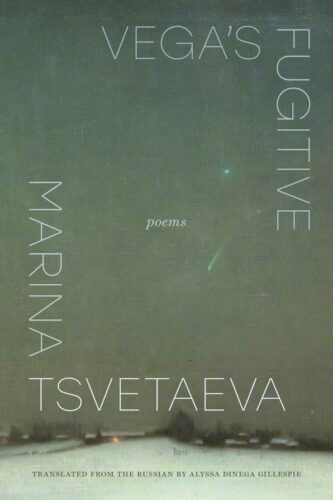
Vega’s Fugitive by Marina Tsvetaeva, translated by Alyssa Dinega Gillespie, Northwestern University Press
 Tsvetaeva. It’s the name among great Russian poets of the twentieth century that, if you aren’t already familiar with Slavic vowels and consonants, you are most likely to trip over. Marina Tsvetaeva’s poems can be equally intractable. Yet, among her titanic contemporaries — Akhmatova, Mandelstam, Pasternak — she was the one most esteemed by successors like Joseph Brodsky, who championed Tsvetaeva’s work. Despite this, she is the least celebrated and translated.
Tsvetaeva was born in 1892 and hanged herself (“I am looking for a hook,” she had written in her notebooks) in 1941. After living in the post-Revolution European diaspora, she returned to a Russia she had never really left:
My land so sorely failed to keep
Me safe that the most shrewd detective —
Won’t find a single birthmark streaked
Along my soul, forward or — backward!Foreign — each house, and null — each church,
They’re all the same — to me, all — nowhere.
But if along the road — a bush
Should rise, especially — a rowan . . .3 May 1934
This translation comes from Dinega Gillespie’s Vega’s Fugitive, the first substantial selection of Tsvetaeva’s verse in English since Mary Jane White’s 2020 After Russia, which limits itself to the poet’s work in exile, from 1922 to 1927. Gillespie’s selections range from 1913 to 1941, a span that covers distinct stages of the poet’s complicated life, including relationships involving varying degrees of physical or literary intimacy with Sophia Parnok, Rainer Maria Rilke, and Boris Pasternak, among others; life in Prague and Paris as well as Russia; and a difficult, tormented marriage to Sergei Efron, whom she followed “like a dog” back to the Soviet Union, where the whole family fell into catastrophe.
Vega’s Fugitive does not follow a coherent chronology in presenting Tsvetaeva’s poems. Gillespie arranges her choices thematically. The poet scrupulously dated her own texts, but those dates are not provided in this edition, and the life of the poet was so peripatetic that it’s useful to have them anchored in time and place, as other translators have done. Nevertheless, in an exemplary introduction Gillespie provides a coherent rationale for her selections and her editorial approach; she looks informatively at both the life and the work, explaining how she wanted to unmoor the range of the poems from the writer’s biography. She also appends a chronological key for those who are interested, along with useful notes.
None of this may matter to the reader who just wants to be introduced to the poems. For that purpose, Gillespie’s work serves at least as well as White’s and other earlier translations (by David McDuff, Robin Kemball, Elaine Feinstein, and Nina Kossman).
Beyond capturing much of Tsvetaeva’s sound and form, Gillespie conveys her tone: a kind of savage Emily Dickinson, all abruption and ferocity. The formal parallels are familiar (they have been made before), but much of Tsvetaeva’s work is more mundane in the best sense—worldly and earthy, pursuing what Brodsky called “an extremely uncomfortable thought taken to its conclusion.”
The Russian poet is remembered for her most intense, her most passionate work. Her “Attempt at Jealousy” is an aria of either straight rage or devastating, self-mocking irony (it has been read both ways):
How’s life with another woman—
Simpler, yes? — The stroke of oars! —
Did you quickly lose the memory of me . . .How is life with a commodity
Prized in markets? Rent’s too steep?
After fine Carrara marble
How is living with that cheapGypsum dust? . . .
Like Dickinson’s, Tsvetaeva’s poems often turn suddenly inward: “How faithless we both are, that is — / How true we are to ourselves.”
What makes Tsvetaeva so difficult for the translator is the poet’s attention to sound. This is best illustrated in a 1925 poem Gillespie translates as “Dis-tance, sundering: versts and acres . . .”, which plays throughout on the Russian prefix ras-, conveying active and passive separation seventeen times in eighteen lines (not counting echoing rhymes). Gillespie’s dis- pulls off the repetitions thirteen times, but misses the harsh rasp of the Russian syllable. In effect, she does the best she can.
In fact, more than any earlier translator, Gillespie tries to capture the wrenched music of this poet. For the most part, she succeeds remarkably, without having to wrench the sense as well. When she does make substitutions, she has good grounds: “My decision to use ‘lilac’ to translate Tsvetaeva’s zhimolost’ (literally honeysuckle) . . . Why? Because for Tsvetaeva, it is not the particular botanical species (honeysuckle) that is paramount here . . . but this plant name’s consonance — through its initial sound zh — with the poem’s keywords: zhizn’ (life) and lzhi (lies). Lilac in English preserves this acoustic fabric (life/lies/lilac), whereas a literal rendering of honeysuckle would not.”
A similar substitution for “rowan” in the first poem quoted would not have been similarly defensible, because semantically the rowan is so identified with the homeland — rodina — the speaker denies and longs for, even though the Russian riabina achieves a similar acoustic effect.
Brodsky called Tsvetaeva the “sincerest” of Russian poets. “But this sincerity is, above all, a sincerity of sound — as when people cry out in pain. The pain is biographical, the cry is apart from any individual.” With Gillespie, we can sense some of her artistry and sensational intensity, perhaps as much as we can ever get in English.
J. Kates is a poet, feature journalist, reviewer, literary translator, and the president and co-director of Zephyr Press, a nonprofit press that focuses on contemporary works in translation from Russia, Eastern Europe, and Asia. His latest book of poetry is Places of Permanent Shade (Accents Publishing), and his newest translation is Sixty Years Selected Poems: 1957-2017, the works of the Russian poet Mikhail Yeryomin.
Tagged: Alyssa Dinega Gillespie, Emily Dickinson, Joseph Brodsky, Marina Tsvetaeva, Northwestern University Press, Russian poetry, book review, literary translation, poetry in translation