
Jazz Album Review: Shakespeare’s Sonnets — Jazzed and Sometimes Overwrought
By Steve Provizer
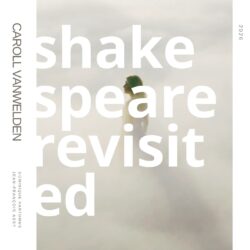
Singer Caroll Vanwelden’s Shakespeare Revisited brings a flexible voice and adventurous textures to the sonnets, but its melodies and production too often overwhelm the poetry.
Song and dance were integral to Shakespeare’s stagecraft. His plays contain roughly a hundred songs and lyric passages, among them “Under the Greenwood Tree” and “It Was a Lover and His Lass,” from As You Like It, and “Full Fathom Five,” from The Tempest.
Composers have long been drawn to Shakespeare’s words and plays. In the Elizabethan and Jacobean periods, Thomas Morley and Robert Johnson set some of his lyrics; later, Henry Purcell wrote music for Restoration adaptations of The Tempest and A Midsummer Night’s Dream. In the nineteenth and twentieth centuries, Felix Mendelssohn’s incidental music for A Midsummer Night’s Dream and Ralph Vaughan Williams’s Three Shakespeare Songs and opera Sir John in Love extended that tradition.
Some years ago, I worked with a company that performed Shakespeare, writing both incidental music and settings for the plays’ songs. If the director wanted the dances shifted from gavottes to swing, I wrote swing. Otherwise, I may have slipped in the occasional musical anachronism, but I tried to remain within the boundaries established by composers closer to the Bard’s own time.
But composing music for Shakespeare’s lyrics, or incidental music for the plays, is different from writing music for words not written to be accompanied by music—that is, the sonnets. I have heard music set to sonnets that might have been written, let’s say, within a hundred years of the Elizabethan era. The question raised by the album Shakespeare Revisited is whether “modern” music written for sonnets from a distant era must be branded as inappropriate. Or can the results be satisfying enough to allay the inevitable charges of crass anachronism?
Belgian singer, pianist, and composer Caroll Vanwelden is the creator of Shakespeare Revisited.
Vanwelden originally set Shakespeare’s sonnets in a “traditional jazz quartet setting”—music I haven’t heard. This time, according to the album notes: “Jazz remains part of the musical language, but the album moves freely between contemporary songwriting, chamber music, improvisation, electronics, and cinematic soundscapes.” She is joined here by Dominique Vantomme—keyboards and electronics—and Jean-François Assy—cello and electronics. Here’s what they undertake:
- “So Shall I Live, Supposing” (Sonnet 93)
- “Who Will Believe” (Sonnet 17)
- “I Never Saw That You Did Painting Need” (Sonnet 83)
- “My Mistress’ Eyes” (Sonnet 130)
- “Shall I Compare Thee” (Sonnet 18)
- “Two Loves” (Sonnet 144)
- “No Longer Mourn for Me” (Sonnet 71)
- “When I Do Count the Clock” (Sonnet 12)
- “Let Those Who Are in Favour” (Sonnet 25)
- “The Marriage of True Minds” (Sonnet 116)
- “How Can I Then Return in Happy Plight” (Sonnet 28)
- “If My Dear Love” (Sonnet 124)
- “Like as the Waves” (Sonnet 60)
Let me first stipulate that Caroll Vanwelden has a lovely and flexible voice, with a supple range. She renders the music as it was intended to sound. Sadly, her performances are often superior to the music. I won’t go through all the sonnets. Instead, I will make my points through representative examples.
Sonnet 93, “So Shall I Live.” Played at a medium tempo, the melody is cast in a Middle Eastern mode. A long electric-piano solo follows, retaining the mode while adding jazz inflections. Vanwelden scats, then returns to the melody. The sonnet’s meaning is ambiguous: the speaker seems to suspect his wife of infidelity and struggles to reconcile himself to his fears, perhaps even wanting her to feign innocence whether or not she is guilty. Does the music capture that ambiguity? In tempo and sonic palette, I would say no. The slightly exotic scale lends the melody a dislocating orientation, which has some of the right resonance. But nothing in its contour prepares us for the sonnet’s emotional destination—a problem that recurs in several of these songs.
Sonnet 144, “Two Loves I Have of Comfort and Despair.” This is a difficult sonnet, invoking a good angel and a bad one: the male writer as the former, a woman as the latter. It opens aptly with strings engaged in contrapuntal activity. The voice enters alone; the piano follows. A lengthy instrumental and scat section ensues, its shifts and dissonances echoing the speaker’s divided psyche. The intrusion of instrumental and electronic sounds beneath the vocal is an effective idea, but the melody is so prosaic that the overall effect feels pedestrian. The ending—a protracted blend of altered sounds and wordless vocalizing—serves little purpose.
Sonnet 17, “Who Will Believe in My Verse in Time to Come.” “Desert” is not pronounced “dessert.”
Sonnet 71, “No Longer Mourn for Me.” The speaker seeks to spare his beloved further grief by urging her not to dwell on him after his death. The song begins promisingly, with simple minor-key piano chords and the entrance of cello. The vocal aspires to a cri de cœur but too often slips into power-ballad territory. Electronic manipulation of the cello enters, followed by a brief coda. Granted, the sonnet’s complex emotional argument would challenge any musical setting, but here the music feels overstated; it misses the poem’s emotional pitch.
Sonnet 124, “If My Dear Love Were but the Child of State.” A tango-like rhythm rides atop a rhythm-section ostinato. The tune has a playful, almost throwaway quality, and the vocal sits in Amy Winehouse territory. Another long electric-piano solo follows, then more scat. It’s hard not to feel that scat’s ad hoc syllables sit uneasily against the sonnet itself. Her voice is remarkably flexible, but its rapid shifts in emotional register may work against the poem’s purpose: to affirm the timeless, enduring nature of the writer’s love.
Sonnet 130, “My Mistress’ Eyes Are Nothing Like the Sun.” Again, the sonnet carries a complex message. The speaker catalogs the ways his beloved falls short of ideal beauty—her cheeks, her hair, her voice—yet he loves her in a rare and singular way. Challenging material. Bowed cello opens the track, followed by an updated Elizabethan harmonic idiom that soon slips into a more modern power-ballad manner. Had the simpler melody been sustained through a full chorus, it would have suited the sonnet better. The impulse to overdramatize is a mistake. The harmonic devices are clichéd, and since they are the pianist’s primary material, the solos feel uninspired and overlong.
Sonnet 25, “Let Those Who Are in Favour with Their Stars.” The cello opens, joined by piano. The melody begins with an intriguing contour but soon settles into a repetitive mode we have heard before, backed by an insistent piano and cello. The vocal continues in unison with the piano, then is joined by electronically altered cello as Vanwelden’s voice rises to its extreme upper register. The effect is elegiac, though I am unsure what it contributes here. A scat-cello tag works well. Throughout, these songs succeed best when they are simpler and the production is restrained.
Sonnet 116, “Let Me Not to the Marriage of True Minds.” This and Sonnet 18 are probably Shakespeare’s best-known sonnets. At a medium tempo, bass and scat vocal enter over a repeating piano riff. Her accent sometimes makes the words difficult to understand. Stops and starts are deployed, presumably to emphasize certain lines, though I am not sure why. Several phrases depart from the text in my edition: “Not time’s fool” becomes “Not a times fool”; “I never writ” becomes “Then that’s never writ”; “Love’s not time’s fool” becomes “Love not a time fool.” The ending fades out amid repetitions of words I could not make out—and believe me, I tried. The question of how much gravity the music should carry is a constant one, but Vanwelden lightens her voice until it becomes almost childlike—a questionable choice for a sonnet containing “Love alters not with his brief hours and weeks, / But bears it out even to the edge of doom.”
Sonnet 17, “Who Will Believe in My Verse in Time to Come.” A pastiche of piano and electronic sounds opens with an appropriate sense of foreboding for this sonnet. The vocal strikes a suitably serious tone, though the harmonic resources are limited. The music then moves into a gospel feeling—the only instance on the record—and it is a good choice. There are no solos, and the arrangement’s brevity is all to the good.
Sonnet 18, “Shall I Compare Thee to a Summer’s Day?” Probably one of Shakespeare’s two best-known sonnets. An altered cello begins, with electronic touches; the voice then enters in a semi-soul vein, its emotional pitch matching the poem fairly well. Another long piano solo follows, with added scat. The electronically altered piano has a funky edge, as does the vocal scatting. But again, the melody fails to reach a convincing conclusion at the sonnet’s end, as though the final two lines were meant simply to repeat and signal the tune’s close. Some things work here; some do not.
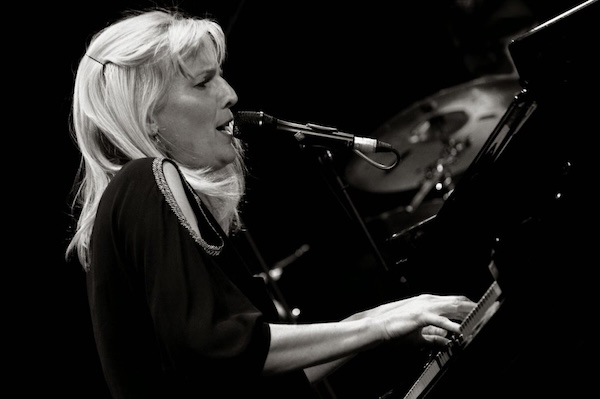
Belgian singer, pianist, and composer Caroll Vanwelden. Photo: courtesy of the artist
According to the notes for Shakespeare Revisited, “The aim is to let Shakespeare’s words be felt before they are analysed.” I understand this to mean that the music is meant to privilege feeling over analysis. But is that really what setting words to music should do? The relationship between poem and song seems better understood as symbiotic: neither can stand entirely alone—notwithstanding Bob Dylan’s Nobel Prize in Literature—and something greater than either should emerge from their union.
Listening to and writing about this album made me wonder whether I harbor an inbuilt prejudice against anyone tampering with these poems. I tried to imagine music that would add something, at least do justice, to the experience of reading the sonnets, or of hearing them read aloud. I came up short. Perhaps that reflects a failure of imagination on my part; perhaps there are also larger aesthetic considerations that argue for letting certain works speak for themselves.
The repetition of devices, the narrow harmonic language, the prosaic melodies, the lengthy solos, the overreliance on power singing, the alterations to the sonnets’ lines, and the occasional difficulty in understanding the singer: despite the skill of the musicians, the sum of Shakespeare Revisited‘s parts is less than the whole.
Steve Provizer writes on a range of subjects, most often the arts. He is a musician and blogs about jazz here.
Tagged: Belgian jazz, Caroll Vanwelden, Dominique Vantomme, Jazz, Jean-François Assy, Poetry, Shakespeare, Shakespeare Revisited, Sonnets, album review, chamber jazz, contemporary jazz, electronics, music review, vocal jazz
