Film Review: “La Bola Negra” — Spain’s Queer Past Transformed into a Sweeping Historical Epic
By Noah Goldstein
Spanning three timelines, Javier Calvo and Javier Ambrossi’s ambitious drama pairs intimate stories of repression and desire with grand cinematic spectacle.
La Bola Negra, directed by Javier Calvo and Javier Ambrossi. Screening at Coolidge Corner Theatre, Brookline.
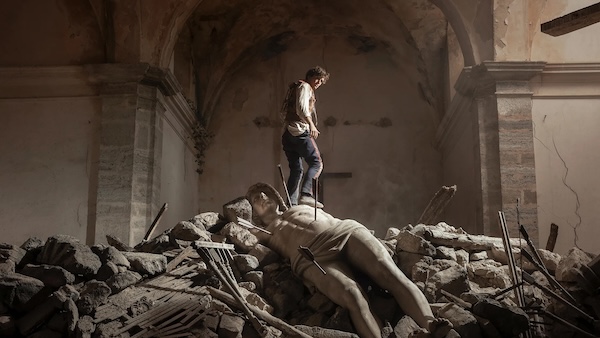
Guitarricadelafuente in La Bola Negra. Photo: Carla Oset / Netflix
Isn’t it strange that the most ambitious historical epic in a year when Hollywood rebuilt the Trojan Horse is a queer Spanish drama? Directed by Javier Calvo and Javier Ambrossi — a creative duo known simply as “Los Javis” in Spain — La Bola Negra is a work that attempts, mostly successfully, to corral a century of national history into under three hours of screen time.
The story is a triptych, unfolding in three separate settings: among Granada’s bourgeoisie in 1932, at a military camp on the Spanish coast in 1937, and on the frenetic streets of Madrid in 2017. Characters from the different periods never meet but, as the plot unfolds, Calvo and Ambrossi attempt to present these disparate threads as a coherent whole, each earlier event jiggered to bring the film into a present — where the enigmatic past still looms large.
Attentive to the gaps history leaves behind, this work draws its inspiration—and its title, which translates as The Black Ball—from a play Federico García Lorca left unfinished when Nationalist forces killed him at the outset of the Spanish Civil War. Only four pages survive; Los Javis shape them into the Granada timeline that opens their film. We first see the pristine hallways of a grand casino and two equally polished sets of marble balls. Then, in a striking low-angle shot that makes the surrounding space feel vast and imposing, we meet Carlos (Milo Quifes), nervously approaching a panel of stone-faced judges. They will decide whether he merits entry into their exclusive club. The vote begins, and Carlos is blackballed in the most literal sense. We don’t yet know why, but he does: as the judges later explain, his rumored homosexuality is the town’s most open secret—and reason enough to bar the door.
Which is why it makes almost too much sense that we cut to Alberto (Carlos González) scrolling on Grindr in 2017. He won’t be persecuted for his sexuality, but he, like every principal character, is estranged from himself in some way. As his boyfriend (played by Problemista director and star Julio Torres, unfortunately massively underutilized here) bluntly puts it, the historian and former playwright is interested in every story — except for his own. Perhaps it’s that confrontation — or the disastrous lunch with his mother, Teresa (Lola Dueñas), who plays Candy Crush while he talks and disappears midway through the meal to do a line in the bathroom — that pushes Alberto to explore his own past after he inherits money from a grandfather he never met.
The truth behind the inheritance is only revealed minutes before the final credits, but it doesn’t take much guesswork to understand that it has something to do with Sebastián (Barcelona-based pop star Guitarricadelafuente), a Nationalist soldier tasked with guarding Republican prisoner and former star futbolista Rafael (Miguel Bernardeau) in 1937. Their dynamic is the film’s most captivating, in part because they benefit from the script’s strongest dialogue, but also because of the passion the performers generate between them. Guitarricadelafuente makes the most of his acting debut, lending Sebastián a conflict that runs from his attraction to Rafael—or at least his curiosity about him—to his service on behalf of the fascists, whose cause he fights for simply because they put a rifle in his hand. He deserves an Oscar nomination for the performance alone, though the chance to hear a presenter attempt his stage name would be its own reward.
Estranged relatives who reappear, repressed sexualities, and an eventual cameo from Penélope Cruz as a cabaret showgirl: if this sounds like something out of Pedro Almodóvar’s wildest fantasies, that’s no coincidence. The Spanish legend was a producer on the film — which earns him an offhand mention as a clue during a game of charades — and traces of the bizarre yet emotionally sincere melodrama of Volver and Talk to Her are ubiquitous here.
What separates Los Javis from their cinematic forefather, though, is their uncompromising determination to bring such a massive project to life. Much of the drama is intimate, but the film nonetheless feels like a true epic, particularly in musical numbers where Gris Jordana’s camera and Raúl Refree’s colossal score swell together into spectacle. If one moment could define such a grand work, it would be the barroom dance number that follows a drunken Carlos in a oner as perfectly executed as the Copacabana sequence in Goodfellas.
Not that there isn’t some room for improvement. While Calvo and Ambrossi never collapse under the weight of their aspirations, their effort, so heavily reliant on intricate relationships established among storylines, could benefit from a bit of balancing. While the 20th-century sequences are intentional in composition and heartache-inducing to boot, Alberto’s journey is scattered, leaving intriguing figures, such as Lorca scholar Isabelle Durand (Glenn Close, flexing a surprisingly solid Spanish accent), saddled with rushed exposition.
But weak characterizations feel relatively unimportant once the film barrels towards its climax. The story’s tension holds until the end as the directors embrace expressionism, composing monumental images, at least one of which is a direct homage to a frame from Tarkovsky’s Stalker. Rarely do filmmakers prove as insistent on engagement as our duo does in these sequences. It’s hard not to be caught up, emotionally, with the sheer force of what’s on screen.
Calvo and Ambrossi are aware that they can’t heal Spain’s fractured past through celluloid. Their historical reconstruction, though somewhat radical in its queerness, deliberately avoids the provocations of an accusatory film. Instead, it makes a plea to reckon with the ugliness of the past in order to build a better future.
Noah Goldstein is a student at Tufts University pursuing a dual degree in Film and Media Studies and Cognitive Brain Sciences. He covers the film and music beats for the Tufts Daily and occasionally writes on sports.
Tagged: " Glenn Close, Carlos González, Federico Garcia Lorca, Guitarricadelafuente, Historical drama, Javier Ambrossi, Javier Calvo, Julio Torres, LGBTQ cinema, La Bola Negra, Los Javis, Pedro Almodovar, Penelope Cruz, Queer Cinema, Spanish Cinema, film review