Book Review: “Andy Warhol’s Index (Book)” — Gadget-Packed and Proud of It
By Trevor Fairbrother
Phaidon’s meticulous facsimile revives the playful chaos of Warhol’s 1967 experiment in publishing, though new additions intrude on the original’s aesthetic.
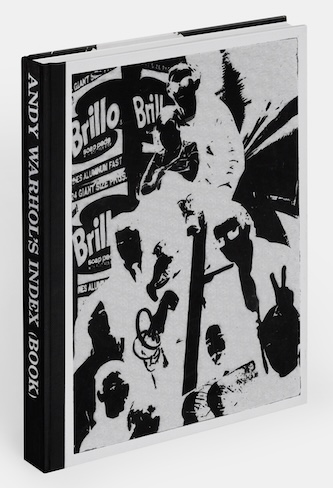
Andy Warhol’s Index (Book), Andy Warhol, with an essay by Charles Melcher, 2026. Photo: Phaidon.
Andy Warhol’s Index (Book) was a 48-page experimental oddity published simultaneously in hardcover and paperback editions by Random House in 1967. Now, Phaidon Press is offering a “painstakingly accurate facsimile edition” of the hardbound book, priced at $75.
From 1964 through 1967, Warhol’s hub was a disused hat factory on Manhattan’s East 47th Street. Billy Name, a lighting designer, photographer and live-in custodian, used spray paint and tinfoil to “silver” everything from floor to ceiling. They nicknamed it the Silver Factory. There, in 1965, Warhol renounced painting to pursue experimental filmmaking. A year later, he pioneered multimedia shows that combined films, light shows, dancers, and live rock music. March 1967 saw the release of The Velvet Underground & Nico, the album by his collaborators that sported his peelable sticker of a banana on its cover. Index (Book) was an extension of – and an homage to – all those activities.
Warhol issued a landmark challenge to traditional books, defying conventions of content and physical design. Many pictures had the attitude of cinéma vérité, but other features were permissive, playful, and absurd. The genre-defying reputation of Index (Book) stemmed in part from ten inserts and interactive elements:
- A pop-up illustration of a medieval castle under siege. This was an existing Random House unit tweaked to include photos of Warhol and friends; when it was opened, the words “We’re attacked constantly” filled the foreground.
- A red accordion that squeaked when its fold-out spread was opened; Random House ads referred to it as a “Bronx-cheer maker.”
- A cartoonish pop-up illustration of a biplane.
- A paper doodad that wobbled atop a wire spiral; it was a promotional piece for the 1966 film The Chelsea Girls.
- A polyhedron with photos of a hairy-chested man; the enclosing pages were sealed with stickers that had to be cut to release the folded object.
- A one-sided flexi-disc with a mugshot of Lou Reed wearing shades; it featured a recording of the production crew and the Warhol gang reviewing a mock-up for Index (Book).
- A three-page fold-out with a close-up of a man’s head in profile. Random House ads called it a “do-it-yourself nose job” because multiple flaps allowed the reader to alter the size, contour and color of the nose. Although he was not identified, the subject was Bob Dylan.
- A pop-up of a 6-ounce can of Hunt’s Tomato Paste.
- A small sheet of thin paper printed with four Warhol signatures. The reader was instructed to tear it along the perforated lines and drop the tabs into warm water; the surprise was that the paper dissolved and disappeared, leaving just Warhol’s name.
- A small inflatable silver balloon with “INDEX” printed in pink.
Warhol credited twelve people as contributors on the title page, ranging from Factory Superstars Nico and Ondine to designers David Paul and Akihito Shirakawa. The unruly, off-kilter design was reminiscent of the typography of the Futurist and Dada artists, and, inexplicably, the word “RUIN,” in giant letters, was its most prominent component. Warhol opted to publish the title page in an unfinished state – as a printer’s galley with handwritten corrections, additions and deletions.
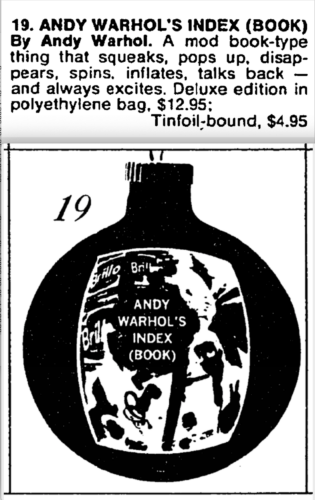
Two details of “Random House Christmas Gift Reflections,” ad in New York Times Book Review, December 3, 1967. Image pairing by the author.
Most images in Index (Book) were made on a Photostat machine set to produce areas of stark white and solid black. Nat Finkelstein, Stephen Shore and Billy Name all contributed photographs, and readers had no way of knowing which of them had created a given image. Overall, the visual style was raw and crude. Warhol used those words in his 1980 memoir POPism: “Raw and crude was the way I liked our movies to look, and there’s a similarity between the sound in that album [The Velvet Underground & Nico] and the texture of Chelsea Girls.”
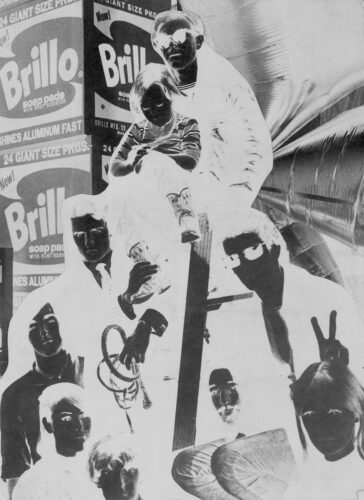
Billy Name, photostat of his collage for the cover of Andy Warhol’s Index (Book). Photo: © Billy Name / courtesy Dagon James.
Five interviews by unnamed interviewers were wedged haphazardly into Index (Book): three with the artist and two with his Factory sidekick, Ingrid Superstar. The first interview, titled “An Interview with Andy at The Balloon Farm,” was conducted by “German Reporter.” Predictably, Warhol’s comments were vague and often monosyllabic. For comic effect, the ponderous questions posed by “German Reporter” were set in a “Gothic” typeface. The book also included an untitled, unsigned write-up overlaid with the words “Reprinted from the Fire Island News.” It was a waggish description of a multimedia event called Andy Warhol, Up-Tight.
Random House promoted Index (Book) as a gift suggestion for the holiday season. A large ad in the book review section of The New York Times illustrated 21 publications as Christmas tree ornaments and termed Warhol’s publication “A mod book-type thing.” Another ad in the Times specified: “A mod, gadget-packed item guaranteed to surprise and delight. Deluxe edition, $12.95; Tinfoil-bound, $4.95.” The cover of each edition featured a negative image of Factory denizens huddled around a stepladder, with Warhol perched on top. The hardbound edition featured it as a lenticular print that produced a 3D effect; the paperback edition reproduced it on silver cardstock. In both cases, the high contrast made it impossible to see that the picture was a collage of three images: the Factory group portrait flanked by details from two installation shots of Brillo Box sculptures and Silver Clouds. Billy Name took the photos and made the collage.
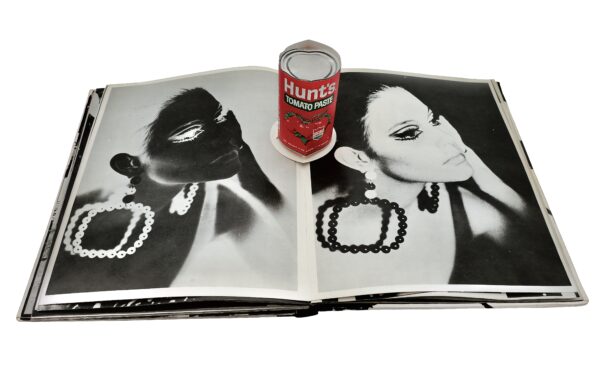
Andy Warhol’s Index (Book), pop-up of Hunts Tomato Paste can and photographs of International Velvet (Susan Bottomley) by Billy Name. Photo: Phaidon.
Index (Book) sold well, despite mixed reviews. The comments of William French, published in Toronto’s Globe and Mail on January 13, 1968, were more insightful than most. French stated: “The book is an extension of Warhol’s pop art and underground movies, which means it’s illogical, frustrating and exhilarating. … It goes several steps beyond Marshall McLuhan’s The Medium Is the Massage [1967], from which it is a natural progression.” French also mentioned “a couple of alleged interviews with Warhol that are hilarious.” He called the book “a wild and funny essay in non-meaning” and suggested that readers yield to its nonlinear, fun-house setup as something “meant to be experienced.”
Tremendous effort went into Phaidon’s recreation of the hardcover version of Index (Book). The special features feel remarkably accurate, with the exception of the lenticular cover (the granulated surface of the original produced optical illusions that were more vivid). Vintage copies rarely have a complete set of interior elements. This should not be surprising, given Warhol’s request that readers tear out and get physically involved with several inserts. If a balloon is present, it has probably deteriorated and discolored the adjacent pages. The rarest original element is the transparent plastic bag created to house the 1967 “deluxe edition.” It featured the title printed in pink and, above it, the following line from an article by the young countercultural journalist Richard Goldstein: “… Warhol’s bag is the neatly packaged, Saran-wrap society.” Phaidon’s reproduction of the plastic bag is very good.
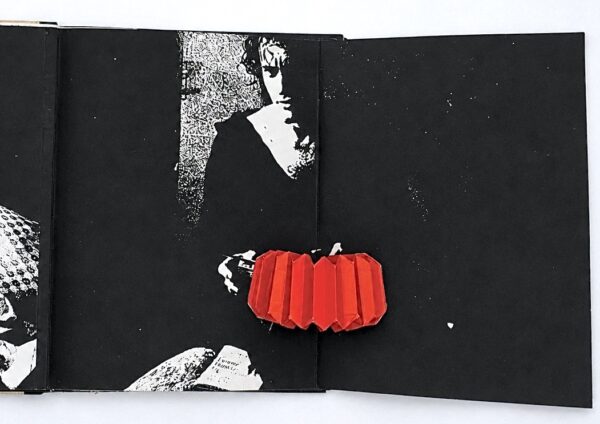
Andy Warhol’s Index (Book), paper accordion and photographs by Billy Name. Photo: Phaidon.
My quibble with this endeavor concerns two intrusions that undercut the aesthetic integrity of the original object. The first is the placement of two columns of small-print verbiage – new publishing and copyright information – in the empty space abutting the title page. That Warholian blank zone gave breathing room to the dizzying typography described above. The second breach is the folded sheet of paper glued to the book’s closing endpaper spread, a rather funeral image of many canvases from Warhol’s Flowers series laid flat on the floor. The insertion is a new essay by Charles Melcher, the founder and CEO of Melcher Media, the company that produced the facsimile. A more appropriate solution would have been to combine the credits, acknowledgments and essay in a pamphlet for inclusion in the plastic bag.
Short and euphemistic, the essay is geared to a broad audience. Melcher extols Index (Book) as a “portal into Warhol’s artistic universe” and presents the Factory as a self-contained social space where authorship was redefined. He ignores the evidence that some people turned against Warhol for paying them poorly and not crediting them appropriately. In fact, Index (Book) included glimpses of dark and ambiguous moments: for example, a photograph of young men on cleanup duty in a jail and another of a woman standing behind Warhol and pointing a gun at his head.
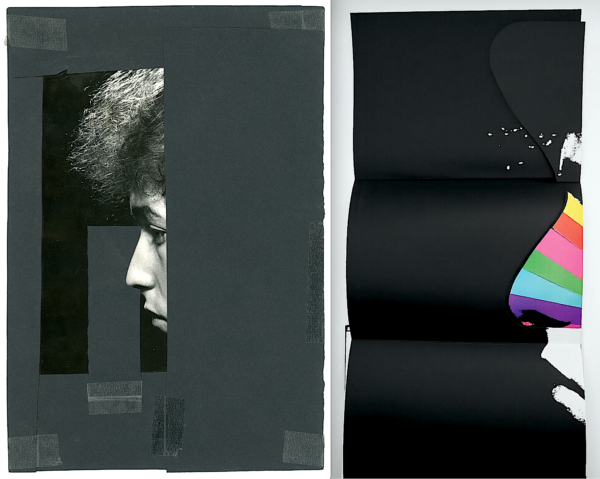
Left: Billy Name, collage with masked photograph of Bob Dylan. Photo: © Billy Name / courtesy Dagon James. Right: Andy Warhol’s Index (Book), DIY nose job with photographs by Billy Name. Photo: Phaidon. Image pairing by the author.
To his credit, Melcher mentions the non-mainstream publishing project that paved the way for Index (Book). In 1966, Warhol and David Dalton designed the third issue of Aspen: The Magazine in a Box. They produced a cardboard container that mimicked the packaging of Fab detergent powder. The printed components inside included a movie flip book, a flexi-disc, excerpts from talks given at the Berkeley Conference on LSD and a spoof newspaper titled The Plastic Exploding Inevitable.
The building that housed the Factory was slated for demolition in 1967. When Index (Book) hit the stores, Warhol was investigating a more upscale studio on Union Square. There, on June 3, 1968, Valerie Solanas, a writer and acquaintance, shot him. He underwent extensive surgery and was briefly declared dead. His attacker was diagnosed with paranoid schizophrenia.
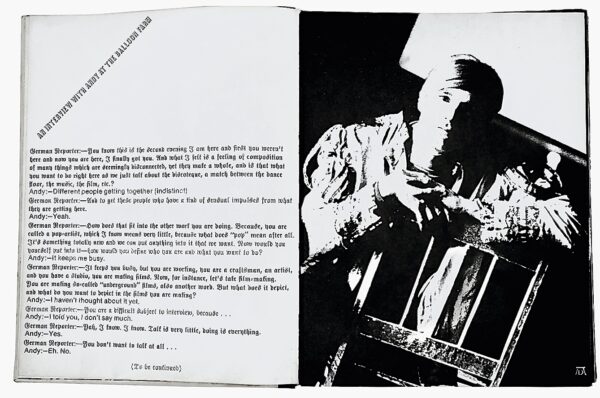
Andy Warhol’s Index (Book), interview by “German Reporter” and photograph of Warhol by Billy Name. Photo: Phaidon.
With that tragedy in mind, it is touching to contemplate the most tender photograph of Warhol in Index (Book): he’s wearing a Renaissance-style costume, and the high-contrast printing has erased most of the detail and texture from his face. The monogram of Albrecht Dürer, the German old master, was added at the bottom right because the picture accompanied the interview conducted by “German Reporter.” Billy Name took the photograph, and his artful manipulations made a man in his late thirties look young, winsome, and princely. That reverent portrait epitomized the mythical figurehead of the Silver Factory.
Trevor Fairbrother is a curator and author. He wishes to thank Vincent Freemont, Matthew Gray, Dagon James, Neil Printz and Rachel Tassone for their help. To learn more about Index (Book), he recommends the writings of Branden W. Joseph, Lucy Mulroney and Nina Schleif.
Tagged: 1960s Counterculture, Andy Warhol’s Index (Book), Andy-Warhol, Artists’ Books, Billy Name, Book Design, Experimental Publishing, Multimedia Art, Phaidon, Pop Art, The Silver Factory, The Velvet Underground, art books, book-reviews