
Film Review: Off the Cliff
By Peter Keough
Quentin Tarantino’s “The Further Mis-Adventures of Cliff Boot” is a mess.
The Further Mis-Adventures of Cliff Booth. Directed by David Fincher. Written by Quentin Tarantino. With Brad Pitt. Screening beginning November 25 at the Boston Common and suburbs.
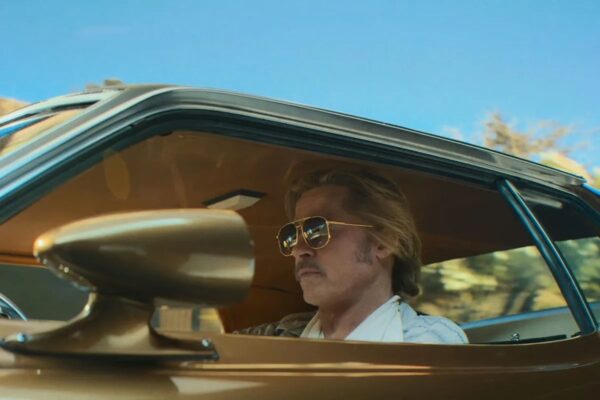
Brad Pitt in The Further Mis-Adventures of Cliff Boot. Photo: Netflix
You know it’s a Tarantino screenplay because of the misspelling in the title. You know he did not direct it because there are no close-ups of women’s feet. Otherwise, there is the same racism, misogyny, and homophobia that mark him at his worst, minus the ingenious structure and chronology and pungent dialogue that distinguish him at his best. As for the film’s actual director, David Fincher, he hasn’t made a significant film since The Social Network (2010).
When we last saw the eponymous stuntman extraordinaire Cliff Booth (Brad Pitt) in Once Upon a Time… in Hollywood (2019), he was beating Manson gang member Patricia Krenwinkle to death with a rotary phone in a counterfactual take on that infamous 1969 massacre. A few years prior to that, his wife had died under mysterious circumstances — murdered by Booth, it turns out (with a speargun), as confirmed by Tarantino in his 2021 novelization of the movie.
This cavalier attitude towards women continues in this film’s opening, which takes place in an LA strip joint in 1977 as two Black pimps discuss their trade while naked female bodies undulate in the background. But it’s all taking place in a feeble meta movie within a movie: a takeoff on a Blaxploitation action thriller that Booth, working as the manager of a movie theatre, is projecting for a skimpy house. He’s a fan, though, of the lead actor, Rodrick “Hot Rod” Harrison (Yahya Abdul-Mateen II), and mouths “This don’t mean shit to me” along with the actor as the screen goes dark. Meanwhile, in his role as fixer to the stars, he has to deal with a “chickenhawk” blackmailer and his grotesquely stereotyped catamite accomplice.
Booth’s reputation for ruthlessness and discretion in the fixer trade has reached TV star Charlie Peters (Scott Caan), who, in a weak moment after a marital tiff, paid $200,000 to Filipino gangsters to off his wife, Toni (Carla Gugino). But now they have reconciled, and he wants Booth to call the hit off and get his money back. No stranger to femicide, Booth is sympathetic to Peters’s indiscretion but says that, to be fair, Peters should pay half the amount to settle the deal. Peters reluctantly agrees, and so the situation would have been bloodlessly resolved, except that something happens that violates Booth’s code of honor, an arbitrary ethos that is as fetishistic as Tarantino’s taste for toes.
So how does this piffle stretch to the unconscionable length of 140 minutes? Some of the wadding includes a Mansonish massacre of a family (perhaps to make up for the lack of one in Once Upon a Time) and a long and tedious demolition derby. Still, some of the throwaways are better than the actual narrative, such as the newsreel-like montages of the careers of Booth and Peters. These include the former’s WWII service, when, as a 15-year-old, he nearly defeated the Japanese in the Philippines single-handedly, and the latter’s stunts in various TV series, including a spectacular shot of a car vaulting through a drive-in screen.
Add in an ill-advised romance that develops between Booth and Peters’s towering agent, Karen Crosby (no relation to Bing, which passes as a running joke), played by Elizabeth Debicki (cast probably because her 6-foot-3 height looks so funny when she’s next to the 5-foot-5 Caan). Though a hint of S&M adds a little intrigue to the relationship, they otherwise have zero chemistry. Like Lieutenant Archie Hicox in Inglourious Basterds (2009), Crosby is a former film critic and delivers a tedious analogy between movies and hamburgers, a sad reminder of the “Royale with Cheese” routine in Pulp Fiction (1994).
This is the work of a tired mind rehashing old shtick to no avail. With a fiery finale perhaps recalling the incineration of Manson Family member Susan Atkins in the original film, it closes with Harrison’s catchphrase, “This don’t mean shit to me.” A fitting epitaph for the film.
Peter Keough writes about film and other topics and has contributed to numerous publications. He was the film editor of the Boston Phoenix from 1989 to its demise in 2013 and has edited three books on film, including Kathryn Bigelow: Interviews (University Press of Mississippi, 2013) and For Kids of All Ages: The National Society of Film Critics on Children’s Movies (Rowman & Littlefield, 2019).
Tagged: Brad Pitt, Carla Gugino, Cliff Booth, David Fincher, Elizabeth Debicki, Once Upon a Time in Hollywood, Peter Keough, Quentin Tarantino, Scott Caan, The Further Mis-Adventures of Cliff Booth, film reviews