Concert Review: Pianist Jan Lisiecki Finds Poetry in Mendelssohn’s First Piano Concerto
By Rebecca Qiu
With Samy Rachid and the Boston Symphony Orchestra, the pianist balanced youthful fire with a quieter assurance, letting the concerto’s intimate moments speak as clearly as its bravura passages.
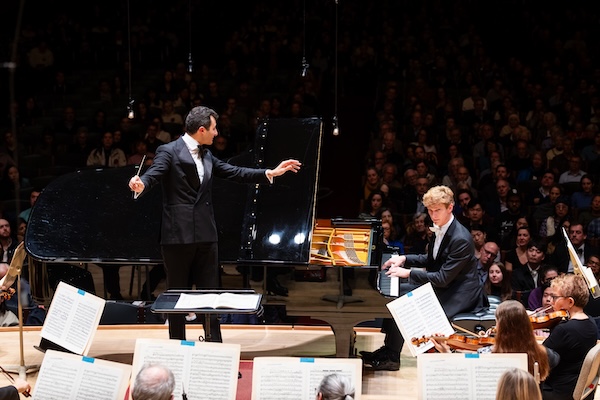
Conductor Samy Rachid, the Boston Symphony Orchestra, and pianist Jan Lisieki performing Felix Mendelssohn’s Piano Concerto No. 1 in G minor. Photo: Robert Torres
Felix Mendelssohn was 22 when he wrote his first piano concerto in 1831. While in Munich, he met a young pianist named Delphine von Schauroth, who caught his eye and for whom he seems to have had the concerto in mind. Mendelssohn confided to friends that he had fallen passionately in love with her. He spent hours at her house at least twice a week and sheepishly reported that they played piano duets. In the end, he left Munich for reasons that remain unclear, reportedly feeling guilty and with the matter unresolved.
Jan Lisiecki first recorded the concerto at 23, only a year older than Mendelssohn had been when he wrote it. Lisiecki was still widely known as a child prodigy, a label he had long resisted, as he explained in a 2025 CBC interview. That early recording was fiery, at times almost restless, and occasionally verged on the breathless. Eight years later, at 31, Lisiecki returned to the concerto on November 19 with the Boston Symphony Orchestra under Samy Rachid. This time, he brought a different kind of assurance. In an age increasingly enamored of speed and spectacle, Lisiecki chose craftsmanship over showmanship: brilliance need not announce itself to be heard.
Lisiecki opened the first movement with quiet resolve. Crisp and decisive, his playing picked up the momentum established by the orchestra and propelled the music forward. The fire of youth was unmistakable, yet it never cost him control: each phrase was carefully shaped. Brilliant piano octaves gave way to the orchestra, ushering in the lyrical second theme. Here, Lisiecki brought an intimate quality to the singing melody, the earlier exuberance melting into hesitation and longing. The orchestra echoed the melody lightly, sustaining the momentum without rushing or overpowering the piano.
As the orchestra took over the melody, Lisiecki’s playing remained expressive, though the speed of certain passages occasionally blurred his otherwise meticulous articulation. Yet more than he had in his early twenties, Lisiecki seemed to shape the music’s momentum rather than be swept along by it. This was especially apparent in the brief exchanges between soloist and orchestra, when the piano answered the orchestra’s challenges with firmness tempered by elegance and delicacy.
The second movement opened with a beautiful transition at the piano, a haunting G-sharp turning the first movement’s forward drive into something more intimate. Lisiecki played as though telling a story, never rushing toward resolution. The orchestra, however, occasionally seemed restless, both when taking over the theme and when accompanying the piano. Lisiecki’s voicing was clear yet delicate, drawing listeners into a more personal encounter with the music. The tentativeness of youth coexisted with the melody’s beauty and grandeur. When the theme returned for the last time, piano and orchestra found a more natural balance. The orchestra murmured beneath the flowing melody, drawing this intimate chapter to a close. Lisiecki gave a masterclass in interpretation, playing with a restraint that made the music feel personal without becoming overly demonstrative.
The third movement, however, seemed to rush in before the piano’s final E had fully faded into the open space of Symphony Hall. Lisiecki’s technique remained as impeccable as it had been in his recording at 23. The piano runs had an almost skeletal clarity: there was no excess, every line and phrase stood out, and the passages still sparkled. The energy never flagged, but Lisiecki never let it carry him away. Brief touches of rubato suggested the young Mendelssohn’s hesitations and added a hint of drama without becoming mannered. As the orchestra took over the final line, Rachid drew both the movement and the concerto to a powerful close.
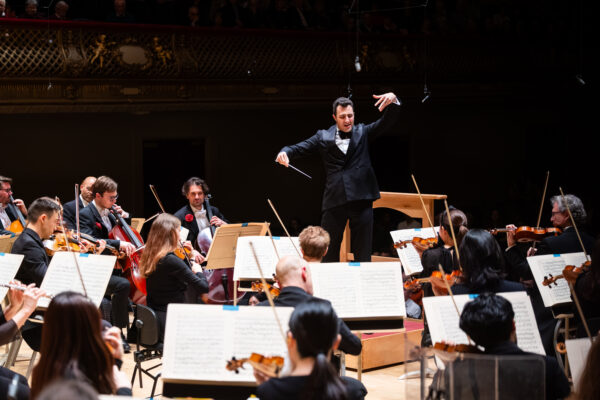
Samy Rachid conducting the Boston Symphony Orchestra. Photo: Robert Torres
For his encore, Lisiecki chose Brahms’s Waltz in A-flat major, Op. 39, No. 15, a piece he had recorded and played as an encore before. Its familiar melody, simple yet personal, offered a welcome contrast to the fiery brilliance of the Mendelssohn.
The evening’s orchestral works, Weber’s Oberon Overture and Schumann’s First Symphony (“Spring”), framed Lisiecki’s performance. The Oberon Overture opened with precision and elegance, its delicate woodwind exchanges floating above the rest of the orchestra. Yet the performance sometimes felt too restrained, sacrificing some of the theatrical excitement and dramatic contrasts that give the overture its character. Schumann’s “Spring” Symphony, by contrast, was more exuberant. The second movement, Larghetto, offered brief but memorable moments of searching lyricism. Sometimes described as a musical portrait of Clara, whom Schumann had married only months before composing the symphony, the movement conveyed a tenderness all its own. The finale balanced animation and grace, its buoyant momentum, sparkling piccolo, and expansive coda bringing the symphony to a satisfying close. The work was also a fitting companion to the concerto: Mendelssohn himself conducted its premiere at the Leipzig Gewandhaus in 1841.
Rebecca Qiu is a Cambridge-based musician and legal researcher. She graduated from Harvard Law School in 2026.
Tagged: Boston Symphony Orchestra, Carl Maria von Weber, Felix Mendelssohn, Jan Lisiecki, Johannes Brahms, Mendelssohn Piano Concerto No. 1, Oberon Overture, Robert Schumann, Samy Rachid, Schumann Spring Symphony