
Book Review: When Dogs Look Back
By Peter Walsh
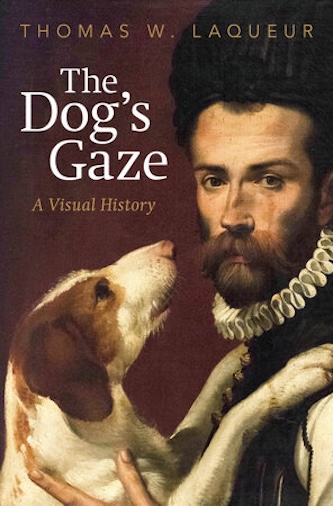
“The Dog’s Gaze” is so remarkably erudite, so thorough, so fully documented, and so elegantly written that it seems fated to be the definitive book on its subject for the foreseeable future. You don’t need to be a dog lover to find it a delight.
The Dog’s Gaze: A Visual History by Thomas W. Laqueur. Penguin Press, 400 pages, $45.
Years ago, I had an office down the hall from a retired museum director and curator emerita. Sometimes I ran into her in the elevator on her way up from the mailroom. Shuffling through envelopes and small packages, she would confide, a bit bashfully, that she had an obsession: dogs, and in particular, representations of dogs. She shared brochures for coffee-table books of the puppies-on-couches variety and mailings she got from the AKC Museum of the Dog on Park Avenue in New York, which has a collection of artwork depicting dogs. Any picture of a dog, it seemed, warmed her heart in a way that other pictures—and she had seen many thousands—did not.
I hadn’t owned a dog since childhood. Though she was beloved, there had only been the one. So I would nod politely and comment on one or two of the images the curator held up. And that was that.
Sadly, the curator died long before she had the chance to read The Dog’s Gaze: A Visual History, evidently a years-long labor of love for its author, the distinguished intellectual historian Thomas W. Laqueur, professor emeritus of history at the University of California, Berkeley. The book is so remarkably erudite, so thorough, so fully documented, and so elegantly written that it seems fated to be the definitive book on its subject for the foreseeable future. You don’t need to be a dog lover to find it a delight.
Professor Laqueur’s title reverses the usual perspective: rather than simply looking at dogs, he invites us to watch them looking at us. “This book is about dogs,” he writes, “and not cats, horses, or cattle—because it is about an aesthetics of sociability rather than utility as represented in art. Dogs pay attention to us; they see us; they join us in a great number of things we do. The book is about an animal that, because it sees with us, is uniquely gifted at breaching the bounds of species in art and also in life.”
Laqueur’s interspecies journey takes us through the history of art in roughly chronological order, though it is by no means limited to art history. Once he opens our eyes, dogs turn up everywhere, even in some of the greatest paintings of the Western canon: in portraits by Bronzino and Titian and in Jan van Eyck’s Arnolfini Portrait (1434), which incorporates, Laqueur says, “one of the most famous dogs in art history.” Several join the throngs of humans eating and drinking in luxurious digs in The Wedding Feast at Cana by Veronese (whom Kenneth Clark called “the greatest dog lover of the Renaissance”). One lies in the foreground near the Infanta in Diego Velázquez’s Las Meninas (ca. 1656). Another sleeps on the floor in Dürer’s celebrated engraving Melencolia I (1514). Two appear amid the artist’s enemies and friends in Gustave Courbet’s The Studio of the Painter (1855), and a black dog sniffs the grass near Parisians enjoying a sunny summer afternoon in Georges Seurat’s A Sunday Afternoon on the Island of La Grande Jatte (1884–86). How can all these dogs have been there all along, virtually unnoticed?
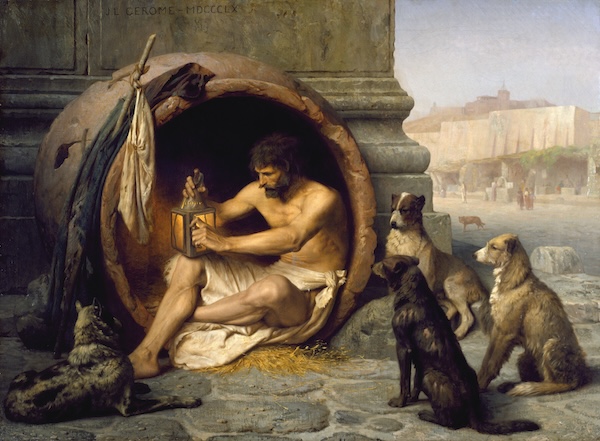
Jean-Léon Gérôme. Diogenes, 1860. oil on canvas. Photo: courtesy of the Walters Art Museum
Because artists often used their own beloved pets as models, we sometimes know more about the dogs than we do about the human models. Laqueur introduces us to Franz Marc’s Russian Siberian shepherd mix, Russi; William Hogarth’s pug, Trump; Brâncuși’s much-loved Samoyed, Polaire; and Lucian Freud’s whippets, Pluto and Joshua. We meet many other dogs from the history of art, including some that appear in portraits with their celebrated owners.
Nor are these animals just bit players or local color. Professor Laqueur shows how they play major roles in the plot: they help organize compositions, subtly draw viewers into the scene by inviting them to follow the dogs’ gaze, and convey symbolic and emotional meanings. In his discussion of the 2014 painting Untitled (Studio) by the contemporary African American artist Kerry James Marshall, Laqueur writes that the dog
is in the painting because it is the base of a triangle of yellows— the dog, the glass, and the sleeve of the man undressing behind the red screen— that, like the head of an arrow, push the picture— and our gaze— up and to the right. It offers instructions about how we should be looking. The dog under the brown table is in a frame within a frame within a frame— the shadows, the table legs, and, of course, the painting’s borders. The dog’s gaze directs our eyes to the standing woman assistant, who is in turn looking out at where the photographer— or the painter— and we, the viewers, are standing… The yellow dog in Marshall’s painting is, finally, also an homage to the long tradition of dogs in studies and studios…
In chapters such as “The Deep Time of the Dog,” “Dogs and the Human Condition,” and “Dogs and the Moral Imagination,” Laqueur moves beyond art history, delving into the social, cultural, and genetic history of dogs, the oldest domesticated animals, whose origins lie somewhere in prehistory. In each chapter, he circles back to visual imagery: paw prints on a Mesopotamian paving brick next to a block of cuneiform text (ca. 1900–1600 BCE); Actaeon about to be torn apart by his dogs on a Greek red-figure krater from ca. 440 BCE; and a poster for an 1881 theatrical production of Uncle Tom’s Cabin. Laqueur’s erudition is on full display. He quotes or cites not only artists and art historians but also critics such as Ruskin, John Berger, and Robert Hughes; poets and novelists such as Petrarch, Rilke, Proust, Pablo Neruda, and W. G. Sebald; scientists such as Charles Darwin (to whom he devotes seven pages); social scientists such as Adam Smith; and philosophers such as Immanuel Kant. The breadth of his reading can be intimidating even to the intellectually inclined, but his allusions are always apt and illuminating, and often fascinating.
Laqueur, an avowed dog lover himself (“I would not, and could not, have written this book,” he says, “had I not lived with… a succession of dogs and enjoyed the intimacy of a dog’s gaze”), tends not to dwell on the less appealing aspects of life with dogs, such as their propensity to land their owners in court by biting a neighbor. But he doesn’t shy away from two particularly unpleasant chapters in their history with humans: vivisection—the practice of dissecting or experimenting on live dogs for supposedly scientific purposes, often without anesthesia—and the use of dogs to track, terrorize, and attack people escaping slavery before emancipation. He also examines the use of dogs against civil rights demonstrators in the Jim Crow South. Both topics are amply illustrated with gruesome images.
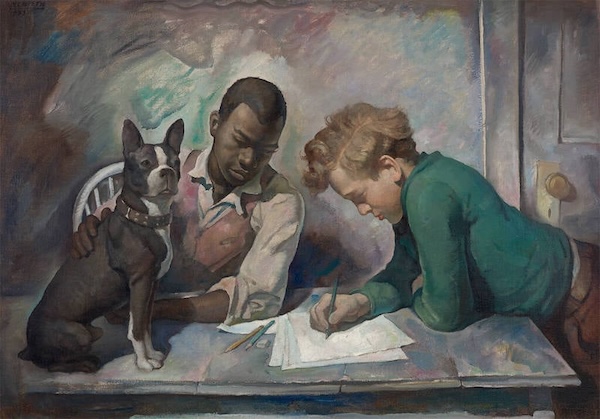
N. C. Wyeth, Portrait of a Dog, 1933. Photo: Brandywine Museum of Art
In his last chapter, “We Are Not Alone,” Laqueur brings his narrative up to the present, noting that “new technologies in the last 150 years have opened new possibilities in the art of the dog.” He discusses movies (in which dogs appeared from the very first), television, snapshots, brand logos, and mass advertising. Vintage posters illustrate passages on canine stars such as Rin Tin Tin and Lassie, as well as on Charlie Chaplin’s A Dog’s Life (1918) and Asta’s role in The Thin Man (1934). Francis Barraud’s original painting His Master’s Voice (1898) evolves into “one of the most famous images in the history of advertising.”
At the end of the book, Laqueur muses on the “hundreds of millions of images in the mass culture of the twentieth and twenty-first centuries. Whether we are dog lovers or not, whether we take notice or not, they circulate among us in superabundance… It was the fate of the now extinct grey wolf and its proto-dog successors— or more precisely the cunning of evolution— to evolve into a socially competent creature that shares the world with an art-producing human. In all their ubiquity, dogs are always entering our frame.”
Peter Walsh has worked as a staff member or consultant to such museums as the Harvard Art Museums, the Museum of Fine Arts, Boston, the Davis Museum at Wellesley College, The Metropolitan Museum of Art, the National Gallery of Art, and the Boston Athenaeum. He has published in American and European newspapers, journals, and in scholarly anthologies and has lectured at MIT, in New York, Milan, London, Los Angeles, and many other venues. In recent years, he began a career as an actor and has since worked on more than 100 projects, including theater, national television, and award-winning films. He is completing a novel set in the 1960s.
Tagged: Art History, Dogs in Art, Human-Animal Relationships, The Dog’s Gaze, book-reviews