
Book Review: The Swallows Are Watching — Radka Denemarková’s Dark, Restless “A Contribution to the History of Joy”
By Bill Littlefield
In this ambitious Czech novel, a detective’s inquiry into an apparent suicide becomes a meditation on violence against women, historical memory, and the possibility of joy.
A Contribution to the History of Joy by Radka Denemarková, translated by Julia and Peter Sherwood. Coffee House Press, $20.
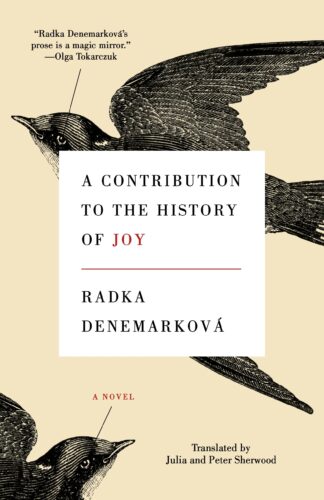
Radka Denemarková is a prolific and celebrated Czech novelist, screenwriter, literary historian, and translator of German literature—and one of her country’s most widely translated writers, with work available in 28 languages. (She was a featured author at this year’s Frankfurt Book Fair, where the Czech Republic is Guest of Honour.) A Contribution to the History of Joy is her second novel to be published in English.
One of the stories at the center of this novel has to do with an apparent suicide. A wealthy, successful businessman who seemed to have everything going for him is found hanged in his attic. Initially, there is no clear evidence of foul play, and nobody is talking about the possibility. But a stubborn police officer identified only as “the Detective” has questions. His investigation is seriously complicated when he falls in love with the dead man’s widow, whose charms Denemarková describes at some length.
Eventually, the Detective thinks he has discovered a connection between the hanged man and the activities of three women who travel together and live in a peculiar house through which the Detective wanders a lot. One of the women, Diana, is a yoga teacher and something of a mystic. Erika writes about musicians and has an enormous record collection. Birgit journals exhaustively about all sorts of matters, including Czech history and, in particular, one former president of Czechoslovakia, Edvard Beneš. She also teaches creative writing, but only to a very few students at a time. It turns out that the dead man has been one of her students and that she has dismissed his memoir as trash.
As the Detective tentatively conducts his lonely investigation, the three females go about their business, much of which has to do with bringing vengeance to men who have raped women, and more generally addressing the tyranny men have exercised over the opposite sex pretty much everywhere and forever. At the hands of men, women have suffered every imaginable form of violence, and the result, as Diana explains it, is “humiliation.” As she contends, “A body remembers being humiliated and unless it gets justice, its behavior remains affected for the rest of its life. It demands more humiliation.”
As the women and the Detective proceed, they are observed by various birds, mostly swallows, and the swallows don’t just watch: “A swallow detaches itself from the flock on the telegraph wires at the back of the garden, flies over their heads and, having described an arc, returns to its friends, tweeting a report. As if by command, tiny black bodies swiftly rearrange themselves on the stave.”
In the prologue to the novel, Denemarková prepares the reader for the appearance of these curious birds and their inclination to “report.” She suggests that “for centuries, swallows on the wing have talked about the human bodies down below.” Readers unwilling to accept circumstances such as this are likely to find the novel frustrating.
Perhaps not surprisingly, the definition of “joy” in this history of the same is not simple. Sometimes it has to do with the accomplishment of vengeance. The three women are good at that. The connections between them sometimes provide them with joy, though they also lose patience with each other and bicker. The clearest manifestation of joy comes when “the Detective and the Woman” kiss. “Their bodies overflow with joy and grow languorous, shedding tension. This is the most straightforward, but also the most difficult, kind of yoga, as bodies can rid themselves of tension ONLY if they feel safe and trusting, not just desire. If their souls feel safe and trusting. If their hearts feel safe and trusting. They have come to rest in deserted places and this is their contribution to the history of joy.”
A Contribution to the History of Joy is an ambitious novel in which Denemarková wrestles with social norms, the recording of history and who gets to record it, physical love, politics real and imagined, and the mysterious tendency of birds to watch, comment upon, and judge the curious, perhaps doomed, two-legged creatures bumbling about below them. The swallows, she suggests, have something to teach her characters—and perhaps her readers. Watching “the formations” of the swallows as they “perform” their “ballet in the sky” and sing their “astonishment at human history,” the author adopts a literal bird’s-eye view. Midway through the novel, she concludes that “it is only among people that they (the swallows) see mass murderers. Human beings are the only creatures that have not adjusted to their own society.”
Bill Littlefield’s most recent novel is Mercy (Black Rose Writing).
Tagged: A Contribution to the History of Joy, Coffee House Press, Czech literature, Czechoslovakia, Edvard Beneš, Julia Sherwood, Peter Sherwood, Prague, Radka Denemarková, Revenge, book review, feminism, history and memory, literary fiction, mystery, novel review, suicide, swallows, translated fiction
