
Book Review: The King of the Cats Returns — Seamus Heaney’s Complete Poems and the Poetry of Justice
By Michael Londra
In a monumental new gathering of his work, the Nobel laureate’s poems—of rural labor, private grief, history, and divided Northern Ireland—remain a moral force in a newly fraught moment.
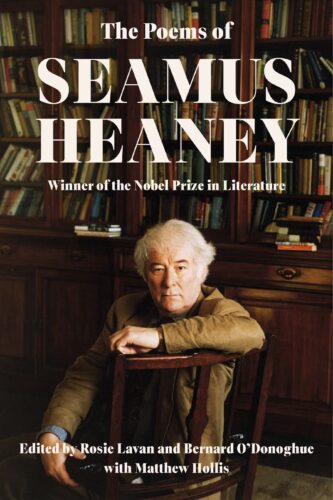
The Poems of Seamus Heaney, edited by Rosie Lavan and Bernard O’Donoghue, with Matthew Hollis, Farrar, Straus and Giroux, 1,296 pp., $60.
As I write, the stalemate continues between the Orange Order—a Protestant British fraternal lodge—and the Irish Catholic residents along Garvaghy Road, a public thoroughfare in County Armagh, Northern Ireland. Begun a little over a week ago, the impasse concerns an Orange Order parade commemorating the 1690 victory of William of Orange over King James II, an event that imposed absolute British control over Ireland. A colonialist tradition for hundreds of years, Orangemen lorded their supremacy over indigenous Irish populations during their so-called “marching season.” Sinn Féin president Mary Lou McDonald characterized these sectarian pageants as “ballyragging” (extreme bullying intended to provoke violence) and “tailcoating” (letting one’s coattails drag, hoping someone will step on them—an excuse to inflict injury in return).
Though thousands of these marches occur annually without much incident, tensions over parading along Garvaghy Road have continued to escalate. In 1997, the British Army assisted local police in brutally cracking down on peaceful Garvaghy protestors, sparking six days of nationwide unrest. Then, in 1998, the Quinn brothers—aged eight, nine, and ten—were firebombed to death in their home by Loyalist paramilitaries in support of the march. An independent panel, the Parades Commission, was established in the aftermath, ostensibly to end all processions down Garvaghy Road. For 28 years, this mechanism has been maintained and kept the peace. On September 27, however, the Parades Commission’s sop to allow a “limited march” of 35 sectarians was halted by nonviolent protestors. Northern Ireland’s Chief Constable is wisely loath to compel compliance. But the residents won’t relinquish their right to civil disobedience. The Orangemen refuse to retreat. Now the stability of nearly three decades is at risk.
Reading The Poems of Seamus Heaney, I wonder what the Man Himself would have made of this. Born in County Derry in Northern Ireland, Heaney (1939–2013) was the eldest of nine siblings and raised on his family’s farm. He attended a Catholic boarding school and would go on to Queen’s University Belfast. Earning his living in academia, Heaney assumed the rank of Professor of Poetry at Oxford and would teach at Harvard, among other universities. Robert Lowell famously dubbed him the “most important Irish poet since Yeats.” Indeed, for his undisputed accomplishments, Heaney received the 1995 Nobel Prize. At the time of his death, he enjoyed nearly universal fame. To the rest of world literature, he was what Yeats called himself after Swinburne died in 1909: “King of the Cats.” Certainly, few can compete with his 12 original collections, numerous plays, translations, and volumes of prose. Imbuing his verse with a consistent aesthetic vision, Heaney advocated for poetry’s relevance as a moral instrument. Colm Tóibín declared that during “a time of burnings and bombings,” Heaney “used poetry to offer an alternative world; he gave example by his seriousness, his honesty … thoughtfulness … [and] generosity.” Tóibín further observed that Heaney’s “books were events in our lives.” Appropriately, the poet’s last words on his deathbed in Latin were reassuring: “noli timere”—Don’t be afraid.
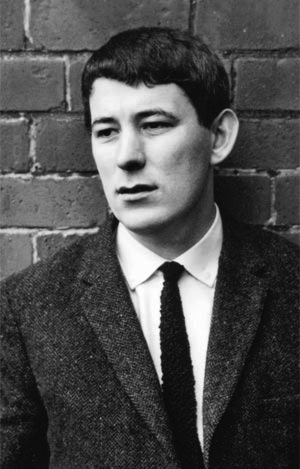
Seamus Heaney around the time of his first book, Death of a Naturalist, 1966. Photo: WikiMedia
The Poems of Seamus Heaney gathers together the entirety of his poetic career for the first time. His oeuvre is a planet. Textbook-sized, Poems is a Goliath of over 1,200 pages. The ideal audience, surely, must be scholars and biographers. Or, like me, Heaney obsessives. Tracing the long song of his prolific career, the lyrics are organized according to time period. First, we start with a suite of unharvested verse dating from 1959 to 1966; then we progress to his 1966 debut, Death of a Naturalist. The tome, thereafter, adheres to this structure: the uncollected, followed by the published volumes. The gang’s all here: Door into the Dark (1969); Wintering Out (1972); North (1975); Field Work (1979); Station Island (1984); The Haw Lantern (1987); Seeing Things (1991); The Spirit Level (1996); Electric Light (2001); District and Circle (2006); and Human Chain (2010). Kudos to the editors for carefully assembling more than 700 poems from this list and beyond. Rosie Lavan, a professor at Trinity College Dublin, working alongside Bernard O’Donoghue, an emeritus fellow of Wadham College, and the poet and biographer Matthew Hollis, has scrupulously prepared valuable notes in the “Commentary” section. These contextualize the history and development of the verse and accompany definitive critical introductions to every component of the Heaney canon. Readers will also appreciate the cross-references between poems and commentaries at the bottom of each page, which enable smooth movement back and forth without frustration.
Like a John Coltrane vinyl box set, The Poems of Seamus Heaney vibrates with classic tracks. Determining his finest moments is like rating Michael Jordan’s playoff wins. My favorites remain: “Lightenings viii”: “The annals say when the monks of Clonmacnoise / Were all at prayers inside the oratory / A ship appeared above them in the air.” And “Digging”: “Between my finger and my thumb / The squat pen rests. Snug as a gun.” Along with “Song”: “There are the mud-flowers of dialect / And the immortelles of perfect pitch / And that moment when the bird sings very close to the music of what happens.” Not to mention “Clearances”: “Her breath in mine, our fluent dipping knives— / Never closer the whole rest of our lives.” As well as “Mid-Term Break”: “He lay in the four-foot box as in his cot… A four-foot box, a foot for every year.”
Primetime Heaney is thrilling: “The socket of each axehead like the squared / Doorway to a megalithic tomb / With its slabbed passage that keeps opening forward / To face another corbelled stone-faced door / That opens on a third. There is no last door, / Just threshold stone, stone jambs, stone crossbeam / Repeating enter, enter, enter, enter. / Lintel and upright fly past in the dark” (“In Memoriam: Robert Fitzgerald”). That said, there are undeniable duds. Much of the early uncollected stuff strikes my ear as warmed-over Robert Lowell: “Tuft cranium / topping / charred bone / that stiffens / up from bone-veined clay” (“Scotch Fir in City Cemetery”). This Johnny-one-note descriptive filler becomes boring fast: “Gray as slugs, / Blue or red as lug-worms, / The tractors lumber in their fields” (“Tractors”). Not to mention the jejune aping of Dylan Thomas in “Song of My Man-Alive:” “We were a giddy eddying; it was all tune-tumbling / Hill-happy and wine-wonderful.”
Conversely, many gems may be unearthed among the previously unaccumulated lyrics: “Lauds and Gauds for a Laureate” honors fellow Nobelist Joseph Brodsky: “When I consider Joseph’s work / I recollect, in Stalin’s dark, / How one man wrote, / Then sealed his manuscript in jars / And buried them beneath the stars”; and “The Stirling Stanzas”—commemorating an honorary doctorate invite—has a wild Bob Dylan gallop to its rhetoric: “At times in Dublin life is tame / So when a certain letter came, / And said in June if I was game / And came to Stirling / They’d put new letters to my name —/ My heart went birling.”
There are also 25 selections chosen by Heaney’s family specifically for this edition that have never been seen before: including “Chair, Pocket Knife, Guitar,” composed for his son’s 2004 wedding; “Lighting the Lamp” (“I shut all doors and go / Forward into the dark”); “Oral English” (“He would cultivate the slobland of the larynx”), and “At Yeats’s Grave” (“I came expectant, as one learning the trade, / To find the grave plain, the verge and stone well-made”); and “Ribbons,” a portrait of his sisters.
Of this uncollected material, “An Open Letter” is the strongest. In 198 lines addressed to Andrew Motion and Blake Morrison, editors of the 1982 Penguin Book of Contemporary British Poetry, Heaney sought to school these Englishmen who, without asking, included him in their anthology. Just because he was born in Northern Ireland didn’t make him British: “Be advised, my passport’s green / No glass of ours was ever raised / To toast the Queen.” This blind spot in England regarding the North persists. It is, arguably, at the root of the Garvaghy Road crisis.
In Crediting Poetry, his Nobel lecture, Heaney remarks that poetry was the best place to “hold in a single thought reality and justice,” a quote from Yeats. In this regard, maybe his best—and best-loved—lines are from his translation of the Greek tragedy Philoctetes by Sophocles, which Heaney renamed The Cure at Troy, included in The Poems of Seamus Heaney. Inspirational without being sentimental, these lines keep me company when I’m most alone. I believe that, if he were still here, he would stand—as I do—with the Garvaghy Road community. This stanza belongs to all of us, Protestant and Catholic, unionist and nationalist: “History says, Don’t hope / On this side of the grave. / But then, once in a lifetime / The longed-for tidal wave / Of justice can rise up. / And hope and history rhyme.”
Arts Fuse review of The Letters of Seamus Heaney
Michael Londra is a poet, fiction writer, and critic who has appeared over twenty-five times in The Arts Fuse. He recently introduced the Poets Confront AI and Surveillance Capitalism event at Poets House, available on YouTube. He can also be seen talking about New York writers in the YouTube indie doc Only the Dead Know Brooklyn (dir. Barbara Glasser, 2022). “Time is the Fire,” the prologue to his soon-completed novel of Delmore Schwartz and Lou Reed, was published in DarkWinter Literary Magazine. His poetry was translated into Chinese by scholar-poet Yongbo Ma. Two of his Asian Review of Books contributions were named Highlights of the Year for 2024 and 2025, one of which was translated into Vietnamese. “Life in a State of Sparkle—The Writings of David Shapiro” from The Arts Fuse was selected for the Best American Poetry blog. He can be found, or is forthcoming in, Lana Turner: A Journal of Poetry & Opinion, Restless Messengers, The Fortnightly Review, spoKe, Cha: An Asian Literary Journal, and The Blue Mountain Review, among others. He added six essays and the introduction to New Studies in Delmore Schwartz, coming next year. Born in New York City, he lives in Manhattan.
Tagged: Bernard O'Donoghue, Colm Tóibin, Drumcree conflict, Farrar Straus and Giroux, Garvaghy Road, Irish Literature, Irish history, Irish poetry, Matthew Hollis, Nobel Prize in Literature, Northern Ireland, Orange Order, Philoctetes, Poetry reviews, Rosie Lavan, Seamus Heaney, The Cure at Troy, The Poems of Seamus Heaney, book-reviews, collected poems, contemporary poetry, poetry and justice, political poetry, sectarianism
3 Comments
Leave a Comment
So fine! Though I blather on that one can, at one’s acquired severity, pose “good” against “bad” poetry; and that the early holding-on to the rising craft is the start, middle, and endpoint of a poet’s oeuvre. But always I am a little, “Nah, that ain’t so!” in reaction to being told: this is fine verse; this other isn’t.
Though, of course, all efforts are noted as personal choice in the choosing; and Monsieur Heaney is loved here for his mostly “quiet,” yet truth-aiming, voice. And one does pray to emulate that in dark times: be help, not hindrance, to the long-held-at-bay peace among us—hope of man, poets.
Such bloviating, Joseph!? No! I just don’t like the labeling of what—even as misses—were, in most cases, so labored over.
I hope someone will be able to tell us why Michael Londra felt it was appropriate to open this review with two paragraphs about the Drumcree crisis? This is especially incomprehensible to Heaney disciples, as we know the great man was loath to create further conflict by taking sides in his poetry. I respect the reviewer’s reputation, intellect and right to an opinion; but I resent the fudging of fact and opinion – and the the condensing of decades of political differences into a few sentences is remarkably irresponsible. Londra’s clumsy quoting of Heaney’s remarkable retelling of Greek tragedy, and his belief that Heaney would have chosen this moment to take a political stance, indicate a willing blindness to the poem’s determination to speak for all sides in the history of conflict in Northern Ireland.
I benefited much from this review and its various reminders. To smooth the feathers, so to speak: my recent Substack devoted to St. Francis’ recent 800th death anniversary closes with Heaney’s beloved short poem, envisioning the unconventional, (ecumenical?) friar preaching literally to a flock. ‘St. Francis and The Birds.’