Arts Commentary: The Distance Between Us and the Museum
By Mark Pawlak
For a working-class kid from Buffalo who once saw museums as places for other people, a lifetime among Cambridge and Boston collections became an education in class, access, exclusion, and the complicated act of looking.
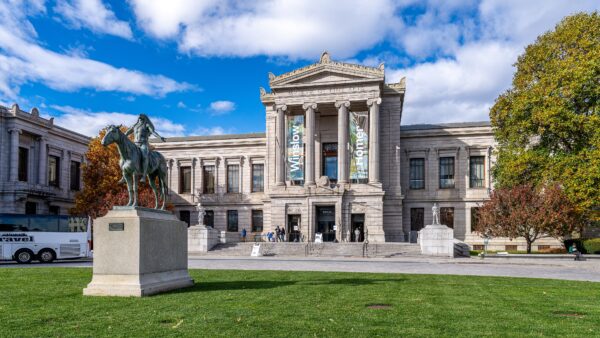
Museum of Fine Arts main entrance with the Appeal to the Great Spirit statue in the foreground in 2025. Photo: WikiMedia
Any Sunday when the weather turns—low gray clouds, steady rain, the threat of snow—my thoughts drift toward museums. Art museums, most often: the Museum of Fine Arts, Boston; the Isabella Stewart Gardner Museum; the Peabody Essex Museum; the Addison Gallery of American Art; or one of the university museums scattered across Cambridge and Boston. They are now a kind of refuge.
That was not always the case.
In the Buffalo of my childhood, I never set foot in an art museum, though the city had several: the Burchfield-Penney, the Albright-Knox. They might as well have been in another country. No one explicitly barred the door, but the message came through clearly, early on: museums were for other people. A different class of people.
My parents, second-generation immigrants, worked hard and without pause. Weekends were for errands, for rest, not for wandering galleries. Cultural outings meant polka bands at American Legion halls, company picnics, church bazaars. A seventh-grade class trip to a Buffalo Symphony matinee was my lone exposure to what we thought of as high culture. Whether my parents sensed they would not find their kind inside those walls, or simply passed them by without curiosity, I can’t say. But the distance was real.
Years later, in my first poetry collection, I included a portrait of the public-housing developments where my Cambridge high-school students lived—multistory red-brick buildings clustered around paved courtyards—places nearly identical to the one where I had grown up in Buffalo in the 1950s. The poem ends with the line: “Let them hang that in their museums!”
It was meant as a dare. Those landscapes—our landscapes—were not the subjects of oil paintings or marble sculpture. They did not belong to the aesthetic imagination of the institutions I would later come to frequent. The line carried the assumption I had inherited: museums belonged to the upper classes, and people from places like ours would not be welcomed there anyway.
My relationship to Cambridge—where I have lived, with brief interruptions, for more than five decades—has always been ambivalent, a muted love shaped as much by class as by place. I arrived as a scholarship student at MIT, coming from working-class Buffalo into a city defined by its institutions: MIT at one end, Harvard at the center, Lesley to the north. Even then, Kendall Square was beginning its transformation into a glass-and-steel corridor of biotech and research.
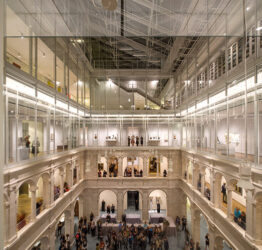
The historic Calderwood Courtyard after the renovation of the Harvard Art Museums. Photo: Nic Lehoux
In the 1970s, the divide between town and gown was unmistakable. Behind the granite and marble façades sprawled neighborhoods of wood-frame houses and brick projects. The people who lived there—groundskeepers, secretaries, janitors, electricians, lab assistants—maintained the institutions. After college, teaching at an alternative high school, I worked with their children. They moved through Harvard Square with a visible edge, jostling the more privileged students who passed easily through the gates of Harvard Yard. I recognized that edge. I carried it myself. The defiant tone of my poem belonged as much to them as to me.
And yet Cambridge also offered something I had never known: a dense, cosmopolitan world of culture. Foreign films, bookstores of every kind, restaurants from every continent—and museums. So many museums, many of them free. At first, access did not mean ease. I moved through them self-consciously, alert to the small signals that mark class difference.
My education began at what are now the Harvard Art Museums, though at the time their collections were housed separately. The Busch-Reisinger, in particular, became my first real point of entry. In its former home—Adolphus Busch Hall, a modest Gothic structure arranged around an open-air courtyard—I found a place to linger. I was living cheaply then, in a communal house in East Somerville, walking to Harvard Square to save bus fare. On days I taught at the Group School, I would stop in the courtyard to eat the sandwich I’d packed earlier, then wander inside.
I returned to the same works: Erich Heckel’s To a Convalescent Woman; Franz Marc’s Grazing Horses, alive with animal energy; Max Beckmann’s Self-Portrait in Tuxedo, cigarette smoldering, gaze unwavering. There, I first encountered paintings by Kandinsky and Klee in a joint exhibition. Upstairs, a Flentrop pipe organ filled the hall during lunchtime concerts by E. Power Biggs. What had once felt foreign slowly became familiar. Repetition granted permission.
Elsewhere in Cambridge, I wandered the Peabody Museum of Archaeology and Ethnology and the Museum of Natural History, sometimes with friends, sometimes alone. In those years, one could drift through their corridors almost unnoticed. On occasion, high on the era’s sanctioned substances, we stood over display cases of mineral crystals and blown-glass flowers, marveling—look at this—as if the world were newly made.
Still, I often felt like an interloper.
That feeling shifted one afternoon while I was teaching at the Group School, when a colleague invited me to meet a friend at the Fogg Museum. The friend, a Harvard student, turned out to be a member of the Wertheim banking family. As we wandered the galleries, he was casual, unassuming. But seeing his family name carved into a museum gallery lintel was a quiet revelation. The paintings we passed—Picasso, Manet, Cézanne, van Gogh—were not just cultural treasures; they were also the residue of wealth, of patronage, of inheritance. Museums, I began to understand, were built by class.
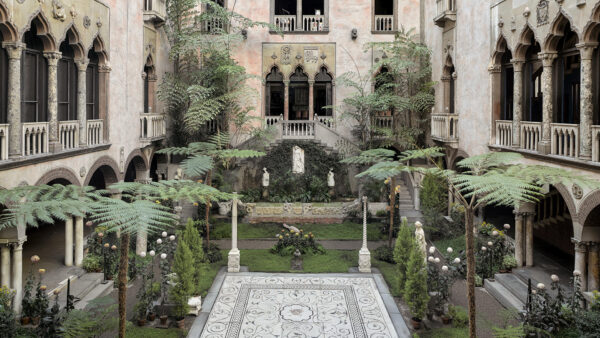
Courtyard, Isabella Stewart Gardner Museum, Boston. Photo: Sean Dungan
Yet something shifted. If he belonged there, and I could walk beside him, perhaps belonging was not fixed. I returned on my own, lingering over van Gogh’s Three Pairs of Shoes—scuffed workingmen’s shoes—and his Self-Portrait Dedicated to Paul Gauguin; Picasso’s blue-hued Mother and Child; and Degas’s bronze Little Dancer, Aged Fourteen, poised in permanent rehearsal. The hesitation remained, but it no longer stopped me.
My apprenticeship deepened a few years later in Worcester, where I served as poet-in-residence in the public schools. To manage the long commute from Cambridge—two hours each way by bus and subway—I arranged my teaching days back-to-back and slept on a friend’s couch. That left long afternoons before she returned from work. I spent them at the Worcester Art Museum.
Entering the museum through its Renaissance courtyard, paved with Roman mosaics unearthed at Antioch, I saw a grand staircase rise in a V toward a colonnaded second floor. Off to one side stood a reconstructed 12th-century French chapter house, dim, stone, almost cave-like. I would sit there for long stretches, writing, letting the day settle.
Weekday afternoons were quiet, the galleries nearly empty. Without the press of other visitors, without the subtle social surveillance that once made me self-conscious, I wandered freely among Persian and Mongol miniatures, their intricate scenes unfolding in jewel-like detail; Japanese woodblock prints; and Renaissance and Flemish paintings that revealed themselves slowly, over repeated visits. I returned often to Piero di Cosimo’s The Discovery of Honey by Bacchus, drawn to its mythic vitality. Time dissolved the old anxiety. By the end of those two years, the voice insisting you don’t belong here had largely fallen silent.
And yet it never disappears entirely.
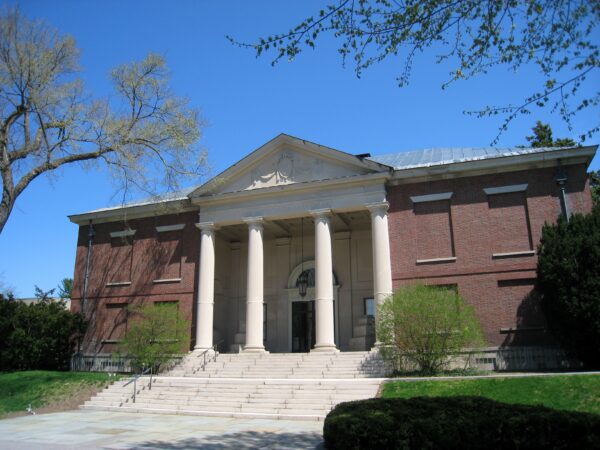
The front facade of the Addison Gallery of American Art. Photo: WikiMedia
Reading about the controversy following a 2019 visit by Black and Hispanic middle-school students to Boston’s Museum of Fine Arts, I recognized something painfully familiar. Honor students, there as a reward, they reported being followed by security, reprimanded for touching objects, and subjected to racist remarks: “No food, no drink, no watermelon.” Other patrons told them, in effect, to move aside, to know their place. What had been implicit in my childhood was, for them, made explicit. The incident prompted apologies and reforms. It also revealed how fragile the sense of welcome can be, how quickly a museum reverts from public space to guarded territory.
Writers have described the museum in strikingly different ways, depending, it seems, on how securely they feel they belong.
In her essay “A Home from Home: Boston’s Museum of Fine Arts,” Claire Messud describes the MFA as an extension of her domestic world. Educated at Milton Academy and later teaching at Harvard, she describes returning to the museum “as if to the embrace of extended family,” greeting paintings by Copley and Sargent as old friends, and bringing her children to visit “often.” It is a portrait of ease.
A very different response appears in Teju Cole’s Tremor. His protagonist, a Nigerian-born Harvard professor invited to speak at the MFA, comes face-to-face there with J. M. W. Turner’s Slave Ship, an imaginative rendering of an atrocity during the Middle Passage in 1781. The first time, it grips him “in an unpleasant way.” He forgets it—until he sees it again, and this time it overwhelms him: “the shock for me is unabating each time I encounter it.” The museum itself, he writes, begins to feel like “a series of sustained shocks.” Here, the question is no longer simply who belongs in the museum, but what histories the museum contains—and how those histories implicate the viewer.
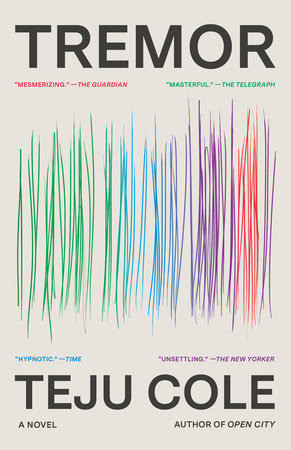
Reading Cole, I found my own concerns shifting. The issue was not only access or class discomfort, but the deeper legacies embedded in these institutions: colonialism, slavery, cultural erasure. The museum is not just a space of exclusion but a repository of difficult inheritance.
If I return now to that line—let them hang that in their museums—I hear in it the voice of someone who had already decided, without quite knowing it, where he did not belong. The distance I felt then was not only from those institutions, but from the world that produced and sustained them—the donors whose names mark the walls, the histories preserved and, just as often, concealed.
And yet I have spent much of my life in those rooms.
Not all at once, and never without a residue of that earlier awareness. I learned them gradually: first as a place to pass an hour, then as a place to return, and finally as a place where I could linger without feeling watched. I came to know their rhythms—the hush of weekday afternoons, the way light shifts across a painting, the small adjustments of posture and gaze that signal who feels at home and who does not.
What took longer was learning how to answer that old message. Not by overcoming it—because it never fully yields—but by outlasting it. By returning. By standing in front of a painting long enough for the question of whether I belong to recede behind the act of looking.
The museum is never a neutral space. A painting like Turner’s Slave Ship carries histories that exceed the frame, implicating not only the past but the act of viewing itself. It shifts the question from who is welcome to what is being held here, and at whose cost. That question remains.
If I walk now through these galleries, I do so with a familiarity I once could not have imagined. I know where to find the works I return to. I move without hesitation. I bring my children, my grandchildren. I pause where I once hurried.
But the feeling of arrival is never complete. The distance that once kept me out has not vanished; it has been measured, crossed, and measured again. A mile or two in the geography of Cambridge. A much longer distance otherwise. I have spent a lifetime learning how to cross it.
And still, in certain rooms, before certain paintings, I feel it again—faint but unmistakable—not as a barrier now, but as a memory of one. The young man who packed a sandwich and ate it alone in a courtyard, unsure he belonged inside, is still in there somewhere. He’s the one who taught me how to stay.
Mark Pawlak (he/him) is the author of 10 poetry collections, including Away Away (Arrowsmith Press, 2024). He is the editor of six anthologies and has published the book length memoir My Deniversity: Knowing Denise Levertov (MadHat Press, 2021). Pawlak’s poems have been published in The Best American Poetry and New American Writing, among numerous other anthologies and journals. His work has been translated into German, Japanese, Spanish, and Polish, and has been performed at Teatr Polski in Warsaw. His essays and memoirs have been published in Jacket2, Woven Tale, spoKe, Let the Bucket Down, and in two anthologies, Writers and Their Notebooks (2009) and Denise Levertov in Company (2018), both from South Carolina University Press. Pawlak has been an editor of Brooklyn-based Hanging Loose magazine and press since 1980. He is retired from the University of Massachusetts Boston, where he taught mathematics. He lives in Cambridge.
Tagged: Cambridge, Harvard-Art-Museums, Museums, arts-criticism, class and culture, cultural access, museum-of-fine-arts-boston