
Visual Arts Review: Esther’s Many Faces at the Gardner
By Debra Cash
An incisive exhibition traces how Rembrandt, his Dutch contemporaries, and earlier artists remade a biblical story of concealment, power, and survival.
The Book of Esther in the Age of Rembrandt at the Isabella Stewart Gardner Museum is on view through January 18, 2027, with lectures and performances scheduled through November 2026.
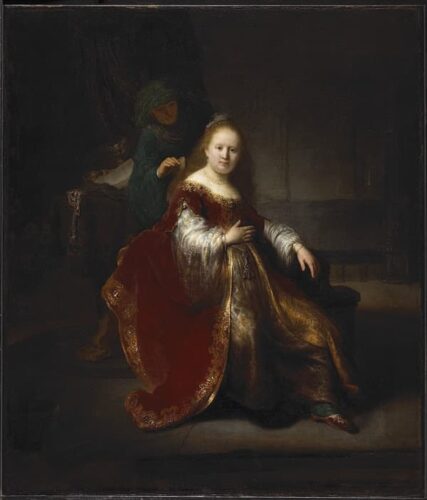
Rembrandt van Rijn. A Jewish Heroine from the Hebrew Bible, 1632-33. Oil on canvas. 109.2 x 94.4 cm. National Gallery of Canada, purchased 1953.
Most Jewish folks think about the biblical Book of Esther—the ahistorical story of the secretly Jewish Persian queen who saved her people from a wicked vizier’s genocidal plot—only during the spring holiday of Purim. But given that, on Purim, everything is meant to be topsy-turvy—holiday observers are encouraged to get so wasted that they cannot distinguish the virtuous Jew Mordechai from the wicked Haman—it may be apt to check out The Book of Esther in the Age of Rembrandt now, in the fall. The original show, curated by Abigail Rapoport, was organized by the Jewish Museum in New York and the North Carolina Museum of Art in Raleigh. An abridged version at the Gardner leaves out a number of items—primarily Jewish ritual objects, illuminated scrolls, and paintings—but contextualizes priceless treasures from the Gardner’s collection.
The Book of Esther in the Age of Rembrandt speaks to the presence of Jews in the 17th-century Netherlands, and in particular to the Amsterdam neighborhood where Rembrandt made his home. That community retained painful memories of forced conversion and of the Spanish Inquisition, still underway in many parts of the empire’s far-flung territories. Its members resonated with the story of a heroine whose Jewish identity was both a liability and a dangerous secret.
In these artworks, canonical biblical images are repurposed to comment on love and power; on urban cosmopolitanism and the exotic luxury goods brought to the rising Dutch bourgeoisie by the Dutch East India Company; and, perhaps most unfamiliar to American museumgoers, on the Protestant Dutch Republic’s resistance to Catholic Spain.
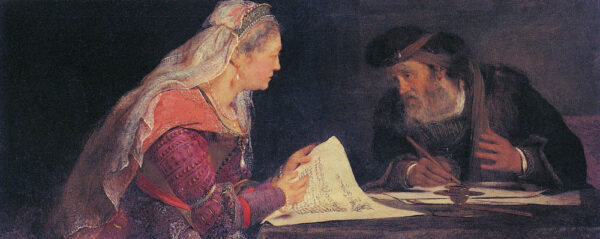
Aert de Gelder, Esther and Mordecai Write the Second Purim-letter. c. 1685. Photo: Rhode Island School of Design Museum of Art, Providence
Esther is an exhibition whose materials mirror its images. In the narrow front gallery, you can put on headphones to hear a man chanting the Book of Esther in the Sephardic (Spanish) cantillation style that would have been standard in Rembrandt’s time. An Italianate parchment scroll is partially unrolled in an adjacent vitrine, its Hebrew calligraphy set within a preprinted design of Corinthian columns and arches capped with pairs of lions. (The catalogue shows other, equally intricate sections of the scroll.) Just a few steps away, Aert de Gelder’s 1685 painting of a bejeweled and literate Queen Esther conferring with her turbaned uncle Mordechai is bisected by the document in her hands—either the proclamation ordering the Jews’ destruction or the proclamation of the holiday—flowing toward a silver inkpot, a pile of scattered papers, and the quill in Mordechai’s hand.
Paintings of royal encounter are crammed with sumptuous orientalist textiles. Jan Lievens’s depiction of the queen’s strategic feast is hung in front of a stunning rug from “Mrs. Jack’s” collection; the burnt umber and blue arabesques of the carpet expand the majesty of King Ahasuerus’s embroidered cloak upward and across the gallery wall. An earlier, magnificent 16th-century Gardner-owned Flemish tapestry, Esther Fainting Before Ahasuerus, is almost as crowded as a Bruegel. Esther slumps, dazed and cross-eyed, in the arms of a lady-in-waiting as two others rush to her aid. You can almost overhear the courtiers’ gossip. Including this masterpiece reinforces the concept that each generation reflects on a biblical episode in a way that reveals its own preoccupations.
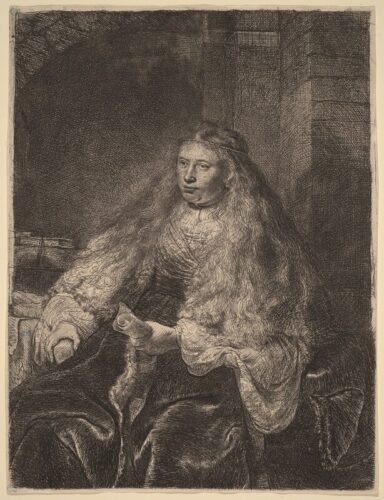
Rembrandt van Rijn, The Great Jewish Bride (also known as Esther before Ahasuerus), 1635. Photo: Rosenwald Collection
I would not have imagined that “while Protestants adapted Esther to symbolize their struggle for freedom, Catholics identified Esther with the Virgin Mary.” Textually, that seems misplaced, given the opening salvo of the story, in which Ahasuerus summons and summarily deflowers the beautiful virgins of the Persian kingdom before eventually deciding he likes Esther best. The halo that painter Geldorp Gortzius places behind the head of his barely adult Esther is less noteworthy than the scepter she is fondling with both hands.
In this show, Queen Esther and Rembrandt get equal billing. The Great Jewish Bride (also known as Esther before Ahasuerus), from 1635, is an etching of Rembrandt’s wife, Saskia Uylenburgh. Her wavy hair escapes toward her elbows from a cinched coronet; her shadow falls on a stone wall. She seems to keep her own counsel. A more fully developed oil painting, dating to 1632-33 and titled A Jewish Heroine, features a different model. Esther, sitting on a throne and swathed in a gold-embroidered red gown with diaphanous sleeves, is being fussed over by an attendant standing behind her shoulder. Rembrandt’s gift for representing the distinct textures of flowing fabric goes without saying, but the message seems to be that, despite her lavish surroundings, Esther is a woman profoundly alone. That isolation is palpable even if the biblical character is someone else: the National Gallery of Canada, which owns the painting, suggests that she might be Bathsheba or even Judith preparing to murder Holofernes.
The mood in Rembrandt’s The Triumph of Mordechai, from 1641, could not be more different. A smug-looking Mordechai is paraded on horseback through the town of Shushan by his nemesis, Haman. Townspeople kneel; little dogs snarl and bark. A sketchy dome behind him indicates centralized power. In the catalogue, art historian Larry Silver says that this might represent the messianic dream of a rebuilt Jewish Temple in Jerusalem. Rembrandt’s Mordechai is positioned at the apex of the image’s triangle and flourishes a scepter of his own.
The 23-year-old Rembrandt’s dreamy self-portrait is one of the great treasures of the Gardner collection. The current exhibition positions it as the finale to the Book of Esther–themed images in the Hostetter Gallery. Bernard Berenson acquired the painting for Isabella Stewart Gardner in 1896 as the first item for her envisioned museum. Rembrandt’s jeweled beret, with its sloping white feather, looks like a deflating turban. His parted lips look ready to interrupt a conversation already in progress.
Debra Cash is a Founding Contributing Writer for the Arts Fuse and a member of its Board. Her immigrant grandmother’s name was Esther.
Tagged: Abigail Rapoport, Aert de Gelder, Amsterdam, Book of Esther, Boston visual art, Dutch Golden Age, Esther, Flemish tapestry, Isabella-Stewart-Gardner-Museum, Jan Lievens, Jewish art, Jewish history, Mordechai, Purim, Rembrandt, art exhibitions, biblical art, museum reviews, religious art, seventeenth-century Dutch art
1 Comment
Leave a Comment

Excellent review, Debra.