
Arts Commentary: Trump’s War on the Kennedy Center Is a War on Culture Itself
By Jonathan Blumhofer
His threatened destruction of the nation’s living memorial to John F. Kennedy exposes not merely an assault on a building, but the petty authoritarianism, civic vandalism, and cultural contempt driving his presidency.
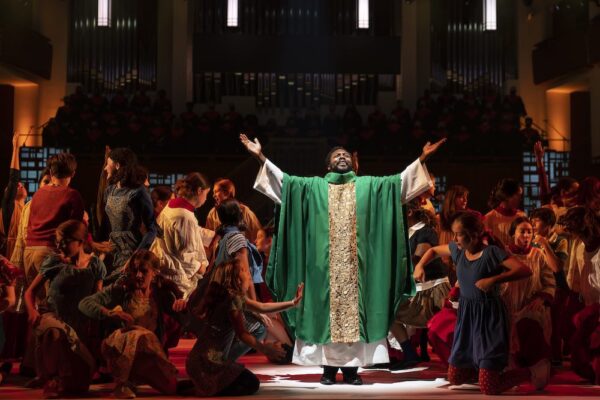
Will Liverman as the Celebrant with the Children’s Chorus of Washington in the 1971 premiere of Leonard Bernstein’s MASS at the Kennedy Center.” Photo by Scott Suchman
How easily things get broken, the Celebrant sings at the beginning of his climactic “mad scene” in Leonard Bernstein’s Mass. When Jacqueline Kennedy Onassis commissioned the score for the opening of the John F. Kennedy Memorial Center for the Performing Arts in 1971, nobody imagined that the phrase might apply so soon to the complex itself.
Yet here we are.
Less than two years after Donald Trump had himself installed as chairman of the venue’s board, presided over an exodus of artists, a collapse in audience numbers and finances, slapped his name on the building, grudgingly accepted a court order requiring the removal of that signage and delaying an announced two-year shutdown, and then defied the courts by shuttering the place, the arts palace on the Potomac seems under imminent threat of destruction. A photograph taken through an Air Force One window recently showed the president studying a poster apparently labeled “Kennedy Center Demolished.”
Never mind that such an act would be illegal. Or that the $257 million Congress earmarked for needed renovations remains available, though Trump is refusing to release it. Or that a perfectly lawful solution to this self-created dilemma—his petulant demand that his name be restored to the building and its façade—lies at hand: the same Congress that created the nation’s only official arts center has the sole authority to rechristen it.
One might not guess it, but both houses of that venerable body are controlled by Republicans. Though this Congress’s lack of productivity makes the 1947-49 “do-nothing” Congress look like a paragon of legislative responsibility, surely the gang could get together, do its master’s bidding, and give him what is evidently his heart’s desire?
Apparently not. Rather than remain in session to address pressing issues of national and global import—or even lesser matters—House Speaker Mike Johnson sent his charges home early for a near-two-month recess. They will not return until after the midterms.
Whether the Kennedy Center will still be standing to welcome them back is another matter.
Trump’s obsession with the place has always been peculiar. Yes, the president once fancied himself a Broadway producer. And his rejection by a broad swath of artists surely stings.
Of course, some of that reception is attributable to Trump’s thin skin. One indelible image from the transition after the 2016 election was the cast of Hamilton addressing a list of concerns about the incoming administration to Mike Pence, who had attended a performance of the hit show in Manhattan. The worries articulated then—“that your new administration will not protect us, our planet, our children, our parents, or defend us and uphold our inalienable rights,” as Brandon Victor Dixon put it—are no less pressing today. Nor, from the vantage of 10 years, is Trump’s tone-deaf response to the display surprising: he accused the cast of “harassing” his vice president and demanded an apology. None came. “A conversation is not harassment,” Dixon noted.
Given that history, perhaps the president’s fixation on the arts world is explicable, at least on some level. Still, his conduct regarding the Kennedy Center seems increasingly pathological.
It is important to remember that the Kennedy Center has always been more than a performing-arts venue. First and foremost, it is Washington, DC’s sole memorial to the nation’s slain 35th president. Fittingly, it is unique: a “living memorial,” as the original congressional charter stipulated, and therefore among the most sacred functioning public spaces in the country.
Certainly, its namesake was no model patron of the arts—his wife quipped that the only song JFK recognized was “Hail to the Chief”; her husband agreed that “it has a nice ring to it.” And his advocacy for the nation’s artistic standing was driven primarily by Cold War considerations. Yet no president before Kennedy—or since, for that matter—has elevated the arts with greater enthusiasm or eloquence. “If art is to nourish the roots of our culture,” he said in a brief but potent address at Amherst College in October 1963, “society must set the artist free to follow his vision wherever it takes him. We must never forget that art is not a form of propaganda; it is a form of truth.”
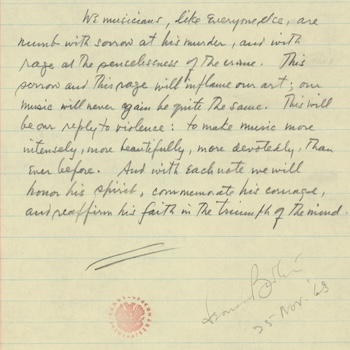
A page from the speech Leonard Bernstein spoke at a Night of Stars memorial for President John F. Kennedy at Madison Square Garden in 1963. Photo: WikiMedia
The impact of Kennedy’s untimely death—a tragedy from which the United States does not seem fully to have recovered, nearly 63 years later—is hard to overstate. “I know of no musician in this country who did not love John F. Kennedy,” Bernstein told a crowd at Madison Square Garden three days after the assassination. “American artists have for three years looked to the White House with unaccustomed confidence and warmth. We loved him for the honor in which he held art, in which he held every creative impulse of the human mind, whether it was expressed in words or notes or paints or mathematical symbols.”
It is impossible to imagine anyone of comparable stature saying the same of Trump—not merely because of his glaring lack of sympathy with, or understanding of, those principles.
Ironically, few of the current president’s acts have more thoroughly laid bare his venality, immaturity, and fundamental unfitness for office than his “management” of the Kennedy Center. Phillip Kennicott writes with righteous indignation in The Washington Post that “[no] episode in Trump’s second term better encapsulates the triviality of his agenda and the pettiness of the man. We knew he was a bully, we knew he was a narcissist; the plot had been building all along to those inescapable conclusions. Now, with tragicomic clarity, we see those truths revealed in a way that should be, must be, shocking.… When the ambition to destroy culture is bottomless, the anger must be even deeper.”
What the Kennedy Center’s fate will mean more broadly for American arts and culture remains, on some level, to be determined. Certainly, most of the United States’ more than 340 million inhabitants have never set foot in the venue. And the country has always had a tenuous relationship with arts institutions generally. The artistic freedom Kennedy envisioned a month before his death—particularly the conviction that “the highest duty of the writer, the composer, the artist is to remain true to himself and to let the chips fall where they may”—can easily offend, especially when opinions are shaped by hearsay or by a lack of direct engagement with the art in question. That the National Endowment for the Arts has survived into 2026 is itself something close to miraculous.
Yet the charge that the Kennedy Center is an elitist, anti-American citadel is belied by the facts. This is a place that brings together audiences and arts of every kind—musicals, symphony concerts, dance programs, recitals, film screenings, and more—sometimes all at once on the same night, when the stars align. Its family and educational programs have been generous; its free offerings, considerable. Among them were those infamous, infrequent drag shows supposedly corrupting America’s youth. One hopes the nation’s innocents have not since encountered similar examples of debauchery in episodes of Looney Tunes and Tom & Jerry—or in the core canon of American cinema.
Even for those who never enter a theater, the Center’s grounds and terrace are active parts of the larger complex. Ultimately, as Kennicott writes, it is “a place where, for a few hours, you could escape the mendacity of Washington, the transactional friendships and the pompous self-importance of our self-appointed martinets.”
Alas, no more—at least not until 2029. By then, who knows what will remain of the Kennedy memorial? At least it seems unlikely to bear the current president’s name. Trump’s compulsion to build monuments to himself is becoming ever more pronounced—“Nobody will do it once I’m gone,” he recently conceded—but he is doing his best to ensure that his memory becomes a curse and his name an epithet.
Despite his efforts, the seeds of the Center’s eventual renewal may have been planted on that long-ago opening night, when Bernstein shared a box with the Kennedy family.
At the end of the Celebrant’s “mad scene,” after he has shattered the monstrance, torn off his ecclesiastical robes, and stormed away in disillusionment, the silence is broken by a solo flute playing a slightly skittish, fragmented melody. Anyone who knows Mass recognizes the motive: we have heard it many times before, in various guises.
In his notes on the piece, Bernstein labeled the figure “Spiritus Sanctus”—the Holy Spirit. In Christian theology, this person of the Trinity conveys God’s peace to humanity. Ironically, its clearest manifestation now arrives at a moment of utter brokenness, after every attempt to stave off destruction—ritualized, improvised, studied, and otherwise—has collapsed in on itself. Only from the silence of the rubble does the possibility of peace emerge. One voice after another takes up a call to praise—“Lauda”—and, as Mass ends, the cast extends the “touch of peace” among themselves, into the audience, and “on and out, through the ranks, out through the street, the lands, the nations, wave on wave, wave enfolding wave,” as the composer optimistically put it.
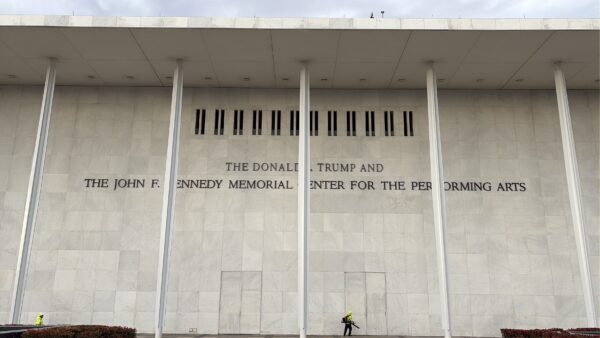
Trump’s name was added to the Kennedy Center facade on December 19, 2025. It was removed from the façade on June 13, 2026 by order of the US District Court for DC. Photo: Wikimedia
On one level, that final gesture was pure Lenny. At the same time, it accords entirely with centuries of Catholic teaching. One of Bernstein’s central points in Mass is that the faithful must put sincere belief into action. Blindly going through the motions—liturgical or otherwise—will not, by itself, save us or bring about the desired result. Active, communal engagement with what we preach and believe, followed by the hard work of thoughtfully carrying it through and living it out, just might. Such action often requires risk and courage, perhaps more of both than we expect, and it hardly guarantees success. But it is the necessary path if there is to be any hope of social growth, change, or improvement.
We are seeing some engagement of that sort with regard to the Kennedy Center even now: further court injunctions, lawsuits seeking to place the institution in receivership, and Kerry Kennedy’s “Hands Around the Kennedy Center” event, among them. More opportunities will surely arise, including, crucially, the verdict delivered by the midterm elections in fewer than 50 days.
Eventually, there will be time to rethink the Kennedy Center’s role in the life of Washington and the nation. For all its strengths, the institution can surely become more national in reach and, perhaps in the aftermath of this latest presidential tantrum, more visible and central to our shared cultural experience. But that is a discussion for another day.
For now, the most pleasantly surprising result of the president’s threat to demolish the place has been the loud national chorus of outrage that greeted the news. It is a promising sign that, even as the world burns, inflation balloons, millions lose access to health care, and unchecked AI threatens to annihilate the species, we can still recognize Trump’s defilement of the capital’s memorial to his murdered predecessor as an offense. In an era when the unacceptable is tolerated and the outrageous has become commonplace, can we as a nation still find it in ourselves to say that enough is enough?
We are about to find out.
Jonathan Blumhofer is a composer and violist who has been active in the greater Boston area since 2004. His music has received numerous awards and been performed by various ensembles, including the American Composers Orchestra, Kiev Philharmonic, Camerata Chicago, Xanthos Ensemble, and Juventas New Music Group. Since receiving his doctorate from Boston University in 2010, Jon has taught at Clark University, Worcester Polytechnic Institute, and online for the University of Phoenix, in addition to writing music criticism for the Worcester Telegram & Gazette.
Tagged: Donald Trump, John F Kennedy, The Kennedy Center
Good piece. Everyone who loves DC and the arts and has not yet made up their mind to vote should do so now!!!