
Classical Concert Review: Rachel Barton Pine’s Brahms Resonates at the Gardner
By Aaron Keebaugh
With Matthew Hagle at the piano and a storied 1742 Guarneri in hand, violinist Pine found both familial warmth and dramatic urgency in three Brahms sonatas.
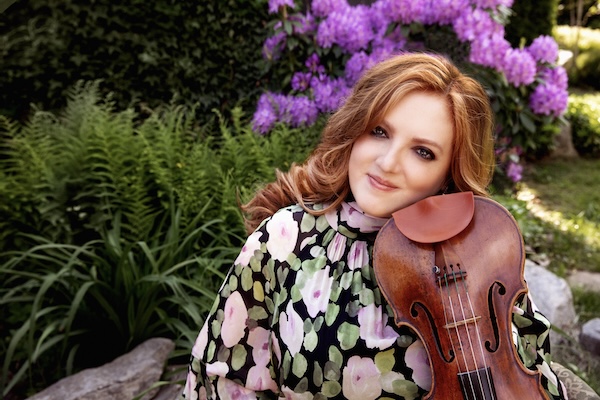
Violinist Rachel Barton Pine. Photo: Lisa-Marie Mazzucco
Violinist Rachel Barton Pine doesn’t just perform the classics. She plays on a piece of musical history itself.
Her violin, a 1742 Guarneri del Gesù, was once played by 19th-century virtuoso Marie Soldat, who had been a close friend and musical partner of Johannes Brahms. Soldat was the first woman to tackle the composer’s Violin Concerto. And, contemporary reports suggest, she mastered it far beyond anyone’s expectations. Brahms, who had nicknamed her “Die kleine Soldat” (the little soldier), proclaimed that Soldat possessed the musical strength of 10 men. “Who could do it better?” the composer shouted after the woman’s performance of the concerto with the Vienna Philharmonic.
Before his death in 1897, Brahms persuaded the wealthy philanthropist and luthier Wilhelm Hermann Hammig to buy the Guarneri and place it permanently in Soldat’s care. The instrument later passed to the Wittgenstein family, only to be seized by the Nazis. In 2002, an anonymous buyer acquired the Guarneri and lent it to Pine, who performed Brahms’s Violin Concerto on it with the Chicago Symphony Orchestra. She has played it ever since, lending particular resonance to her interpretations of Brahms’s chamber music.
Her performance of three Brahms sonatas Sunday afternoon at the Isabella Stewart Gardner Museum’s Calderwood Hall thus carried an unusual convergence of artistry and historical memory. Pine and pianist Matthew Hagle made the music feel warmly communal—less like a monument than a gathering of old friends—with the Guarneri at the center of the occasion.
Brahms composed his Violin Sonata No. 1 around the time he first heard Soldat play, in 1879. Like several of his larger works, the sonata traces a course from tension toward resolution, though it moves restlessly between those states.
Pine and Hagle, however, kept the music at a poised, reverent remove, resisting any temptation to overstate its emotional extremes. From the opening, they responded to one another with extraordinary sensitivity: Pine’s mournful line hovered above Hagle’s hymn-like chords, her sound shifting from silvery to grainy as each crescendo gathered force. The result brought the sonata’s inherent drama close without forcing it.
Their easy rapport gave the Adagio a congenial warmth, while leaving room for its undercurrents of mystery. In the finale, the minor-key whimsy never lost momentum; its playful exchanges gradually settled into quiet serenity.
The Violin Sonata No. 2 offered a sharp contrast, erupting in unguarded joy. Brahms’s shortest violin sonata, completed in 1886, is rich in lyricism but unsettled by Wertherian swings of mood that undermine any easy formal equilibrium.
Pine and Hagle treated it as an animated conversation—at times fervent and high-spirited, but never overwrought. Their restraint did not diminish its urgency. In the opening Allegro, violin and piano phrases seemed to plead for resolution before recovering their balance, only to begin the process again. The second movement brought the evening’s most vivid contrasts, as the duo moved effortlessly between radiant repose and mercurial zest. In the finale, Pine’s expansive line pressed against Hagle’s arpeggios until the music abruptly turned toward the light in its closing bars.
The program’s second half belonged to the Sonata in F minor, Op. 120, No. 1. Better known as the first of Brahms’s clarinet sonatas, it also exists in a violin-and-piano version for which the composer substantially reworked the original, cutting some passages and adding others to accommodate the instrument.
Even at its stormiest, the work sounded natural in Pine’s hands. She and Hagle carried its tension to the edge without sacrificing line or clarity. Pine’s playing was full-bodied and robust; Hagle’s accompaniment bold and cleanly articulated. They opened out the ethereal grandeur of the second theme before releasing another surge of energy. The Andante, with its dusky harmonies and breathy melodic arc, anticipated the lyrical ease of the Allegro grazioso. Then, in the impish Vivace, the duo dug in once more for an exuberant close.
For an encore, Pine and Hagle played Brahms’s Scherzo from the so-called F-A-E Sonata, the collaborative work written for Joachim. It made for a fiery coda, as Pine and her Guarneri joined Hagle in music that churned, drove, and built toward rapt excitement. Given that this was such intimate, arresting music, their connection—to each other, to Brahms, and to the instrument’s history—could scarcely have felt more immediate.
Aaron Keebaugh has been a classical music critic in Boston since 2012. His work has been featured in the Musical Times, Corymbus, Boston Classical Review, Early Music America, and BBC Radio 3. A musicologist, he teaches at North Shore Community College in both Danvers and Lynn.