
Concert Review: Bill Charlap Makes the Tradition His Own
By Jon Garelick
At the Regattabar, the pianist and his trio paired deep musical knowledge with emotional warmth, wit, and exhilarating swing.
Bill Charlap Trio at the Regattabar, Cambridge
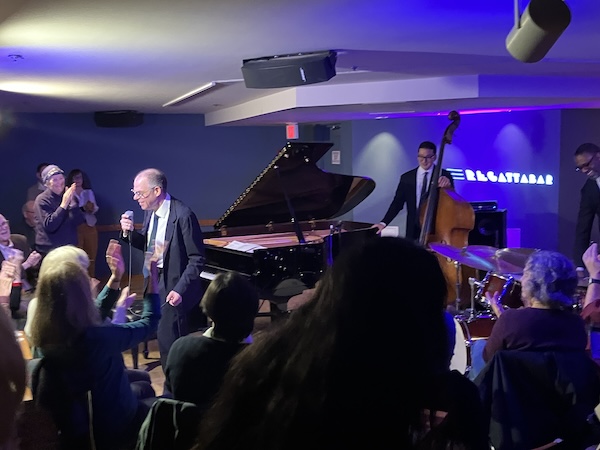
At Regattabar: pianist Bill Charlap, with David Wong on bass and Dennis Mackrel on drums. Photo: Jon Garelick
In my Arts Fuse “Coming Attractions” column, I may have been too hasty in pitching Bill Charlap as a master of standards. At the first of his three shows with his trio (bassist David Wong and drummer Dennis Mackrel) at the Regattabar last weekend (Nov. 13–14), he stretched the definition of standards — not just the Great American Songbook pieces born on Broadway or Tin Pan Alley, but also, for instance, Tommy Flanagan’s “Beyond the Blue Bird” (recorded in 1990) and Joe Zawinul’s “Frog Legs” (1963), from Zawinul’s time with Ben Webster (the titular frog) before Weather Report. And then there were two of Zez Confrey’s “Three Little Oddities” (1923).
Confrey, you’ll recall, was a “novelty piano” composer and performer who had hits with “Nickel in the Slot” and “Kitten on the Keys” (both later recorded on a Confrey album by Dick Hyman).
But even if you don’t remember that, Charlap does. And he’s happy to tell you about it. Charlap’s MO is to play three tunes, tell you about them, then play another three tunes. So, aside from the Confrey tutorial, “Beyond the Blue Bird” came with a thumbnail portrait of Detroit jazz (Flanagan, the Jones brothers — Hank, Thad, and Elvin — and Barry Harris, Kenny Burrell, Paul Chambers, et al.). The oft-played and oft-sung “Detour Ahead” (1947) was duly credited to the Soft Winds (Herb Ellis, Johnny Frigo, Lou Carter), with a side credit to Billie Holiday’s rendition. “Tea for Two” (1924) was followed by the recitation of a stanza of Irving Caesar’s lyrics (music by Vincent Youmans) and a nod to the song’s “Jewish irony.” As a friend of mine said afterward, “That show came with its own liner notes.”
So, how was the music? Exemplary. Astonishing. Heartwarming. Charlap, 60, has been releasing albums under his own name since 1994, following stints in the bands of Phil Woods, Gerry Mulligan, Benny Carter, and others. His parents are the singer Sandy Stewart and the late Broadway composer Morris “Moose” Charlap (Peter Pan).
In other words, this stuff is in his bones. In a show at the R-bar last April in his long-running duo with singer Dee Dee Bridgewater, you could hear previously unexplored facets of every song, not just in Bridgewater’s revelatory reading of lyrics, but in Charlap’s fleshing out of harmonies or lavishing extra care on a particular turn of the melody. As I said in my “Coming Attractions” pitch, “The song becomes a physical space, with corners, doors, and windows.”
Charlap’s erudition doesn’t shortchange emotional warmth or visceral excitement. He likes to luxuriate in harmonies with his voice leading and play a single-note line of melody like a long, unbroken breath. But he also likes turning things into wildly up-tempo knucklebusters and introducing drum solos with keyboard-length glissandos. He’ll punctuate a coda by holding his hands above his head and bringing them down in a series of emphatically smashed chords. He took “Beyond the Blue Bird” in a medium groove with long phrases over Mackrel’s brushes, then brought it to up-tempo swing, then back down to a whisper on the last phrase. (“So good!” I wrote in my notebook.) The brisk “Frog Legs” sported a momentary vaudevillian countermelody in the left hand that seemed to come out of nowhere before a beautifully pointed Wong bass solo and an equally snappy call and response between Charlap and Mackrel. “Tea for Two” was played as super-fast bebop. The single-note lines in “Detour Ahead” perfectly outlined the unsung lyrics, with beautiful blues phrasing on the turnarounds.
After the unaccompanied Confrey piano reverie, it was back into bebop with “Sippin’ at Bells” (by Miles Davis, “dripping with the spirit of Charlie Parker”), Alec Wilder’s “While We’re Young” (“I feel like a waltz”), and a mixed Ellingtonia medley of Billy Strayhorn’s “Lotus Blossom” and “Lush Life,” Duke’s “Sophisticated Lady,” and Juan Tizol’s “Caravan,” the last marked by bravura double octaves coming out of the channel and a crescendo that brought a roaring ovation. “Woody ’n You” showed Charlap sustaining and developing ideas over long arcs of phrasing at a fast clip, with the requisite “Salt Peanuts” quote.
Charlap can fairly be called “mainstream” — he’s not a composer, unless you count his glorious inventions at the keyboard, and he’s firmly within the tradition. You might say he is the tradition. But he speaks a well-known language in a personal voice, as distinctive as any out there.
Jon Garelick is a former arts editor at The Boston Phoenix and a retired member of the Boston Globe Opinion staff. He can be reached at [email protected].
Tagged: Bill Charlap, Bill Charlap Trio, David Wong, Dennis Mackrel, Great American Songbook, Jazz, Jazz piano, Jon Garelick, concert review, jazz trio, live jazz