
Film Review: In “Paper Tiger,” the Real Trouble Is at Home
Writer/director James Gray’s uneven blend of gangster thriller and domestic drama finds its deepest unease in a marriage defined by emotional distance.
Paper Tiger, written and directed by James Gray. Opens November 20 at the Coolidge Corner Theatre in Brookline.
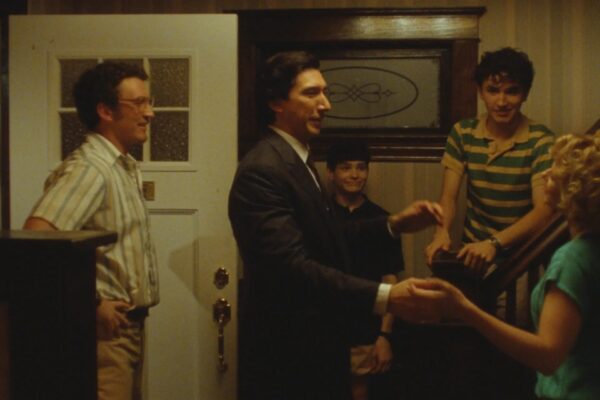
A scene from Paper Tiger. Photo: courtesy of NEON.
Paper Tiger begins as a familiar kind of film: two men slide deeper into trouble, the brasher and more violent one pulling both toward crime. If that were all it amounted to, the narrative would merely rework a clichéd template. But, while director/writer James Gray follows the contours of a gangster movie, he shifts the emphasis, as though performing a a cover song in a new key. Apart from a home-invasion set piece, Paper Tiger is scarcely a thriller. One man’s wife, initially relegated to the margins, emerges as its emotional center. Eventually, the storyline arrives at a place of profound loneliness, a deep isolation that its characters are only beginning to recognize. The most upsetting scene here doesn’t depend on physical violence — it is just the sight of a person fading out of the film.
On Labor Day in 1986, Irwin (Miles Teller), an engineer, appears happy. He celebrates with his wife, Hester (Scarlett Johansson), their two sons, and Hester’s mother, who urges the family to move from Queens to Great Neck. But paying for his older son’s college education is worrying Irwin, and he accepts a business proposition from his brother, Gary (Adam Driver). A former cop who wears expensive, stylish suits, Gary projects wealth and independence. His outsized personality has made him accustomed to dominating any room he enters. He proposes that they start a business cleaning pollution from the Gowanus Canal. All goes smoothly — until Irwin catches workers dumping oil back into the water. When he confronts the men, a gangster assaults him and threatens his sons with a stiletto. It turns out that the brothers have fallen into debt with the Russian mob.
Hester initially comes across as “the wife,” a figure confined to the edges while Irwin and Gary drive the action. That changes when she crashes her car after being momentarily blinded by the sun’s glare. As Paper Tiger unfolds, she learns a secret she cannot bring herself to tell Irwin. Their marriage is gradually dramatized as a study in emotional disconnection.
Gray’s films have always been rooted in New Hollywood, an allegiance that made him an outlier once he began working in the ’90s. Superficially, his early work resembled post-Tarantino neo-noir—his debut, Little Odessa, opened the same year as Pulp Fiction—but his influences extended elsewhere, notably to opera. He has repeatedly returned to the suburban Russian-Jewish community where he grew up, drawing as much on his family’s lives as on his admiration for the work of Coppola and Lumet. Two Lovers, his first film to move beyond focusing on the schemes of criminals, marked a breakthrough. He now considers it his true debut, saying he lacked full control over his first three features. Paper Tiger was conceived as a sequel to his 2022 film Armageddon Time, though those plans changed when he could not bring back Jeremy Strong and Anne Hathaway.
Joaquin Baca-Asay’s cinematography repeatedly finds room for patches of bright yellow. The light offers little warmth; the distorting glare even irritates the viewer. When Gary returns to his old precinct to speak with two cops, the light shines into his face as though he were being interrogated. Brightness is used as a means of concealment: the light in one part of the frame obscures its surroundings, pointing out the limits of what we—and the characters—can see or understand. Still, even the darkest scenes remain legible. Shooting on film was crucial to this texture: Baca-Asay worked with practical light sources, including fluorescent lamps, and produced the grain during shooting.
Unfortunately, Gray never fully reconciles the gangster film with the domestic drama. Hester’s scenes seem as if they were brought in from another world, one in which Irwin barely figures. Gray generates tension without stylistic fireworks, but the film’s noir impulses turn out to be its least rewarding. Gary’s psychology never quite coheres, though Driver’s swaggering performance lends the figure energetic conviction.
Ultimately, Irwin’s attraction to easy money — and his proximity to the machinery of crime — expose how little protection he offers his family. And that leads to the revelation that little common ground remains between him and Hester. Without quite displacing men from its center, Paper Tiger illuminates realities they are comfortable ignoring.
Steve Erickson writes about film and music for Gay City News, Slant Magazine, the Nashville Scene, Trouser Press, and other outlets. He also produces electronic music under the tag callinamagician. His latest album, Bells and Whistles, was released in January 2024 and is available to stream here. He presents a biweekly freeform radio show, Radio Not Radio, featuring an eclectic selection of music from around the world.
Tagged: Adam Driver, American Cinema, Crime Drama, Domestic Drama, Emotional Alienation, James Gray, Joaquin Baca-Asay, Miles Teller, Neo-Noir, New York City, Paper Tiger, family, film review, marriage