
Film Review: “Boorman and the Devil” — A Filmmaker’s Demons, Exorcised
By Peg Aloi
David Kittredge’s lively, illuminating documentary revisits John Boorman’s troubled 1977 Exorcist II: The Heretic—a studio-era fiasco whose ambition, artistry, and afterlife now demand a second look.
Boorman and the Devil, directed by David Kittredge. Screening at Coolidge Corner Theatre, Brookline, through September 24.
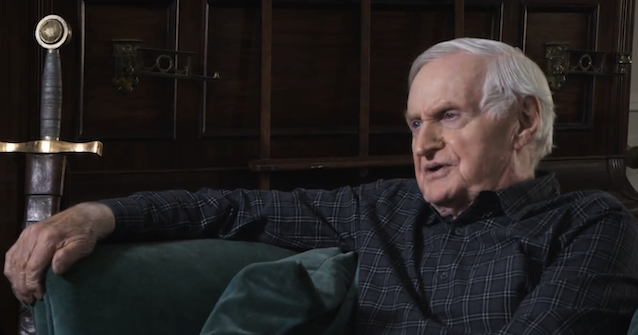
Director John Boorman in a scene from Boorman and the Devil.
Two things happened in the autumn of 2000. In September, before the release of the new “director’s cut” of William Friedkin’s horror classic The Exorcist (1973), I conducted a fascinating phone interview with Linda Blair. My piece in the Boston Phoenix mainly focused on her made-for-TV films of the late 1970s, such as Stranger in Our House and Sweet Hostage, but I also asked her briefly about Exorcist II: The Heretic. Her response was that she had been given an excellent script, but that so many changes occurred before the film’s release that the final result barely resembled what she had signed on to make.
In October, I was invited to Los Angeles to participate in a promotional online event—recorded live, in the days before Zoom—for the release of Book of Shadows: Blair Witch 2, directed by the award-winning filmmaker Joe Berlinger. I had done a bit of uncredited consulting with Joe on the screenplay, helping with several Wicca-based ritual scenes. It was Berlinger’s first narrative film after he had made several highly lauded documentaries with his partner, Bruce Sinofsky. The morning after the event, as early reviews began to appear and the initial reception proved overwhelmingly negative, I called Joe at his hotel.
Me: Good morning, Joe. It’s Peg.
Joe: Hey, Peg.
Me: I just have one thing to say to you: John Boorman directed Exorcist II.
Joe: I think that’s the coolest thing anyone’s ever said to me.
In retrospect, no one could have followed up that lightning-in-a-bottle microbudget film without being subjected to severe, predetermined scrutiny, and Joe and I both knew that. The critics ate it for a snack, though years later many horror aficionados came to agree that it did not deserve such vitriol. At the time, 1977’s Exorcist II was the best example I could think of to cheer up my friend: a reminder that an acclaimed filmmaker’s singular career fumble could seem much worse in the moment than it actually was.
As David Kittredge’s brilliant new documentary shows, Boorman’s experience making Exorcist II: The Heretic was fraught with months of difficulty, of which the poor critical reception was only the cherry on the sundae.
John Boorman, of course, needs no introduction. The overwhelming takeaway from Boorman and the Devil is that his visionary talents, technical expertise, finely honed aesthetic sense, and penchant for deeply human themes have resonated throughout a distinguished career spanning more than half a century. I had the pleasure of meeting Boorman briefly at the Harvard Film Archive and asked him about the mystical green lighting effects featured in Excalibur; he replied that it was meant to symbolize and evoke the power of nature.
Many of that film’s exterior forest scenes were shot near Boorman’s home in Ireland, where Kittredge’s interviews with him take place. It is a cozy room–in it, the legendary sword and a stone mask from the director’s sci-fi cult classic Zardoz (1974) are prominently displayed. Given the enormous success of Deliverance (1972), Boorman’s decision to direct the follow-up to Friedkin’s box-office smash seemed a sound commercial move. Friedkin wanted no part of the sequel, but his thematically related film Sorcerer was also released in 1977. With Linda Blair agreeing to reprise her Oscar-nominated role as Regan, Louise Fletcher fresh from her Oscar win for One Flew Over the Cuckoo’s Nest (1975), and Richard Burton in a leading role, the cast was sure to generate excitement and box-office buzz. What could go wrong?
So many things, it turns out. Kittredge’s interviews with major and minor players—including Blair, Fletcher, various producers, writers, designers, crew members, and industry professionals, as well as horror filmmakers such as Mike Flanagan (who is currently working on an untitled Exorcist sequel slated for 2027) and Karyn Kusama (Yellowjackets, Jennifer’s Body), plus film critics including Stephanie Zacharek and Bilge Ebiri—lend fascinating detail and color to the story of how this highly anticipated film failed so miserably.
One major setback was Boorman’s serious illness, which he acquired during shooting from a rare bacterium found in soil that was part of dramatic desert scenes that featured locusts. His hospitalization caused massive delays in the shooting schedule and prompted Rospo Pallenberg to undertake major rewrites of William Goodhart’s screenplay. Pallenberg, Boorman’s right-hand man, later co-wrote Excalibur with him.
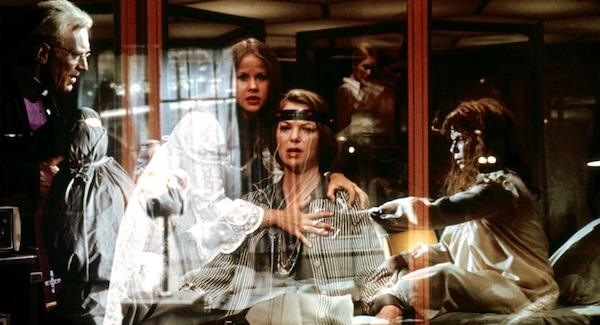
A scene from Exorcist II: The Heretic.
Actors and crew members alike agree that the script revisions were problematic and drastically changed the film’s original vision. Pallenberg’s interview contributions are intriguing: he seems both resistant to, and resigned to, the idea that his ultimately uncredited revisions may have been a major cause of the film’s failure. One principle Boorman and the rest of the creative team held to throughout production was that this was not meant to be a straightforward continuation of The Exorcist. Rather, it was intended as a kind of alternate narrative that explored psychological aspects of the story. Nor was it originally intended to be a horror film in the same intense and shocking mode as Friedkin’s artful but controversial original.
It turns out that audiences wanted a terrifying, shocking sequel, and Warner Bros. hinted that they might get one. After months of major media hype, and nearly unimaginable problems plaguing the production itself, the film’s release was an unmitigated disaster.
Kittredge embellishes the many interview scenes with archival footage and inventive animated sequences by Mindbomb and Craig Smith. The energetic visuals keep the pace lively. These segments not only connect the dots skillfully but also beautifully capture an era that is now regarded as one of American cinema’s most artistically adventurous—a period when studios took enormous risks. It is one whose like may never be seen again. The interview subjects also pay sincere homage to Boorman: his skill, dedication, and passionate work ethic, as well as the bravery he displayed dealing with a demanding project with very high stakes.
Indeed, this excellent documentary is as much about the art and industry of cinema—its triumphs and pitfalls, demands and rewards—as it is about a film that nearly destroyed its maker. Opinions remain divided as to whether Exorcist II is worthy of reevaluation. But, when Kittredge asks the critics whether it is a good movie, Zacharek responds without hesitation: “Exorcist II: The Heretic is a great movie.
Peg Aloi is a former film critic for the Boston Phoenix and member of the Boston Society of Film Critics, the Critics Choice Awards, and the Alliance for Women Film Journalists. She taught film studies in Boston for over a decade. She has written on film, TV, and culture for web publications like Time, Vice, Polygon, Bustle, Dread Central, Mic, Orlando Weekly, Refinery29, and Bloody Disgusting. Her blog “The Witching Hour” can be found on substack.