
Book Review: How Capitalism Treats the Strangers It Needs
By Tom Connolly
In “The Capitalist Era,” Jeremy Adelman traces how global integration bound societies together without teaching them how to live with one another.
The Capitalist Era: The Making—and Unmaking—of the Global Mind by Jeremy Adelman. Princeton University Press. 386 pages, $35.
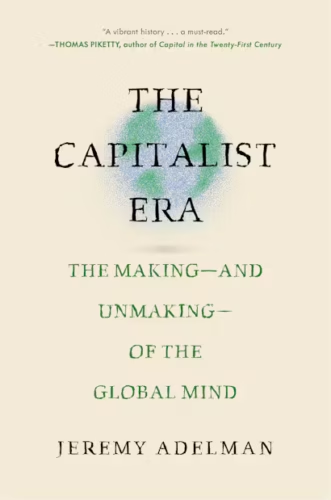
Books on economics are too often throttled by theoretical throat-clearing or bursts of free-market cheerleading, so Jeremy Adelman’s The Capitalist Era arrives as a welcome corrective. Across 386 pages, Adelman charts two and a half centuries of economic entanglement without reducing the global capitalism to bloodless ledgers of tariffs, trade balances, and growth rates. His crisp, accessible prose offers a sophisticated reckoning on this provocative focus: the shifting psychology of interdependence. Capitalism, he claims, bound distant peoples into a single, though fractured, economic “survival unit.” The promise that ever-deeper market integration would yield peace, prosperity, and social harmony maintained an order that was always more fragile than its advocates admitted. Yes, the global economy knitted societies together — while generating inequalities that often left them feeling more estranged from one another.
Adelman’s greatest strength as a historian lies in his refusal to indulge in easy periodization. His treatment of the 1890s is a case in point. Popular memory often pictures a decade of confidence and expansion, Adelman reveals a Belle Époque roiled by economic insecurity and geopolitical tension. He doesn’t open his look at the era with celebrations of Adam Smith’s invisible hand. He goes straight for fin-de-siècle anxiety: bubonic plague creeping from Hong Kong to San Francisco, droughts scorching Russia’s breadbasket, Broadway shows on the corruptions of ruinous bank runs, and painters abandoning idyllic landscapes to depict the brutal labor of exhausted peasants.
One of the book’s most unsettling achievements is how it makes the catastrophe that followed appear less like a historical rupture than the culmination of a precarious global order’s overreach. World War I and the legacy of Versailles emerges from traumatic tensions already woven deep into the fabric of that system.
Equally illuminating is Adelman’s coinage of the term “post-Nagasaki” for the era following World War II. Avoiding familiar Cold War narratives, he examines what he sees as the paradox of the postwar order through photographer Yōsuke Yamahata’s images of atomic devastation. From the rubble emerged an American-led order secured by imperial military and economic power, dominance that appeared unassailable before faltering amid the systemic shocks of the 1970s.
The Capitalist Era offers no comfort to either the utopian boosters of “One World” neoliberalism or the pseudo-biblical mouthpieces of “America First” nationalism. Adelman dismantles the triumphalist post–Cold War orthodoxy personified by Francis Fukuyama and Thomas Friedman. He casts Fukuyama as an “erstwhile booster” of Western destiny whose later disavowals cannot erase his standing as an emblem of the 1990s conceit: that liberal democracy had triumphed once and for all. The unraveling of that confidence—registered in Fukuyama’s own reassessments—sharpens Adelman’s central point: history was never as settled as globalization’s champions imagined. Friedman’s frictionless “flat world” fares no better.
Friedman fantasized digital networks and global supply chains dissolving borders into universal harmony. In contrast, Adelman sees a volatile reality. Interdependence has not eliminated political conflict; instead, it has dispersed it into new arenas, from migration politics to supply-chain vulnerability and economic nationalism. Societies remain dependent on distant strangers for labor, resources, and capital even as they feel increasingly vulnerable to forces beyond their control. Integration produces prosperity, but it also generates instability, resentment, and political backlash. And the process barrels along. Even the 2008 financial crisis, for all its devastation, failed to reverse the trajectory of global economic integration.
Adelman’s long view is especially provocative on migration, exposing the historical myopia of contemporary border panics. Rather than treating mass movement as a uniquely modern crisis, he places it at the heart of capitalism’s expansion across continents and oceans—a principal means of redistributing people, labor, and opportunity. What appears exceptional in today’s political discourse emerges instead as a recurring feature of the capitalist era.
His contrast between the nineteenth century’s age of “Earth Hunger” and today’s “Great Displacements” reveals a transformation less in human mobility than in its political meaning. In the imperial age, mass migration served as an engine of expansion: millions crossed oceans and continents as settler colonialism and capitalism drew labor into an increasingly integrated, if profoundly unequal and exploitative, global economy. Today, the frontier has closed, and migration confronts hardened borders, ecological strain, and instant communication. Yet Adelman shows that migration rates are lower now than during the age of “Earth Hunger.” The paradox is telling: movement once enlisted to build empires is now invoked as a threat to nations and the global order.

Historian Jeremy Adelman. Photo: Princeton University Press
The Capitalist Era’s sharpest insight into economic entanglement turns on what Adelman calls “intervisibility”: modern media’s capacity to bring distant strangers’ lives and crises into increasingly immediate view. His account of Felice Beato’s nineteenth-century photographs of Asia—particularly those documenting the British and French assault on the Taku Forts and the destruction of China’s imperial Summer Palace—casts Beato as a pioneer of war photojournalism whose stark images brought the violence of imperial integration into Western parlors. But visibility, Adelman insists, is not understanding. From early phototelegraphy to the ubiquitous selfie, the international circulation of images has not produced the global village of high-minded liberal aspiration. Mass media have made distant lives more visible without settling a crucial question: do we regard these strangers as partners or rivals?
The gap between seeing and understanding crystallizes the book’s central concern: interdependence generates tensions that neither markets nor technology can resolve on their own. That problem also ended up reshaping Adelman’s project. He initially conceived the book as an inquiry into the “opening of the global mind.” But consideration of Brexit, border panics, resurgent nationalism, and climate anxiety drove him toward a darker question: how do expanding economic ties narrow political horizons? The result is less an exploration of globalization’s enlargement of human possibility than an inquiry into why dependence on others so often breeds fear, resentment, and exclusion.
That The Capitalist Era supplies neither a single villain nor a tidy historical lesson is a measure of its explanatory strength. To his credit, Adelman rejects fairy-tale triumphalism without succumbing to dystopian warnings. Globalization’s tensions, he argues, are not necessarily symptoms of terminal crisis; they are recurring consequences of our age-old dependence on strangers. In the coda, “Top of the Mast,” the historian warns against “the temptation of apocalyptic analysis and doomsday prophecies,” which “conflate the challenges of our internal, fracturing tension over the need for strangers with a terminal crisis.” His conclusion is disquieting because it offers no escape from that dependence: the strangers who sustain modern life are not going away. The task is not to imagine a world without them, but to learn how to share this one.
Tom Connolly is is Professor Emeritus of Humanities and Social Sciences at Prince Mohammad Bin Fahd University. He recently edited Images from Jewish Life in Döbling Vienna: Tracing History Through Memory (Bohlau Verlag, 2026). He has published three books and numerous journal articles on theater, film, and futuristic studies.
Tagged: Capitalism, Economic History, Globalization, Imperialism, Interdependence, Jeremy Adelman, Nationalism, Neoliberalism, Political Economy, migration