
At The New York Film Festival — Three Movies You Probably Didn’t Hear About
By David D’Arcy
Aging actors take on Samuel Beckett’s “Endgame,” Radu Jude reimagines “The Diary of a Chambermaid,” and a restored Indian indie classic challenges pompous authority.
The New York Film Festival offers more films than you can keep track of. That’s a good thing, unless you miss seeing them.
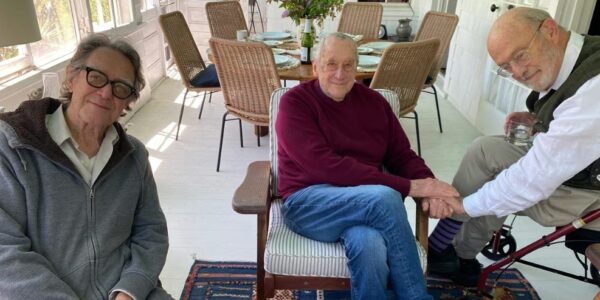
A scene from One More Time, featuring Andre Gregory, Gerry Bamman, and Larry Pine. Photo: NYFF
One More Time was one of the pleasant surprises of the New York Film Festival, yet “pleasant” might not be the right word when you consider the elements of the documentary.
The setting of this doc is a sparsely furnished house surrounded by snow, with windows that let in so much light that nothing seems hidden.
Two actors, two directors, and a cameraman are filming Samuel Beckett’s absurdist comedy, Endgame. You don’t need much besides an empty interior to do that, plus a wheelchair for one of the characters. We are told that the team did not get permission from the dramatist’s estate to perform the script. They are simply rehearsing and filming excerpts. Those rehearsals — along with lots of talk about all sorts of things — are what we are given to see.
The directors are Cindy Kleine and her partner of 25 years, the veteran theater director Andre Gregory, who is 92. The two actors are Gerry Bamman and Larry Pine, once stalwarts of the Manhattan Project, a troupe founded by Gregory. The actors in the no-budget group once performed classics and new work with an irrepressible youthful vigor.
Not so much today. Bamman is in a wheelchair (as is his character in Endgame). Pine, a longtime comic star of Off-Broadway theater, now has Alzheimer’s disease, which means he can’t remember much of the dialogue, even short Beckett lines.
Given the age and the enfeeblement of the players, “one more time” is said … often. To be fair, Gregory’s mind remains sharp, though he moves slowly. “It’s time it ended, and yet I hesitate to end,” says Bamman’s character from his wheelchair. The point is obvious. With this film, they are moving closer to the real end. Think of Waiting for Godot, but here you sense what they’re waiting for.
“You have to remember, we’re not doing a film version of Endgame, declares Gregory at one point, who speaks as a co-director and a commentator on his own work throughout the film. You could call it “My Endgame with Andre.” “We’re doing a film about how difficult it is for two people, both of whom courageously try to do the play in spite of their infirmities,” he notes.
Infirmities indeed. Between rehearsal sessions, we see old clips from earlier days, when both actors were light on their feet, usually ready with a wisecrack.
Now Bamman, his eyes closed much of the time, is sphinx-like. Pine, standing in the nearly bare interiors, struggles with what he can’t remember, even though a person — standing behind him like a guardian angel — is feeding him lines.
One More Time feels more satisfying today than My Dinner with Andre did for me on a recent re-viewing. The older film, entirely scripted by Wally Shawn, felt too much like a performance, even hammy at times, with Shawn doing the shtick that would earn him a good living once the film found an audience, and Gregory coming off as just another credulous globetrotting artist with money. Its real achievement was to show that a single conversation between two men was one of the many things that cinema could be — and could make a profit being. One More Time, filmed in as comfortable a setting as the restaurant in the earlier film dramatizes real discomforts by way of a slow, crooked homage to Beckett and to the actors themselves. The doc will play at Film Forum in New York in February.
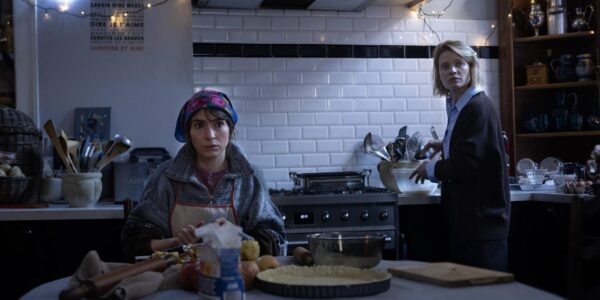
A scene from Radu Jude’s The Diary of a Chambermaid. Photo: NYFF
Radu Jude’s version of the classic The Diary of a Chambermaid arrived under the radar at NYFF, perhaps because the director did not attend.
Jude, 49 and from Romania, is startlingly prolific. He makes about two films a year. Last year’s Continental ’55 concerned a female bailiff’s long journey into the night in the gentrifying Transylvanian city of Cluj. She is agonized after a homeless man whom she evicted commits suicide. Dracula, with its own Transylvanian origins, was an allusive, sometimes pornographic version of the horror legend.
In The Diary of a Chambermaid, Jude retells the story of Octave Mirbeau’s celebrated and notorious French novel of 1900, which has already been filmed by Luis Buñuel, Jean Renoir, and Benoît Jacquot, himself a convicted sex offender. It’s a classic story that always merits another remake. Jude’s version is filled with a satirical cynicism that brings it up to date, along with raunchy moments that put the material inside Jude’s orbit.
Gianina (Ana Dumitrascu) is a Romanian woman abandoned by her husband, who also traveled west. She has left her young daughter at home with the girl’s grandmother while she works as a maid for a bourgeois family in Bordeaux. She’s working illegally, caring for a spoiled child, and listening to armchair experts yell at each other about the political problems of Eastern Europe. Gianina’s daughter begs her to return for Christmas, but her employers insist that she care for the French husband’s mother, who’s bedridden after a fall. Meanwhile, a family crisis looms back home in Romania: Jude’s camera jumps back and forth between the rural Moldavia region, impoverished even by Romanian standards, and the prosperous, stately Bordeaux of grands crus and pompous wine-quaffing leftists.
Jude has an unsparing eye for the manners of place and social rank. His glimpses of Romania often feature animals rather than people—not because he is observing nature, but because anyone who can find work elsewhere has left. In Bordeaux, the streets are immaculate, save for homeless men whom everyone ignores. They stand motionless, then erupt in curses at passersby.
The director also can’t resist bringing contemporary provocations into Mirbeau’s story of one class seen through the eyes of another. Gianina performs in a local independent theater production of The Diary of a Chambermaid that pursues realism by casting nonprofessional immigrants. The producers are snobs, and their careless publicity for the show ends up getting one of their undocumented performers arrested. The down-and-dirty drama onstage is vintage Jude—at moments disgusting, often hilarious in its excess.
The film opens onto a larger subject: the migration of workers, many of them mothers of young children, from economically depressed Eastern Europe to Western countries that need their labor. In France and Italy, the women caring for the elderly are often Romanian or Moldovan.
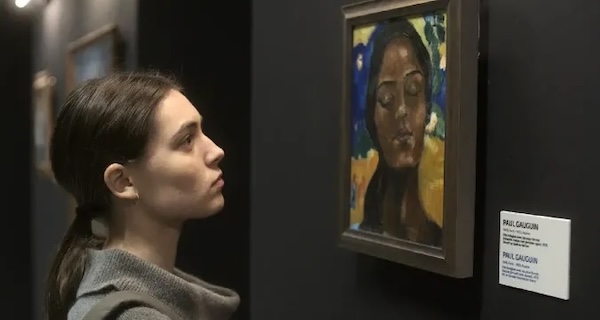
A scene from Teodora Ana Mihai’s Traffic. Photo: NYFF
Migration also drives Teodora Ana Mihai’s recent, still-unreleased Traffic, written by the much-feted Cristian Mungiu (Fjord). Indebted and demoralized, Romanian workers in the Netherlands turn to stealing paintings from a museum: more profit, less work. Echoing the real-life 2012 Kunsthal Rotterdam robbery, they take their haul to a Danube Delta village hollowed out by migration. When the thieves are caught, their relatives burn the paintings—including works by Matisse and Picasso—to destroy the evidence. Traffic screened in New York last December at Making Waves, the annual showcase of Romanian cinema.
Mihai explored the other side of migration—the lives of those left behind—in her poignant 2014 documentary Waiting for August. It follows a 16-year-old Romanian girl raising her six younger siblings while their mother works abroad, returning for just four weeks each summer.

A scene from In Which Annie Gives It Those Ones. Photo: Mubi
Also at the New York Film Festival was a restoration of In Which Annie Gives It Those Ones (1989), an early Indian independent classic with an uncommercial title written by Arundhati Roy and directed by Pradeep Krishen. Made for television, it belongs in film-school curricula far beyond India.
At an architecture school in New Delhi, students labor over their final projects through oppressive heat and all-night sessions, breaking for ping-pong. The school’s director, played by Roshan Seth, is an officious tyrant. Anand, known as Annie (Arjun Raina), is an eccentric idealist whose imagination extends to mocking the great man’s self-importance—and who pays for it. Camaraderie offers a defense against petty authority, giving this Indian campus comedy its wider political bite. Then the judges arrive: more of the same, keener on lunch than on the projects before them.
The ensemble includes a not-yet-famous Shah Rukh Khan in a small role, offering an early glimpse of talents who would help shape Indian cinema—and, in Roy’s case, literature. This is indie India, a world away from Bollywood: a shoestring satire of a state institution, powered by its cast, its eye for institutional absurdity, and its unadorned style.
The unrestored version is widely available on YouTube.
David D’Arcy lives in New York. For years, he was a programmer for the Haifa International Film Festival in Israel. He writes about art for many publications, including the Art Newspaper. He co-produced and co-wrote the documentary Portrait of Wally (2012), about the fight over a Nazi-looted painting found at the Museum of Modern Art in Manhattan.
Tagged: Andre Gregory, Arundhati Roy, Cindy Kleine, David D'Arcy, Endgame, Film Restoration, Gerry Bamman, In Which Annie Gives It Those Ones, Indian Independent Cinema, Larry Pine, NYFF, New York Film Festival, One More Time, Pradeep Krishen, Radu Jude, Romanian cinema, documentary film, film reviews, samuel-beckett