Book Review: Beneath the Waves — A Story of Love, Loss, and Uncertainty
By Kate Lightstone
Kelly Anderson’s The Wild Beneath finds beauty in the eerie aftermath of disaster, where grief settles everywhere and the sea reshapes what its survivors believe is real.
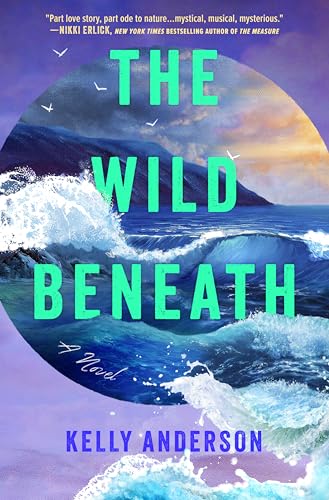
The Wild Beneath by Kelly Anderson. Park Row, 384 pages, $30.
Version 1.0.0
If love knows no limits, can it also escape the confines of reality? In Kelly Anderson’s debut novel, The Wild Beneath, love, loss, and the ocean’s constant, mysterious gifts test the boundary between the real and the unreal.
Annie Macleod has spent very little time on land. Raised aboard a sailboat by her parents—a former doctor and an enigmatic mother, both musical and stern—Annie lives in the fictional town of Hale’s Landing, off Vancouver Island. When a tsunami devastates the coast and destroys the town she knows as home, time, truth, and reality itself begin to bend.
Annie is 20 and in love with her childhood sweetheart, Evan Hale, the son of a local logging tycoon. Then Walker—a silent, mystical man who seems almost made by the ocean—washes ashore after the tsunami. Annie’s world shifts again, in ways Anderson strains to render in language. What follows is a love story that draws the reader slowly — almost underwater — through a winding exploration of love, loss, and visceral mystery.
The Wild Beneath is, first and foremost, a novel of grief. Opening in the tsunami’s aftermath, it uses frayed threads of prose to stitch together an intimate account of loss. Destruction, grief, mass logging, death, and irrevocable change recur like currents, their force evident early on, when grief takes the form of sand: “She finds more still, in the sink drain, embedded in the seams of the mattress, in the plastic utensil divider in the kitchen drawer, in the thumb of Ruth’s oven mitt. Her grief is like this.”
Anderson’s first novel reveals equal measures of strength and weakness. She has a particular gift for describing people and for conveying the inexplicable ways we are drawn to one another. Isaac’s realization that he is falling for his future wife produces one of the book’s more intimate passages: “He already felt reverential toward her. (…) Even then, he was lost in the soft fuzz on her earlobes and the way her hair—pulled back up into place—curled at the nape of her neck.”
Throughout the novel, Anderson lends moments of attraction and connection a tactile, persuasive force. But the book’s frequent shifts among its many characters—each filtered through an omniscient perspective—often blur their emotions, voices, and inner lives into a tidal wash. Just as a reader begins to inhabit one character’s mind and heart, the narrative moves on.
Those transitions keep the plot moving and carry the reader in the story’s wake, but they also blur the novel’s voice. The result is a persistent sense of almost-connection: the reader becomes nearly invested in each character without quite attaching to any of them. This observational distance sits uneasily beside the emotional intensity the narrative otherwise seeks to generate.
The Wild Beneath was completed through a novel fellowship involving mentors and editors, and at times the presence of many hands feels palpable. Anderson’s writing is compelling, but the story can seem stilted, as if individual passages have been placed beside one another rather than integrated into a unified narrative. There is a sense of over-editing and over-refinement; one can almost see paragraphs being cut, rearranged, or rewritten in pursuit of polish. Rather than deepening the book’s world, that visible labor occasionally pulls the reader out of it, creating a surface-consciousness at odds with the depths Anderson seeks to evoke.
Anderson’s fusion of fantasy and magical realism is ambitious. It is a mode that can work especially well in mystical short fiction, where not every detail need be resolved and evocative images can carry much of the narrative’s force. Sustaining it across a full-length novel is harder. Here, some transitions feel clunky—a jarring contrast with Anderson’s otherwise eerie, yearning prose.
The dialogue, however, is consistently strong, an accomplishment for a first-time novelist. The characters’ emotional lives are less fully sustained. Feelings often flash into view for a line or two before the narrative moves on, leaving the reader wishing to dig deeper into their lives and find a more enduring emotional register.
Ironically, the prose itself often compensates for this emotional thinness. Anderson creates passages of unease and fluidity that capture the unnamable suspension that follows a natural disaster. For example, Evan, the logging tycoon’s son, prepares for an ocean crossing that everyone understands is a terrible idea: “Evan pulls up the anchor, but it turns out it isn’t a real anchor at all. It’s a heavy cinder block on a blackened, fraying rope.” The image is ominous, material, and exact.
Most hauntingly, The Wild Beneath imagines life as divided between Hale’s Landing, a community rooted on land, and Annie’s world, which belongs almost entirely to the sea. The novel moves between earth and ocean, before and after, responsibility and soul-calling. Expectations, loyalty, environmental conservation, love, loss, and longing are entangled across its pages.
The Wild Beneath leaves the reader wanting greater depth and cohesion. Still, the story captures the sea’s beautiful, mysterious call: haunting and powerful, it is a harsh reminder of human fragility.
Kate Lightstone is a writer, astrologer and avid surfer who believes magic lives in the mundane. Working as a bookseller throughout her 20s, she self-pub’d her first book, Starseed Survival Guide in 2024 — an energy handbook for highly sensitive and intuitive beings. Her freelance specialties surround warm, authentic reviews and comprehensive astrology forecasts. Her current focus is on a budding novel inspired by her lineage of strange and creative East Coast women. She lives between the far East and West coasts of Canada, in both Tofino, BC and Lawrencetown, NS, respectively.