
Book Review: Jack Cole — Hollywood Dance’s Dazzling Bad Boy
By Debra Cash
Jazzed makes a persuasive case for Jack Cole’s artistic importance, even as its overly admiring portrait evades some of his darkest behavior.
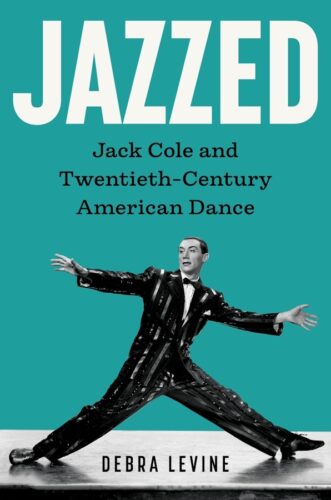
Jazzed: Jack Cole and Twentieth-Century American Dance by Debra Levine, University Press of Kentucky, 384 Pages, $40
There are few dance sequences in the history of Hollywood’s Golden Age as indelible as Marilyn Monroe’s turn in Howard Hawks’ Gentlemen Prefer Blondes (1953). In a strapless fuchsia satin gown and matching gloves, Monroe is irradiated against a red backdrop that just about matches the lipstick on her generous singing mouth. The men surrounding her look mesmerized, even as she slaps them “no, no, no, no” with her black fan. Instead, Monroe sings “a kiss on the hand may be quite continental” as she signals, coquettishly, to the oversized rhinestone bling on her wrist. You can’t take your eyes off her. Truth be told, it makes you feel that Lorelei Lee from Little Rock deserves every bauble she can wrangle.
Writer Debra Levine thinks so, too. Here’s her description of Monroe’s “narrow palette of doable moves”:
She skips, pauses, poses, and walks with saucy weight shifts at the hip. She executes her micromoves — heavy-lidded winks, pouty pursed lips, sexy shoulder shrugs, and taunting finger points — all synched to the lyrics, all eye candy for the camera.
What pisses Levine off is that, except for film buffs and dance folks, few people remember the name of Monroe’s choreographer. His name was Jack Cole.
Movie and stage — and, for that matter, music-video — dance makers rarely become household names. (Thanks, Hermes Pan, for being Fred Astaire’s “idea man.” Hi there, Michael Peters, for choreographing Michael Jackson’s “Thriller.”) But rectifying erasure is a good enough reason for launching what is the first, but probably not the last, full-scale Cole biography.
Cole’s career spanned a period that began with the early 20th century orientalism of Denishawn and ended in 1974, when he died of liver disease, having influenced a generation of choreographers — Bob Fosse, Jerome Robbins, Ron Field, and, possibly, Alvin Ailey — whom Debra Levine routinely implies ripped him off. Cole’s particular, mid-century stylistic fusion came to be known by the now-cringeworthy term “Hindu Swing.” In 1932, he saw a performance by Uday Shankar (sitarist Ravi’s older brother) in New York, and felt compelled to study classical Indian Bharatanatyam, with its specific vocabulary of expressions for fingers and eyes and deep, knee-bent groundedness. Cole spiced that foundation with Afro-Caribbean polyrhythms, Harlem social dance, and a demanding athleticism that made nightclub audiences cheer, Broadway dancers sweat, and Hollywood cameras find rhythmic delight in close-ups.
Cole was the kind of generational talent that changes an audience’s expectations. Vaudeville would have died anyway, but Cole seems to have given it a mighty kick in the ribs. A “physical show-off” with a swimmer’s compact build, he wowed his mentors from the very beginning of his dance career. He was part of the crew that Ted Shawn took to the abandoned farmland that would become the home of Jacob’s Pillow in the Berkshires, where he and Shawn’s male dancers combined dance training and rehearsals of “Papa” Shawn’s choreography with hard physical work, routinely laboring in the nude. But unlike many of Shawn’s other male dancers, Cole was impertinent and sulky. If he wasn’t willing to fawn at Ted Shawn’s feet, he would have to find other places to dance.
He found them. He studied “barefoot dancing” in nascent modern dance studios, especially those of Doris Humphrey and Charles Weidman. He was hired at nightclubs, where he had the opportunity to cast his high-velocity numbers and just-this-side-of-naughty costumes with dancers who would become lifelong collaborators. Levine gets into the nitty-gritty of the hard work behind the glamour, and quotes judiciously from enraptured reviews of the troupe’s stints at classy venues like the Rainbow Room. Cole was not only celebrated, he was making serious money, most of which he refrained from sharing with his dancers. (In 1941, he cancelled a one-night gig rather than pay his dancers more than $50 each out of his $800 fee.) Adept at accommodating the gangsters who ran the clubs, and whose approval smoothed the way onto a national nightclub circuit, Cole’s comfort maneuvering — physically and psychologically — around mobsters would serve him well when he encountered Harry Cohn at Columbia Pictures and played one studio boss off the other to get the best deals for himself.
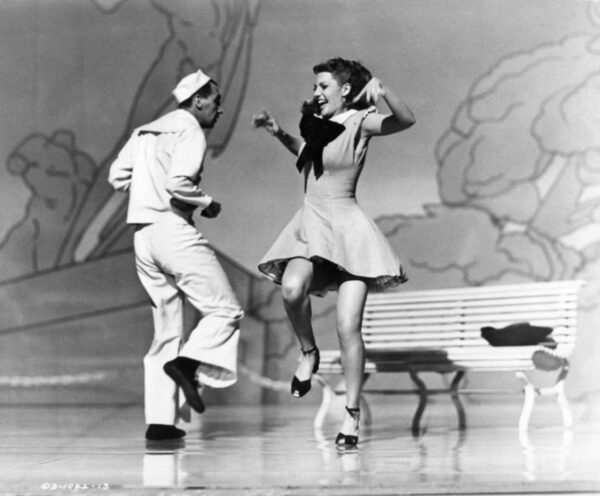
Cole and Rita Hayworth in Tonight and Every Night (1945). Photo: WikiMedia
Reading Jazzed, you’ll be well advised to seek out YouTube samples of his film work. Check out Cole dancing with Rita Hayworth in a perfect “sailors on leave” wartime number; dancing with Gwen Verdon, who would become a muse to both Cole and her future husband, Bob Fosse; Mitzi Gaynor, shedding one costume to reveal a skimpier one — a classic Cole move — in “Johnson Rag” from the 1953 film The I Don’t Care Girl; and the kitschy “Indo-Perso-Arab fantasy” of “Not Since Nineveh” from Kismet (1955) (my knees hurt just watching it). Cole — like Astaire, though Levine doesn’t mention it — designed his Hollywood numbers by camera setup.
I’m always happy when a dance book makes it clear that the writer has really watched and thought about the dancing and the ideas and technique behind it, but Jazzed is marred by Levine’s peculiarly mannered “you were here” tone. She adopts contemporaneous hep-cat lingo (who knew “terps” was a newspaper reviewer’s term for dancers?) and seems to take almost everything Cole said in interviews as God’s honest truth. She also strives to get even with the people Cole disliked. Gene Kelly may not have been a Jack Cole, and maybe he was indeed a “square,” but after all, he was Gene Kelly, excelling in his own lane.
Levine acknowledges that although Cole dancers revered him, and although American dance may owe much to his innovations, Cole could be brutal in the studio and on the street, socking Gwen Verdon in the jaw and kicking another performer to the floor. He called a thirteen-year-old dancer a gorilla and was reported to have thrown one dancer through a French door. She doesn’t mention this much until later in the book, but Cole’s drinking probably contributed to his appalling behavior. By the late 1960s, when such conduct was less likely to be ignored and one abused dancer threatened to sue, it became harder for Broadway producers to have Cole on the roster.
His long partnership with David Gray, a tall, good-looking Texan “with fake British airs” — with whom Cole lived in a California stucco house they transformed into “a mini Parthenon replete with marble floors and antiquities,” overlooking the Hollywood Hills — was an open secret in the Hollywood community. Their swimming pool served as a gathering place for skinny-dipping stars. Levine quotes people who knew them saying that they shared a sadistic sense of humor and that they were “bitchy queens.” That rings true. Jack Cole wasn’t a nice guy, but he was a talented one.
Debra Cash is a Founding Contributing Writer to the Arts Fuse and a member of its Board.
1 Comment
Leave a Comment

Glad to learn more about someone whose name comes up a lot when I am reading about the history of certain performers, composers and lyricists!