
Book Review: “Blow by Blow: The Jeff Beck Story” – Renaissance Guitar Man
By Ed Symkus
Jeff Beck is a bigger guitar hero than you realized.
Blow by Blow: The Jeff Beck Story by Brad Tolinski & Chris Gill. Da Capo, 388 pages, $32.50 (hardcover)
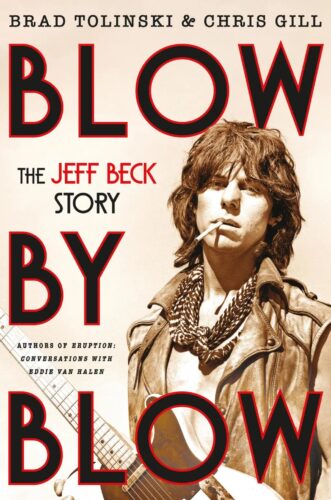 As a longtime Jeff Beck fan – I saw him perform on five occasions, including gigs at The Boston Tea Party, the Orpheum, and the House of Blues – I turned to the first page of this new biography with a great flush of eagerness. I knew what he could do with a guitar, from memories of those live performances as well as countless listenings to the vinyl and CD recordings on my shelves. But I was hoping to get an idea of how he made all of that music and often otherworldly sounds, and what drove him to flit in and out of – and often back into – the worlds of rock and blues and jazz and techno and soul and funk.
After two days and almost 400 pages of unputdownable reading, thanks to the journalistic prowess and musical knowledge of co-authors Brad Tolinski and Chris Gill (both of whom have extensive backgrounds with Guitar World magazine), it’s safe to say that those hopes were exceeded.
Keeping things detailed and chronological, and making exceptional use of interviews they conducted with Beck over the years, along with quotes from his friends, fellow musicians, and former bandmates, Tolinski and Gill present a character study of a complicated guy. They kick things off with 13-year-old Beck watching an “unnervingly primal and hypnotic performance” of “Be-Bop-A-Lula” by Gene Vincent and the Blue Caps in the 1956 film The Girl Can’t Help It. They refer to that instant as “the spark that lit the fuse,” then touch on his resulting fascination with and early attempts at the mastery of electric guitar in teenage cover bands. They trace his illustrious professional career as he worked his way up from the Yardbirds to the Jeff Beck Group to Beck, Bogert & Appice and ever-changing versions of other lineups. They end with Beck’s death on January 10, 2023 (at age 78) from a bacterial meningitis infection. (Arts Fuse tribute to Jeff Beck.)
My two favorite moments in the book are the revelation that Beck’s friend and rival, Eric Clapton – who Beck replaced in the Yardbirds – used to refer to him as Becky, and the inclusion of what passed as Beck’s brief acceptance speech at the 1992 induction of the Yardbirds into the Rock & Roll Hall of Fame. Beck, who had been fired by the band almost three decades earlier, approached the microphone and said, “I have done other music after the Yardbirds. Anyways, somebody told me I should be proud tonight, but I’m not, because they kicked me out. They did. Fuck them!” – then laughed, and walked away.
Those are a couple of the plentiful fun parts. The more fascinating elements – some no fun at all – outnumber them, including accounts of Beck’s numerous physical setbacks, including tonsilitis and an ongoing throat infection, two car accidents resulting in head injuries, a broken thumb, and tinnitus. On the emotional front, we learn of Beck’s recurring inability to get along with bandmates, producers, and management, sometimes due to his infamous bouts of moodiness, or the possibility of angry outbursts if, for instance, something went wrong with equipment (a fictionalized example of which is immortalized in the film Blow-Up when a crackling Vox amplifier leads a frustrated Beck to smash his Hofner Senator guitar).
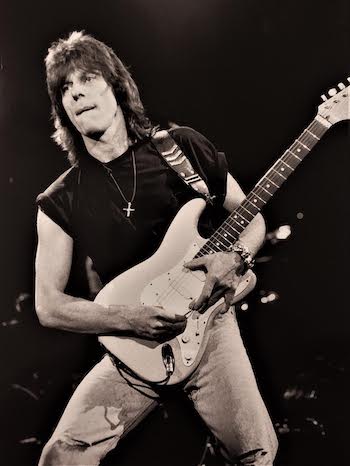
Jeff Beck at the Centrum in 1989. Photo: Paul Robicheau
Tolinski and Gill also look into Beck’s constant search for new creative directions and partners (both musical and romantic ones), and they make sure to point out that though he was a respected and revered guitarist, he never quite reached the level of fame achieved by Eric Clapton or Jimmy Page or Jimi Hendrix. And Beck was okay with that. They quote him, in a self-deprecating, late-career interview, as saying, “I’ve always been at semi-pro status. I’ve never really made it, so I’ve never had to maintain a massive state of popularity.”
They also include many examples of Beck’s other pastime – one that somehow complemented his musical activities – his enthrallment with hot rods, many of which he built from the ground up, and loved to drive.
Another favorite moment for me was reading the sentence “Where Clapton was meticulous and stylish, Jeff Beck, with his greasy jeans and scruffy, shoulder-length hair, resembled someone who had just emerged from under a car … and probably had.”
The book draws on an accessible, almost conversational style of writing. The authors know Beck and they know their music history. They come across as a perfect melding of expert and fanboy. And they’re great with words, balancing straightforward facts with memorable and enjoyable prose.
Of Ron Wood’s bass playing on the Jeff Beck Group’s second album, Beck-Ola, they write that he “navigates through each chord progression with the unpredictable energy of a Mack truck on an icy road.”
Turning to Beck’s attitude on stage, they say, “With an air of smoldering indifference, his menacing nonchalance would be studied and emulated for years,” by other guitarists.
The book is for Jeff Beck enthusiasts who will, no doubt, learn a lot. Without it, I might never have known about Beck’s deliciously raucous instrumental version of “Hound Dog” from the Honeymoon in Vegas soundtrack. But it’s also for Beck novices who will undoubtedly check out his work, and will be musically rewarded for doing so.
Ed Symkus is a Boston native and Emerson College graduate. He plays guitar, went to Woodstock, has interviewed Adrian Legg, Al Di Meola, Bill Frisell, Duke Levine, and Jimmy Vivino, and has visited the Outer Hebrides, the Lofoten Islands, Anglesey, Mykonos, the Azores, Catalina, Kangaroo Island, Capri, and the Isle of Wight with his wife Lisa.
6 Comments
Leave a Comment

Fine review, Ed. I also saw Jeff Beck at the Boston shows you mentioned. I may have to pick up a copy of the book. Thank you!
Jeff Beck was the supreme guitarist I managed to see him live 46 times through the decades. In addition he had such charisma and you couldn’t take your eyes of him and so much more distinctive than any other musician. I particularly loved his work with the Yardbirds and his fusion and Tecno work. I only have one complaint that his discography is so small compared to other less worthy contemporaries.
Thanks for the review Ed! It was a passion project for Brad and me, and we wanted the book to be as accessible to readers unfamiliar with Beck’s career as it was to his longtime fans. A very fascinating, if challenging, subject to write about.
If I may, I’d like to note that I put together a Spotify playlist to accompany the book (Robert, you may discover some side sessions that make up for the lack of material Jeff released on his own).
https://open.spotify.com/playlist/0KPbR0LRmyVjkh3G4v58GZ?si=LzxZngH9Sx2u2HUVbxtJGQ&utm_source=copy-link&pi=d7uNkPDXSke2R
Wow, this is awesome, Chris. Much obliged! What an incredible read! I sometimes wonder how high the hit rate on Jeff Beck raised after this book hit the market. One of the amazing things about today’s tech, which leaves a lot to not like, is the ability to retrieve a lot of historic performances and even direct interviews going back 50 +/- years. So, in addition to reading about the incredible stories, I could almost transport myself back in time listening and sometime watching the performances being referenced. It took awhile longer to get through your book, of course, but it was all time well spent. As I am sure yours was with Brad doing all the research and retrieval needed to bring Jeff’s story to light. It was an awesome job.
Again, much obliged to you both! I lived through most of this time period and could relate. But I’m sure it a stretch for someone who hasn’t to realize what that period of time was like.
I always loved Beck’s playing and attitude. When I met my wife we discovered we had that in common. She had been a fan of his and was very knowledgeable about his music which nicely reinforced my love for her. We saw him 3 times when we were together and she always referred to him as “my Jeffy” though I would tell her that sounded too much like the kid in the “Family Circus” cartoon. I have a collection of books about Jeff and looking forward to this one.
I really enjoyed Blow by Blow. I’ve been a Jeff Beck fan for a long time, seeing him live a number of times, but certainly didn’t know the whole story. This book was very comprehensive and filled in my knowledge of a lot of different aspects of Jeff’s life, collaborations, equipment, music and talents. I was supremely saddened by his sudden passing and found this visit to his life comforting and satisfying.