August Short Fuses — Materia Critica
Complied by Arts Fuse Editor
Each month, our arts critics — music, book, theater, dance, television, film, and visual arts — fire off a few brief reviews.
Popular Music
Played loudly on headphones, Mohamed Borouissa’s Lila (PAN) discloses its true form. The album is restlessly unsettled: stray tones rupture the mix, ricocheting between channels with unnerving precision. Borouissa’s compositions proceed through fracture, as if the connective tissue of conventional songwriting has eroded. Development is associative and tactile, driven by timbre rather than melody or harmonic progression. Production pushes each sound past the thresholds of live performance, exaggerating texture into something volatile and disembodied. Lila hovers in a state of controlled free fall.

Cover art for Mohamed Borouissa’s Lila.
Though an accomplished photographer and filmmaker, Borouissa, at the age of 48, is only now releasing his debut album. Music has long threaded its way through his visual practice; for example, one project translated frequencies emitted by plants into musical notes. Each track on Lila is titled after a person (identified by their initials) who inspired it. His photographs often document immigrant communities in France, reflecting his own Algerian-born background; the music serves as a more diffuse, dreamlike counterpart to those experiences.
Borouissa’s unceasing use of AutoTune throughout the album renders his voice distinctly androgynous. Rather than masking emotional resonance, however, the processing deepens it, while preserving an uncanny edge. The British artist Gaika has pursued a comparable vocal approach. Looked at more broadly, Borouissa pushes the outer limits of trap toward the borders of dub: metallic abrasion gives way to ghostly vulnerability. The songs resist stability; even when a tune’s lyrics surface clearly, its rhythms remain scattered. “MG” offsets a fragile vocal line against rampaging drums and Franco-Senegalese multidisciplinary artist Le Diouck’s harsher interjections. “NMB” seems to drift through negative space, as if we are listening to a conventional track that has been largely erased.
Lila communicates with striking immediacy, sometimes verging on synesthetic intensity. Although tagged as “ambient” on Bandcamp, it is anything but passive listening: the voices and memories it evokes reverberate insistently in the present.
— Steve Erickson
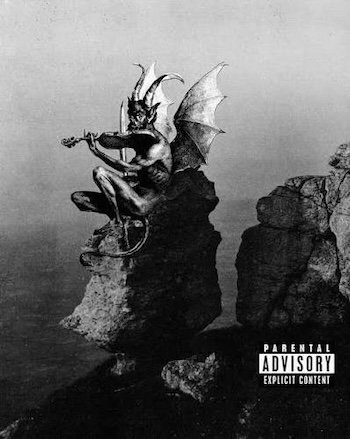
Cover art for Jesse Draxler’s Tongue of Angels.
Although Jesse Draxler is identified as the lead artist on Tongue of Angels (Federal Prisoner), he doesn’t exactly perform on the album. Rather, he created a set of field recordings and other samples, then reached out to a network of artists to produce music that draws on that material. He then sent their contributions to another musician for further work. (This roster includes Zola Jesus, former Sepultura drummer Iggor Cavalera, and Ugandan metal singer Lord Spikeheart.) As the curator of his own streaming platform, Draxler calls himself a “systems designer rather than a conventional songwriter.”
Using this methodological approach, Tongue of Angels casts a consistently oppressive, ominous mood all the way through. Even the recording’s quieter songs are crushingly heavy. The low end of these tracks could probably be felt a block away. Draxler’s photography serves up starkly monochrome images —Tongue of Angels sticks to a similar sonic palette. Its electroacoustic collage pulls from metal, hip-hop, dark ambient, industrial, and noise.
The samples and beats are the star. Human voices are deployed sparingly, sometimes no more audible than the sounds of car horns or passing trains. (Ian Astbury, former singer of The Cult, is unrecognizable, with his voice flanged to rise and fall.) Black Magnet rips into “Prison Birth” with a snarl, while Ho99o9 and Fatboi Sharif add suitably intense rapping to “Ctrl Alt Del” and “Beware of Dog.”
Draxler’s samples record chaotic urban life: jackhammers drilling, a street preacher’s rants. The most resonant songs here leave plenty of open space. “In Silence and In Hope” empties out, looping a rhythm without developing it further. Given all the overtones of apocalyptic cyberpunk, it can be startling when the listener suddenly realizes just how many of these sounds were snatched from real life. Draxler’s intent appears to be to restore a human touch to an art form that’s threatened by the rise of AI. Tongue of Angels works with technology to render emotions that are in danger of being crushed by machines.
— Steve Erickson
 ’92 Winona released their self-titled sophomore album in May of this year and it proves that the band has all the tools necessary for a long creative career. It’s refreshing that this is a group that cannot be easily defined. You can hear indie, grunge, and garage—and, to be sure, all those influences are there in the music—but there is also so much more.
’92 Winona are Steve DelMonico—rhythm guitar/co-vocals; Damien Puerini—lead guitar/co-vocals; Joe Principe—bass; and John Faraone—drums. The inspiration for the band came from a songwriting session between DelMonico and Puerini. Their debut album, Hello, Hello, was released in August 2025. Now they have released their follow-up album, and it is a raw, honest collection of songs. Is everything clean and note-perfect? No. But the honest and invigoratingly self-reliant sound they create is worth ten times more than what could be said of what most Berklee grads are producing right now.
The album kicks off with the song “Out of Place,” a ’60s pop-psychedelic romp that calls to mind the days before punk rock was even a thing. The track is, at times, reminiscent of the glory days of garage rock. Yet, at the same time it feels new.
The album’s second song—and first single—is “Diabetic Coma.” The track is catchy as hell without sounding forced. I defy you to listen to this song and not hum it to yourself for the rest of the day.
At a time filled with useless, overproduced pop music, ’92 Winona is incredibly reassuring. To augment the experience, go hear ’92 Winona live. I doubt you will be disappointed.
— Brian Shovelton
Jazz
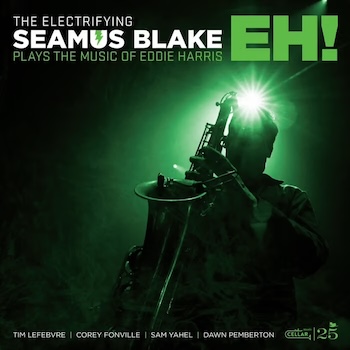 In this Year of Our Lord Centennial of Miles Davis and John Coltrane, Canadian saxophonist Seamus Blake delivers, with The Electrifying Seamus Blake Plays the Music of Eddie Harris – EH!, a rousing tribute to Eddie Harris. 2026 isn’t any round-numbered anniversary of anything in Harris’ life. It’s just because Eddie Harris was a butt-kicking fun player who wrote great hard bop and jazz/R&B fusion tunes with killer solos. Need a better reason than that?
Blake has built a solid reputation and identifiable sound by knowing his way around an Electronic Wind Instrument (EWI) and a variety of synthesized effects. Harris went there first and helped to legitimize and popularize the sound. Blake rightly salutes his inspiration by keeping the plugged-in sound fresh and funky, as Harris would have it.
Of course the album opens with “Compared to What.” It has more of a minor feel than the original, with an ominous undertone to the saxophone effects, which is perhaps what’s necessary to update the song for our still-troubled times. The heavy use of echoes suggests the echoes we’re having to 1969.
“Listen Here” is a classic Harris jam tune, simple and grooving. Blake caputres Harris’ solo style while using a much wider sonic palette. “EH Medley” is a medley of five tunes. I’m not sure the funk groove improves “Freedom Jazz Dance,” but the melody only appears for a few seconds. There are some vocoder vocals, which always remind me of Herbie Hancock on “Sunlight.”
Attention is rightly redirected on this album to some of Harris’ equally worthy and lesser-heard compositions. I’m partial to “Mean Greens,” a fine example of what the saxophone effects can bring to the texture and groove of a catchy tune.
This album makes for great Saturday afternoon jazz.
— Allen Michie
Classical
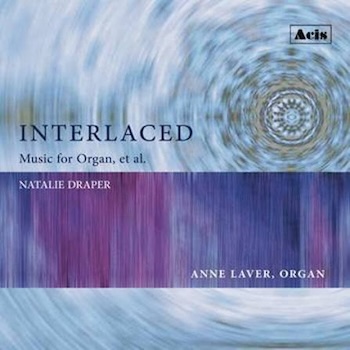
A composer I had never heard of before, Natalie Draper, has released an album of eight recent works for organ, some with another instrument or with singers. (You can purchase it, download the booklet, or try any track here.) Each piece is instantly communicative and fresh-sounding. I don’t recall having enjoyed a new-music CD so much in a long time.
Draper, who has been praised for her “individual and strong voice” (by Colin Clarke, in Fanfare), teaches music theory and composition at Syracuse University. The main performer here, Anne Laver, teaches and serves as university organist at Syracuse. The recordings were made using two organs in Syracuse and one in Rochester.
If you think you don’t like organ music, Draper’s pieces may surprise you: she tends to avoid the overwhelming sounds of multiple ranks of pipes booming away. Often one or two relatively simple melodic lines intertwine intriguingly, as if they were being played by two woodwind instruments. The massive low sounds of the pedals are brought in only on select occasions, to impressive effect.
Draper’s style, often described as post-minimalist, involves close, sometimes overlapping repetition of relatively simple melodic phrases or fragments. An influence from Medieval music is apparent in “A Study in Breathing: Allein zu dir,” in which a mezzo-soprano often holds longish notes while a soprano elaborates in quicker ones, and then vice versa.
Many work or movement titles evoke types of physical actions or moods: Glide, Spin, Joyful Canons, Prayer. The final piece sets a famous Yeats poem ending “Tread softly because you tread on my dreams.”
Laver is assisted by such major performers as violinist William Knuth (in the opening “Interlaced”) and Heather Buchman (trombone, growling and soaring in “Out of the Depths”). Three fine solo singers and the Syracuse University Chapel Choir do all that one could possibly want.
Now what I want is to get to know more of Draper’s music!
— Ralph P. Locke

Nothing quite beats the combination of a composer writing for a close friend who’s a virtuoso. Mozart had a couple of those in Anton Stadler and Joseph Leutgeb. His relationship with the former resulted in some of the finest music in the clarinet repertoire, while the latter produced the four horn concerti Martin Owen essays here with the Manchester Camerata.
>That group’s been busy this last decade taping the Salzburg native’s piano concertos with Jean‑Efflam Bavouzet. Now that that cycle’s through, they and conductor Gábor Takács‑Nagy are on to the next thing—which, happily, means more Mozart.
This hour‑long collection of the four horn concertos and Rondo (K. 371) is nothing short of a delight. Owen, who is principal horn of the BBC Symphony Orchestra, knows all the music’s ins and outs. In these showpieces, his tone is resplendent, rhythms tight, articulations agile, and command of the singing line impeccable.
What really makes these performances click, though, is Owen’s partnership with the Camerata. There is, throughout, a wonderfully uniform sense of how this music ought to go. Listen, for instance, to how the violins couch the soloist when doubling the melodic line in the first movement of Concerto No. 2. Or to the pairing’s realization of the poignant, dramatic progressions in the middle of the Romance in Concerto No. 3. Or to how the imitative figures in the orchestra give a sense of depth and character to the rocking refrains of that concerto’s finale.
The whole enterprise, actually, fulfils a Mozartian injunction: in a 1782 letter to his father, the composer wrote about striking a happy balance between lightness and seriousness in his music. These performances do just that.
— Jonathan Blumhofer

Version 1.0.0
You might guess that Mel Bonis didn’t write much orchestral music from listening to the BBC Scottish Symphony Orchestra’s new recording of her instrumental works with conductor Rumon Gamba: the longest track runs over eight minutes—but only one of the remaining fifteen lasts more than five.
That’s not to say the Paris-born native and contemporary of Debussy didn’t know her way around the ensemble. “Salomé” from Trois Femmes de légende demonstrates a vivid grasp of orchestration. So does the companion piece, “Le Songe de Cléopâtre.” But one misses a command of large-scale structure and contrast typically required of multi-movement works in this compendium of trifles. Instead, the album reads as a portfolio that doesn’t quite cohere, appealing as many of its individual items are.
The Suite en forme de valses, for instance, is a model of grace and elegance: Bonis’s easy command of the genre is underlined by some neat harmonic turns in the opening section and a quietly sweeping, balletic central “Valse lente.” In the Trois Danses, a quietly motoric “Bourrée” prefaces a noble “Pavane” and a sweetly reflective “Sarabande.”
Although there’s nothing obviously exotic about the two excerpts from the Suite orientale, the “Danse d’Almées’” reflective middle episode brings unexpected pathos to the proceedings, and the Danse sacrée offers nearly four minutes of stately ritual. Les Gitanos, on the other hand, offers about the same duration of blunt, imitation-Chabrier—but, again, marked by some fresh turns of phrase and harmony.
Gamba presides over it all with a sure hand and a firm sense of direction. Soprano Elizabeth Watts joins in with silvery contributions to “Le Chat sur le toit” and “Noël de la Vierge Marie.” Although, musically, the compilation doesn’t quite exceed the sum of its parts, the performances are unfailingly first-rate.
— Jonathan Blumhofer
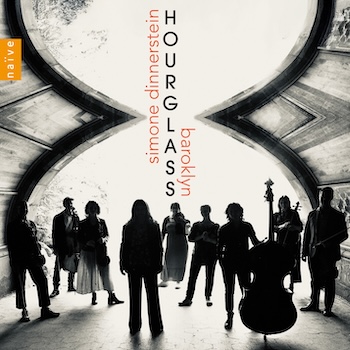
Philip Glass isn’t a composer one expects to lean too heavily into folk music traditions. Yet his Tirol Concerto evidently draws substantially on a traditional Austrian melody. Perhaps that helps explain why it’s such a charmer.
Completed in 2000, the score has a new recording courtesy of Simone Dinnerstein and her chamber group, Baroklyn. Their reading is decidedly songful, an approach that pays considerable dividends (even as Dennis Russell Davies’ crisper take on the finale remains a touch more persuasive). Nevertheless, that section still comes off as one of the most ebullient things Glass has written, while the opening movement sounds particularly rich and poetic.
There and in the big central movement, Dinnerstein and her colleagues absorbingly tease out the music’s textural subtleties, its sense of progression and shape, and, above all, its utilization of repetition as a structural device—not just as an end in itself. The results illuminate the essential nature of the composer’s materials: whatever it is that makes Beethoven and Ellington so often sound inevitable seems to be at work here, too.
Similar qualities apply to the Suite from “The Hours” that fills out the collection. Adapted by Michael Riesman from Glass’s score to the 2002 Oscar winner, the 25-minute-long, three-movement effort receives a colorful, beautifully layered, and well-paced performance from Dinnerstein and her colleagues. The central movement, with its discreet wafts of Gershwin and intensely quiet, prayerful orchestral playing, is especially inviting.
— Jonathan Blumhofer
Books
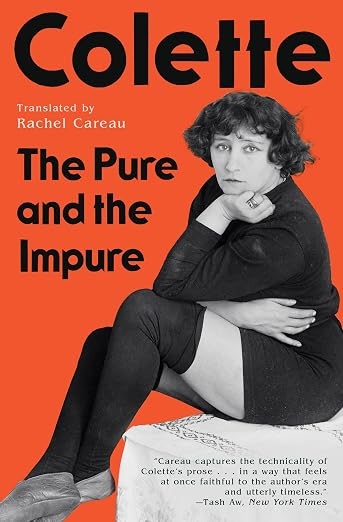
Authors can make odd, though illuminating, choices about the best books they have written. Colette’s favorite, The Pure and the Impure, is an intriguing head-scratcher. On the one hand, this brusque remembrance of the sexual underside of Paris’s Belle Époque—first published in 1932 and reissued in a revised (and retitled) version in 1941—has its striking rewards. But Colette claimed that the volume was “as close to an autobiography as I will ever write.” As translator Rachel Careau admits in her informative introduction, this is far from a tell-all. Revelations about Colette’s personal life, including her bisexuality, are scant and calculatingly oblique.
Instead, the book turns outward, gathering portraits and reconstructed conversations with people Colette knew intimately—friends and enemies alike. The identities of some of those chosen are revealed—including the poet Renée Vivien, the actress Marguerite Moreno, and Colette’s former husband, Willy—while others remain concealed. Careau’s generous and useful background notes add detailed texture to the dissected assemblage. I say “dissected” because Colette’s detached approach is icily analytic rather than warmly empathetic. Her stylish, if at times convoluted, commentary is never moralistic but diagnostic rather than sympathetic. This sensitively translated edition of the book (the first new one in 60 years) offers a succession of sharp—to the point of brittle, sometimes ingeniously curlicued—meditations on the writer’s “favorite form of brutality, love.”
The most compelling parts of The Pure and the Impure display the probings of a sensibility that has been “schooled to cherish the irrational, to incline toward passion rather than kindness, to prefer combat to conversation.” One of my favorite sections grapples with the agony of jealousy:
It’s proper not to deny oneself too soon all familiarity with dazzling grand gestures, which jealousy alone allows us to understand, murderous, effortless grand gestures, so elaborately premeditated, so magnificently carried out in our imagination, that the error of committing them makes them dull.
Of course, when imaginations have the poetic heft of Shakespeare’s and Colette’s, it is no error to render the homicidal bravado of “the green-eyed monster” on the page.
—Bill Marx
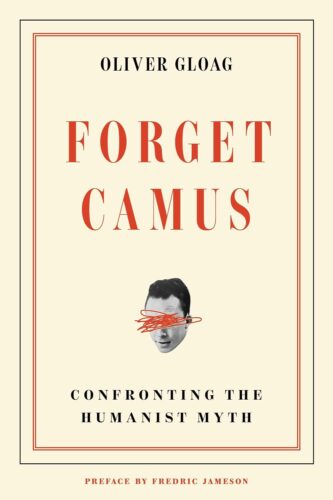 An admirer of Albert Camus, I was expecting to be offended by Oliver Gloag’s polemic, Forget Camus: Confronting a Humanist Myth, which raised a critical ruckus when it was published in France in 2023, where, across the ideological spectrum, Camus is worshiped as a sacred cow—not only because of his literary talent but also for his trenchant anti-Stalinism. (Today, Jean-Paul Sartre’s Marxism has made him a Pavlovian whipping boy for Camus’s idolaters.) Instead, I found this to be a valuable work of criticism that invites fans to rethink hand-me-down assumptions—to consider the political and personal strategy behind Camus’s ideological slipperiness. It was an intellectual shape-shifting partly rooted, Gloag argues, in the writer’s pro-colonial stance and his conviction that France should rule over his homeland, Algeria. Camus’s belief in a moral “universalism” is contradicted by—or masks—the writer’s racism (against Arabs) and silent acceptance of imperialism. Gloag underlines Camus’s hypocrisy: “Some human beings are more equal than others; only some have the right to revolt.”
Gloag gives Camus credit where it is due—notably for being among the few public voices in France to protest the bombings of Hiroshima and Nagasaki. But this brisk book marshals evidence from Camus’s letters, interviews, and published writings (fiction and nonfiction) to document his affection for nationalism and his waffling position on the death penalty. There is also Camus’s troubling sexism: in a letter to a lover, he wrote, “Only he who has dreamed of perpetual imprisonment for the woman he cherishes has truly loved.” Gloag defends Sartre against charges leveled by Camus’s admirers that the existentialist collaborated with the Vichy government; he argues that what drove the initially friendly writers apart was their positions on colonialism. Camus never forgave Sartre for his retorts, which highlighted Camus’s support for France’s dominance and his reluctance to condemn its barbarous treatment of Arabs, along with the country’s antisemitism. Gloag’s most intriguing reading of Camus’s fiction is his suggestion that The Fall’s hollow-man monologuist is a tit-for-tat composite of Sartre and Camus.
Gloag, on occasion, reaches too far, too fast. Yes, The Plague contains no Arab characters—but does that justify reading the title disease as a symbol of the Algerian independence movement rather than of Nazism? Even so, he makes a compelling case that dethroning Camus as a contemporary liberal icon can’t help but be medicinal, freeing him from “manipulation by the political establishment and allowing us to measure the true and complex originality of a historic work endangered by an apolitical propaganda in the service of even more unacceptable anti-political seductions.”
—Bill Marx
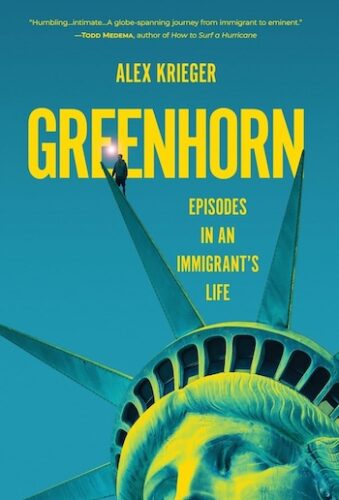 Unlike me, Alex Krieger seems to have clear memories of his childhood experiences and conversations, along with recollections of atmospheric details about various places, people, and problems. He seems to have near-total recall, and he is the rare successful architect who is also a wonderful writer. He has been described as moving from “immigrant to eminent.”
In his new book, Greenhorn: Episodes in an Immigrant’s Life, he narrates his life’s journey by way of a personal stream of consciousness, drawing on the power of his memory to express an individual, and often profound, perspective on his life and times. His narrative is chronological, though he also comments, pointedly, on relevant current issues.
Krieger’s résumé is impressive—practicing architect, urban designer, distinguished professor emeritus at Harvard’s Graduate School of Design, urban scholar, advisor to Boston’s unaesthetic former Mayor Menino, prestigious board member, international consultant, and former two-term member of the United States Fine Arts Commission. What must he think of the more-than-monstrous White House Ballroom, the Arch de Trump, and the Garden of Heroes? Stomach-churning!
His career was built on the foundation of being a child of Holocaust survivors. Krieger was born in Vilnius, Lithuania. He spent a few years in Warsaw, Poland, before moving to Haifa, Israel, for a couple more years. Eventually, at age 9, he ended up in Chicago. Krieger had to overcome language problems posed by changing environments and cultures. He spent first grade in four different countries, doing his lessons in four different languages. His trials and triumphs are a model for immigrant achievement, postwar version.
Written with sensitivity, thoughtfulness, and even soul, Greenhorn celebrates the enormous contributions to America made by our hardworking immigrant neighbors. Politically, it comes at a propitious time.
— Mark Favermann
Film

Violinist and Dear Lara director Lara St. John. Photo: Titilayo
Dear Lara is a gripping documentary made by classical concert violinist Lara St. John, who had no prior filmmaking experience. The result is an extraordinary work that brilliantly captures the deadly conflict between “soul murder” (childhood sexual abuse) and “soul sustenance” (love and practice of music). Both a personal memoir and an international investigative report, the film offers an up-close, long-overdue look at sexual assault in the classical music world and its consequences.
Lara St. John was four years old when she played her first concerto with an orchestra, and 14 when she was accepted on full scholarship to the small, insanely selective Curtis Institute of Music in Philadelphia. She was in her 40s before she felt able to go public with her experience of being sexually assaulted by her teacher, Jascha Brodsky, and its lifelong legacy. She first worked with journalists at the Philadelphia Inquirer, describing the intense and intimate one-on-one relationship between conservatory student and teacher reminiscent of the relationship between therapist and client or clergyman and parishioner. In 2019, the Inquirer published a 5000-word piece documenting the abuse, its psychological and career consequences, and the Curtis Institute’s appallingly inadequate response.
The article elicited hundreds of emails and letters from other musicians who had survived sexual assault; several of them tell their stories on camera—in Toronto, Amsterdam, and Manchester, England. The story also elicited the support of concert pianist and Marlboro Music Festival co-director Jonathan Biss and music critic Anne Midgette. As a long-time music journalist myself, aware of this long unreported scandal in classical music, with implications for us here in Boston, I urge you to help give this film the wide audience it deserves.
— Helen Epstein is a longtime Arts Fuse writer and the author of Music Talks: the lives of Classical Musicians , The Long Half-Lives of Love and Trauma and ten other books of non-fiction.

John Berger in Germinal, his 1973 documentary homage to Émile Zola’s eponymous 1885 novel about French coalminers.
Author and Marxist cultural commentator John Berger (1926–2017) was best known for Ways of Seeing, his 1972 BBC television series that challenged conventional ideas about gender and power in fine art, advertising, and visual media in a society saturated with images. His essays, criticism, and fiction ranged widely across nonconformity, revolution, historical revisionism, and animal rights, deftly and at times cryptically tracing the interplay of art, socialism, and human fragility.
On the centennial of his birth, the newly revived Film Comment magazine has seized the opportunity to present Hold Everything Dear: John Berger and Cinema. The multi-day series, screening at theaters across New York, showcases the breadth and richness of Berger’s work in film and visual media. It includes his collaborations with Scottish director Timothy Neat, Walk Me Home (1993) and Play Me Something (1989), both of which feature Berger on screen; the latter also includes a young Tilda Swinton, with whom Berger developed a lifelong friendship and creative partnership.
Also on view are Robert Kramer’s Walk the Walk (1996), inspired by Berger’s celebrated novel To the Wedding, and two films by Swiss director Alain Tanner, The Salamander (1971) and Jonah Who Will Be 25 in the Year 2000 (1976). A rare screening of Berger’s “animal stories,” made for British television in 1979 and 1980, includes Pig Earth, based on his novel of the same name, and Parting Shots from Animals, adapted from his essays and built around the conceit of exploited animals making films from their own perspective about the injustices inflicted on them by humans.
Perhaps most exciting is the visual lecture “Reality Is All We Have to Love” by documentary filmmaker Brett Story (Union, The Prison in Twelve Landscapes), who has a forthcoming feature on Berger’s work. The informal and elegiac The Seasons in Quincy: Four Portraits of John Berger closes the program, a quartet of short films, one by Swinton, that threads together many of the major themes in Berger’s life and work. The series runs through August 4 at Lincoln Center, BAM, Anthology Film Archives, the Museum of the Moving Image, and Metrograph.
— Neil Giordano
Tagged: "Dear Lara", "Hold Everything Dear: John Berger and Cinema", "Interlaced", "The Electrifying Seamus Blake Plays the Music of Eddie Harris – EH!", "Tongue of Angels", BBC Scottish Symphony Orchestra, Baroklyn, Eddie Harris, Film Comment, Hourglass, Jesse Draxler, John Berger, Lara St. John, Lila, Mel Bonis, Mohamed Borouissa, Natalie Draper, Philip Glass, Rumon Gamba, Seamus Blake, ’92 Winona