
Arts Commentary: Notes on Bob Dylan
By Jon Garelick
A skeptical listener finds phrasing, groove, and quiet authority in an 85-minute Boston set.
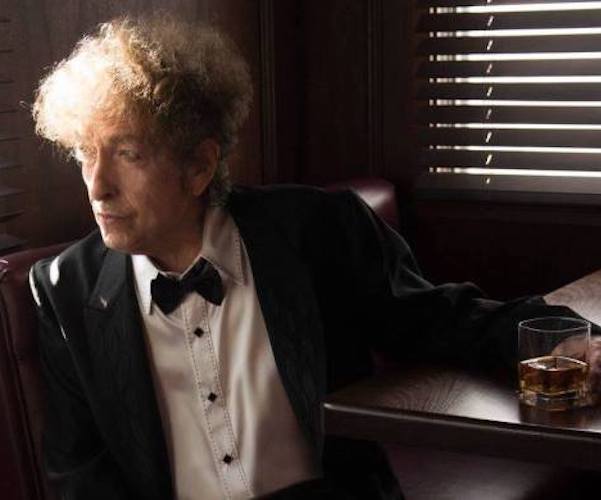
A Bob Dylan promotion photo for his Rough and Rowdy Ways tour.
This is not a review. I was hesitant even to attend Bob Dylan’s concert at the Leader Bank Pavilion on Thursday (July 16). The last time I had seen Dylan was not propitious — several years ago at the New Orleans Jazz & Heritage Festival. Dylan mumbled through his repertoire in a high-pitched rasp. There are generally about 11 stages of music operating simultaneously at JazzFest. I listened to a bit of Dylan’s croak and moved on.
I had no high expectations for Thursday’s show. But a friend talked my wife and me into it — He’s 85! This could be our last chance! OK, then. Enthusiasm for the tour’s first show on the West Coast failed to impress. The band was rockin’! Uh, yeah, but how was Dylan? My friend had seen Dylan last summer. So? His piano playing was great!
There was nothing I heard about the current Dylan tour that didn’t sound like the enthusiastic apologia of hardcore fans.
So I didn’t even bring paper or pencil to the Thursday show. Following two openers (Brittney Spencer and Jimmie Vaughan) Dylan emerged as described in other accounts: dim stage lights, hoodie pulled over his head.
The band started right in without preamble — “Watching the River Flow,” “Man in the Long Black Coat,” “It Ain’t Me, Babe.” Bang bang bang. But here’s the thing: Dylan — despite the rasp — had some breath in those phrases. I had seen one show years ago, at Northeastern University, where I couldn’t understand a single word or make out the tune of a single song, as though he didn’t give a fig for all those amazing words he’d written, never mind the tunes. Now he was phrasing with intent, bringing out the words, the songs.
“People say I can’t carry a tune and talk my way through a song. Really? I’ve never heard that said about Lou Reed. Why does he get to go scot-free?”
That was part of a speech Dylan gave in 2015, accepting a MusiCares Person of the Year award.
Wasn’t it still true? Hadn’t people groused about Dylan’s singing from the very beginning? A Dylan acolyte, I had become one of those naysayers. Now I was listening again. Even though you could still argue that the voice was raw and the tunes had been totally scrambled.
“He’s singing ‘When I Paint My Masterpiece’ but the band’s playing ‘Puttin’ on the Ritz,’” said one of my friends at Thursday’s show.
Really? By that point, about nine songs in, I was entranced. The band was swinging. Two guitars, bass, drums. The guitarists played with elegant detail, the bass and drums grooved without overplaying. And the sequencing of the setlist was ideal, a mix of slow blues, rockabilly, rumba, and swing.
The lighting was perfect. Four or five glowing yellow bulbs on a backdrop, another reading light over Dylan’s keyboard. That keyboard? I don’t think I picked out any of Dylan’s piano playing all night. Didn’t matter. This band was in the groove.
I didn’t know all the songs. Peter Chianca, at Boston.com, bless him, seemed to get them all. I am long past my period of deepest Dylanology — the early ’90s, the years of The Bootleg Series, Vol. 1-3: Rare and Unreleased 1961-1991 (“Who Killed Davey Moore”, “Blind Willie McTell”!), and his two solo acoustic-guitar discs of old folk tunes, Good As I Been to You (“Arthur McBride”! “Froggie Went a-Courtin’”!), and World Gone Wrong. To say I hadn’t kept up was putting it mildly. I will say that when I read the last words of Chronicles: Volume One (2004) aloud to my wife in a Cambridge coffee house, I was feeling perhaps a bit vulnerable because of the recent death of my oldest brother — I burst into tears.
But now I couldn’t have named a single song from Rough and Rowdy Ways (2020), never mind Shadow Kingdom (2023). But it turned out “Black Rider” was a pretty cool song, and so was “Man in the Long Black Coat” (Oh Mercy, 1989).
Was there a theme here?
The band kept cooking, and Dylan kept drawing us in, talking/singing his songs, under his hood in the dark. The big video screens at the side of the stage — where we had been able to watch big images of Jimmie Vaughan playing his guitar upside down behind his head — were black. The crowd was rapt — only a stray hoot here or there.
In the notes to Biograph (1985), Dylan talks to Cameron Crowe about the hoopla surrounding his 1974 reunion tour with the Band, following years off the road: “Rock-and-roll had become a highly extravagant enterprise…. nothing really exceptional just Sound and Lights, Sound and Lights, and more Sound and Lights…. The only thing people talked about was energy this, energy that…. The greatest praise we got on that tour was ‘incredible energy, man,’ it would make me want to puke.”
Now he was being disparaged for playing in a hoodie, in the dark. In an essay called “Style,” Leonard Michaels recalls seeing Miles Davis play with his back to the audience. “It was as if Davis were saying, ‘Don’t look at me. Listen to it.’”
Dylan finished with “I Shall Be Released.” Then, after 85 minutes and 16 songs (by Chianca’s count), he stepped from behind the keyboard, came downstage, and extended his hands to the crowd. He hadn’t said a word, not even to introduce the band. And then he was gone.
So, sure, Jim, if Dylan comes back to town, I’ll buy a ticket.
Jon Garelick was an arts editor at The Boston Phoenix and is a retired member of the Boston Globe Opinion page staff. He can be reached at [email protected].
Great piece! Sorry I missed the show.
Thank you for this, Jon. Here’s what I wrote.
https://dankennedy.net/2026/07/18/bob-dylan-and-his-band-turn-in-a-sterling-boston-performance-of-mostly-newer-material/
I really liked what Peter Chianca wrote, but I assume he was relying on the Dylan set lists that are posted almost in real time.
Just watched Dylan and Johnny Cash sing on TV from a biography of I am Johnny Cash. The sponsor said that Bob fought for his privacy tooth and nail even when singing across country. For Johnny Cash he broke through that for Johnny. A real big deal for Bob. Impressive. He loved Johnny
I was looking forward to seeing him in Forest Hills on Tuesday – now I am totally psyched. Thanks, erynn vocative essay, Jon.
I’ve attended many Dylan concerts from 1970 in Boston to Denver a couple years ago with my son. One of my favorite parts was when the band was several bars into a song and I heard a familiar but differentiated line and realized they were into a familiar and beloved tune. I like that. If i want same-same I‘ll stay home and listen to a record. I enjoy the different arrangements. The concert to me is a singular and important event. I refuse to look at video screens, even. I can look at images on a screen 24-7. The show is the real deal.
I’m always skeptical of the almost typical report “I couldn’t understand a single word or make out the tune of a single song.” Not a SINGLE one? “I don’t think I picked out any of Dylan’s piano playing all night.” Disingenuous, or at least, inattentive. “I don’t believe you, you’re a liar!”