
Theater Preview: Still Dreaming on the Boston Common at 30
By Susan Saccoccia
Commonwealth Shakespeare Company celebrates its milestone season by revisiting A Midsummer Night’s Dream, reaffirming its mission to make Shakespeare a truly public art.
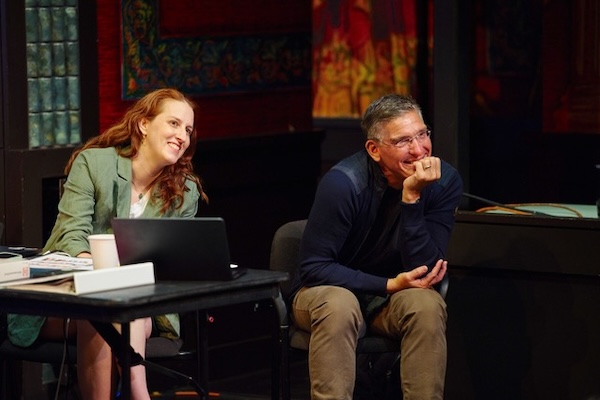
CSC founding artistic director Steven Maler and assistant director Victoria Townsend during a rehearsal of A Midsummer Night’s Dream. Photo: Bob Green
“The course of true love never did run smooth,” says the young Athenian Lysander to his beloved, Hermia, as they decide to make a run for it. They are fleeing her father, Egeus, who commands her to marry another suitor, Demetrius. The penalty if she refuses: execution or life in a nunnery.
The course does indeed prove rocky in A Midsummer Night’s Dream, a beloved mid-career comedy by William Shakespeare to be presented from July 22 to August 9 by the Commonwealth Shakespeare Company (CSC) as its 30th annual free production at the Parkman Bandstand on the Boston Common.
CSC founding artistic director Steven Maler directs the production of this play, which the company performed in Copley Square in 1996 as its inaugural free summer performance. Since then, CSC has staged free annual Shakespeare productions on the Common that over 30 years have drawn more than 1.5 million audience members.
Enjoyed by more than 50,000 people every summer, CSC’s Shakespeare on the Common brings to Boston what theater producer Joseph Papp pioneered in mid-’50s Manhattan: free access to world-class productions of classical theater.

The set model for CSC’s production of A Midsummer Night’s Dream. Photo: Bob Green
“CSC presents Shakespeare’s plays in the center of the city surrounded by the oldest park in the country, transforming downtown into an open-air theater that’s free to all,” says Maler by phone in mid-July as rehearsals were underway and crews were installing sets on the Parkman Bandstand.
“We all walk in Joseph Papp’s footsteps. Back in 1996, we thought we would test this idea out and see if audiences showed up; if the philanthropic community, the critics, and the city were supportive; and if the artistic community was interested. At the end of that first year, it was all green lights. So we decided to keep moving forward and building the company.”
Above all, Maler takes his cues from Shakespeare, whose audiences encompassed groundlings standing in the pit below the stage as well as the royals who were his benefactors and assorted citizens in between. All can see themselves in Midsummer Night’s Dream.
“We want to re-democratize these plays,” says Maler, whose multiple Elliot Norton awards include its Award for Sustained Excellence. “Shakespeare was a democratic writer. Everybody went to the theater in Shakespeare’s day. Now theater is segregated by income. So the idea is to put it out on the street, so that everybody can enjoy these great stories.”
As the play unfolds, complications soon arise among its three very different societies and three couples, each with problems of their own. In Act I, Duke Theseus, who has abducted his bride-to-be, Hippolyta, queen of the Amazons, promises her to redeem his bruising courtship with a wedding in four days that will be abundant “with pomp, with triumph, and with reveling.”
Demetrius craves Hermia despite his earlier courtship of Helena, who pursues him even to the point of betraying Hermia, her childhood bestie. And in the play’s parallel fairy society, its king, Oberon, and its queen, Titania, feud over possession of a coveted boy nymph and use their magic to wage their competing claims—causing mayhem by Titania’s go-to mischief maker, Puck. Third but not least are the “rude mechanicals,” six humble artisans who aspire to produce a play to celebrate the wedding of Theseus and Hippolyta.
The multiple plots entangle and intertwine with much mischief and mayhem, but being a comedy rather than a tragedy, the play concludes, as Duke Theseus promised, with a grand and festive wedding that includes all.
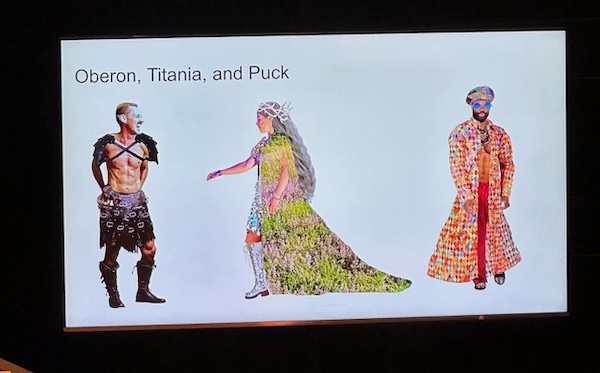
Costume designs for some of the characters in the CSC’s production of A Midsummer Night’s Dream. Photo: Bob Green
Even the “rude mechanicals” get their turn to shine as they perform before the wedded royals. Duke Theseus had learned of their project from his henchman Philostrate, who dismissively describes the six as “Hard-handed men that work in Athens here/Which never labour’d in their minds till now.” But Theseus replies, “I will hear that play;/For never anything can be amiss,/When simpleness and duty tender it.”
With its enduring appeal, says Maler, “as we came to this 30th year, this incredible milestone, we thought it would be fun to revisit the play that started it all for us.
“This is a play about kids rebelling from their parents, fleeing a repressive and patriarchal environment, in this case, Athens, and entering the forest to seek freedom, self-determination, and the ability to love who you want to love and be who you want to be. It’s a play about coming together through adversity to a place of love and celebration.”
Together with the staging team and actors, Maler and associate director Victoria Townsend are mining the timeless vitality of the play. “This story is 400 years old,” says Maler, “but we present it as if it was written yesterday.”
Concocting a carnivalesque contemporary world, the forest that is a refuge for the young lovers has been transformed into a scene inspired by music festivals like Coachella and Burning Man. With sets by Amy Rubin, lighting by Maximo Grano de Oro, costumes by Brooke Stanton (Return of the Jedi) and Rachel Padula, choreography by John Lam, and music by David Reiffel, this vision extends to costuming, scenography, music, and dancing. “Shakespeare is such a total theater artist,” says Maler. “He has everything–song, dance, fights and the greatest language and characters.”
Embodying characters that include nobles, laborers, tricksters and young lovers, the cast reflects the diversity of Greater Boston and its theater community. “This practice has been foundational for us since 1996,” says Maler. “We built it into the DNA of our company from day one.”
Maler recalls the diversity of talents enlisted by the American Repertory Theater (ART), while training as a director under Robert Brustein, its founder. “I grew up at the ART,” says Maler. “Its inventive productions of classic works inspired me as well as the breadth of its inclusiveness.” Among its theater artists were female directors at a time when few women had such roles.
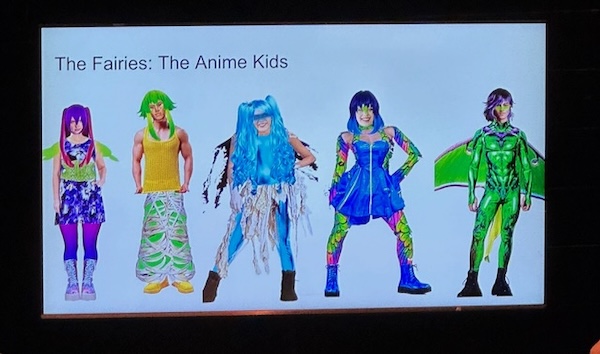
The costume design for the Fairies in the CSC production of A Midsummer Night’s Dream. Photo: Bob Green
Maler finds memories of the 1996 staging mingle with the excitement of creating an entirely new production. “It’s fun to be looking at this play through the lens of these wonderful actors that we have now,” says Maler, “while also reminiscing on the performances from 30 years ago, which are still very etched in my mind.”
Audiences who frequent Shakespeare on the Common will recognize among “the rude mechanicals” long-time CSC actors John Kuntz and Karen McDonald. Kuntz, recipient of six Elliot Norton Awards, plays Snout, a tinker; and McDonald, a founding member of ART and recipient of an Elliot Norton Prize for Sustained Excellence, is carpenter Peter Quince—in this production Petra Quince.
Theseus and Oberon are performed by De’Lon Grant, featured in Tony Award-winning Broadway musicals Jersey Boys and Come From Away and, for his role in Speakeasy Stage Company’s The Scottsboro Boys, IRNE Award-winner for Best Actor in a Musical. Jaime José Hernández, a founding member of Teatro Chelsea, is Lysander. Nick Cearley, who with Lauren Molina comprises the musical comedy duo the Skivvies, plays both Philostrate and what promises to be a wildly burlesque Puck. The play’s band of fairies is drawn from CSC2, the company’s program for early career actors—one of multiple CSC programs that each year serve thousands of emerging theater artists, middle and high school students, and educators.
“Our mission as a theater company is to democratize this art form,” says Maler, noting that this goal extends to providing accessibility services that at all performances include open captioning, assistive listening devices, and large-print and Braille programs; and at selected performances, ASL interpretation and audio description.
“Theater has the power to bring people together,” says Maler. “At a time when our society is so balkanized and we are stuck in front of screens, Shakespeare on the Common invites everyone to join others and share a live experience.”
Given CSC’s track record of enchantment, that experience is likely to be memorable.
Susan Saccoccia is a recipient of NEA Arts Journalism fellowships in theater, dance, and music. She is an independent arts journalist who reviews visual and performing arts in the US and overseas.
Tagged: A Midsummer Night's Dream, Amy Rubin, Commonwealth-Shakespeare-Company, De’Lon Grant, John Kuntz, Karen McDonald, Steven Maler, Victoria Townsend
1 Comment
Leave a Comment
This article is correct. Shakespeare’s magnificent and joyous work — written during pauses in the bubonic plague — is receiving a most entertaining staging by CSC on the Common. Given our own, recent close encounter with a contagion, this is a play whose playfulness resonates as much as it exhilarates. And this production — inspired by the vibrant, carefree festival vibe of Coachella — gives the lawn-locked audience the sensation of being both a groundling during Shakespeare’s days and a Phish-head at the concert that was taking place at Fenway Park. The show runs through Aug. 9.